
- Read Genesis 21
MORNING— Promise Fulfilled
- Focal Passage: Genesis 21:1-2
“Then the Lord took note of Sarah as He had said, and the Lord did for Sarah as He had promised… at the appointed time of which God had spoken.”
Genesis 21 opens with quiet precision: as He had said… as He had promised… at the appointed time.
God’s promises are not vague hopes or spiritual metaphors. They are fulfilled exactly as spoken—and precisely when God determines.
Some promises of God are conditional, calling for obedience and response. Others are unconditional, rooted not in what we do but in who God is. Isaac belongs to that second category. Abraham and Sarah did not produce this child by effort or ingenuity. They received him by promise.
Isaac’s very name means laughter. Once Sarah laughed in disbelief. Now she laughs in joy. The same mouth that once questioned God now praises Him. Delay did not diminish the promise—it deepened the delight.
Yet notice what follows fulfillment: obedience. Abraham names his son as God instructed. He circumcises Isaac as commanded. Faith does not relax after blessing arrives. True faith continues walking with God once the storm has passed.
It is easy to make promises to God in moments of desperation—what some call foxhole faith. Harder is keeping those promises once calm waters return. Abraham teaches us that obedience after blessing matters just as much as obedience before it.
And then—celebration. Abraham throws a feast. Joy is not postponed. Gratitude is expressed openly. God is honored not only by our obedience, but by our delight in His faithfulness.
- Reflection:
Where have you seen God keep His word—and how are you responding now that the promise has been fulfilled?
EVENING— Planting for the Long Haul
- Focal Passage: Genesis 21:33
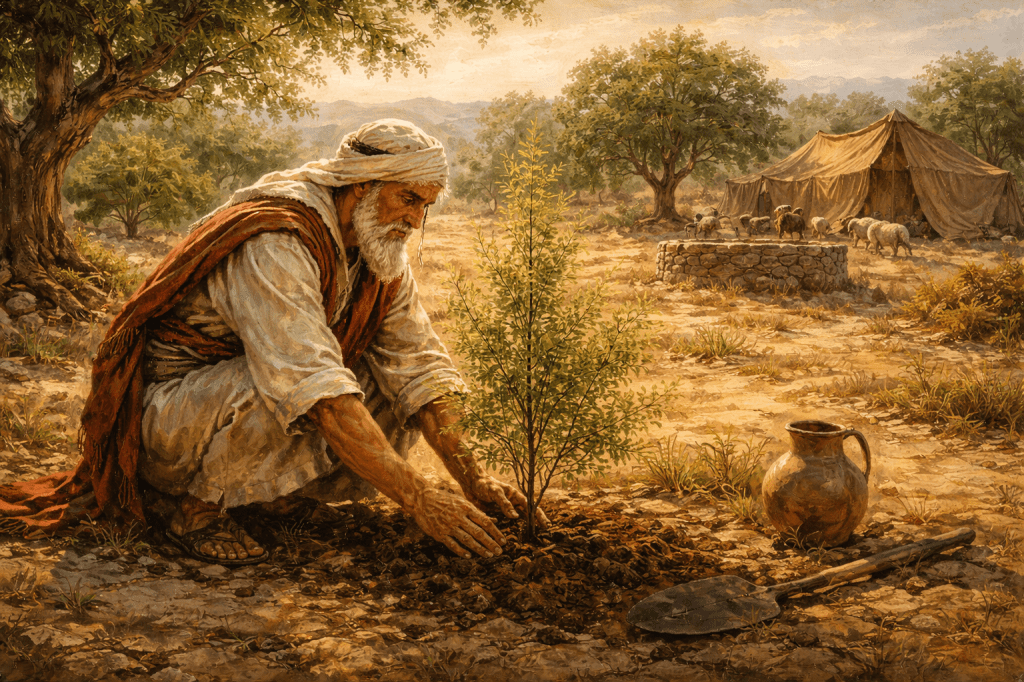
🌳 “Abraham planted a tamarisk tree at Beersheba, and there he called on the name of the Lord, the Everlasting God.”
After celebration comes something quieter—but just as meaningful. Abraham plants a tree.
The tamarisk was not chosen for beauty. It was chosen for endurance. Deep-rooted and slow-growing, it provided shade in arid land and stabilized soil over time. Planting one was an investment not just for the present, but for future generations.
Abraham plants this tree at Beersheba, a place of covenant and provision. And beneath its branches, he worships. He calls on the name of the Everlasting God. The tree becomes a living testimony: God’s faithfulness is not seasonal. It is lasting.
This is faith that thinks long-term. Not faith that rushes from miracle to miracle—but faith that plants, waits, and trusts. We often want immediate fruit. God often invites us to plant shade we may never sit under. The tamarisk reminds us that worship is not only spoken—it is lived, planted, and patiently nurtured.
- Reflection: What are you planting right now that reflects trust in God’s long-term faithfulness?
- Closing Prayer: Everlasting God, thank You for keeping every promise You have spoken. Teach me to obey You not only in waiting, but in fulfillment. Help me celebrate Your goodness, and give me faith to plant wisely for the future—trusting that You are faithful across generations. Amen.

Leave a comment