
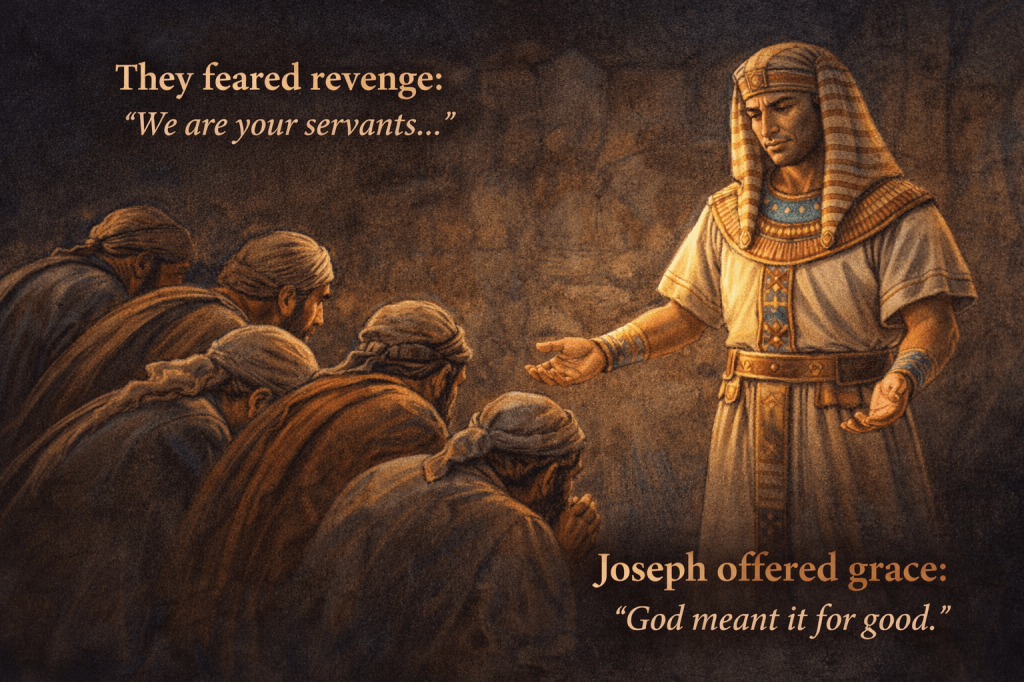
- Read: Genesis 50
MORNING— Let God Hold the Gavel
- Focal Passage: Genesis 50:19
“But Joseph said to them, ‘Do not be afraid, for am I in God’s place?”
Jacob’s death stirred something dark in Joseph’s brothers. Though Joseph had already forgiven them, guilt whispered lies: What if he was only waiting for Dad to die? What if now he pays us back?
Fear reveals what guilt cannot bury.
What makes their fear even more striking is the setting in which it arises. Egypt—an idolatrous nation—treated Jacob with extraordinary honor. The land mourned for seventy days. A royal procession followed his body back to Canaan. Even the Canaanites paused and remarked on the gravity of the grief. Strangers showed reverence for Jacob’s life and legacy.
And yet, his own sons—standing at the graveside—could not trust grace.
Instead of honoring their father’s memory, they put words in his mouth. They sent a message to Joseph claiming that Jacob had issued a final command to forgive them—something Scripture never records Jacob saying. The contrast is sobering: outsiders respected Jacob enough to stop and mourn, while his own sons used his name to shield themselves from consequences.
Joseph’s response is stunning—not because it ignores the deception, but because it refuses to become its judge. “Am I in God’s place?” Joseph steps out of the judge’s chair. He leaves vengeance where it belongs.
We often say we forgive, but still replay the case. We keep the evidence organized. We imagine future verdicts. Joseph shows us another way. Forgiveness is not pretending evil never happened; it is choosing not to sit where only God belongs.
A modern example of this came from Corrie ten Boom. In 1947, while speaking in a church in Munich, she recognized a man who had been a guard at Ravensbrück concentration camp—where her sister Betsie had died. After the service, the man approached her, extended his hand, and asked for forgiveness. Corrie later wrote that she froze. She knew the theology of forgiveness, but emotionally she could not respond. In that moment, she prayed silently, asking God to help her obey. Only then did she extend her hand. She later described forgiveness not as a feeling, but as an act of the will—choosing obedience and leaving judgment with God. (The Hiding Place)
Forgiveness always begins here—by releasing the role God never gave us.
- Reflection: Where might you still be sitting in God’s chair—rehearsing judgments He never asked you to render?
MORNING— The Long Work of Forgiveness
- Focal Passage: Genesis 50:21
“So therefore, do not be afraid; I will provide for you and your little ones.” So he comforted them and spoke kindly to them.”
Joseph could have exposed the lie. He could have corrected the record. Instead, he wept—and then he blessed. He reassured them. He provided for them. He spoke kindly to them.
That kind of response is rare. As Franklin P. Adams observed,
“To err is human; to forgive, infrequent.”
Joseph goes further still. He forgives and he blesses.
He can do that because he has already settled the deeper issue. “You meant evil against me,” he says honestly—but he also trusts the greater truth—“God meant it for good.” This verse is quite the crescendo to the whole Joseph narrative, if not the whole book of Genesis.
The past need not rule us. God does.
Then Genesis 50:21 reveals something easy to miss: Joseph does not merely declare forgiveness; he continues to live generously toward those who once harmed him. He reassures his brothers again. He commits himself to their future. He provides for their children. He speaks kindly to them—literally, he “speaks to their heart.”
This is the long work of forgiveness.
Many people can forgive once, in principle. Far fewer can forgive consistently, especially when the offenders remain close, dependent, and imperfect. Joseph’s brothers will still live in his land. They will still rely on his provision. Their presence will still remind him of old wounds. Yet Joseph chooses ongoing kindness rather than guarded distance.
This is where forgiveness matures. True forgiveness does not merely release the past; it reshapes the future.
- Reflection: Is fear or guilt keeping you from resting in forgiveness God has already given—or from extending it fully to someone else?
- Closing Prayer: Faithful God, You alone are Judge, Healer, and Redeemer. Teach us to trust Your grace where guilt still whispers, and Your sovereignty where pain still lingers. Free us from fear, deepen our forgiveness, and shape our hearts like Joseph’s—secure, generous, and at peace in You.
Amen.

Leave a comment