
- Read Exodus 2:11-25; 3
MORNING— FIRE!
- Focal Passage: Exodus 3:2
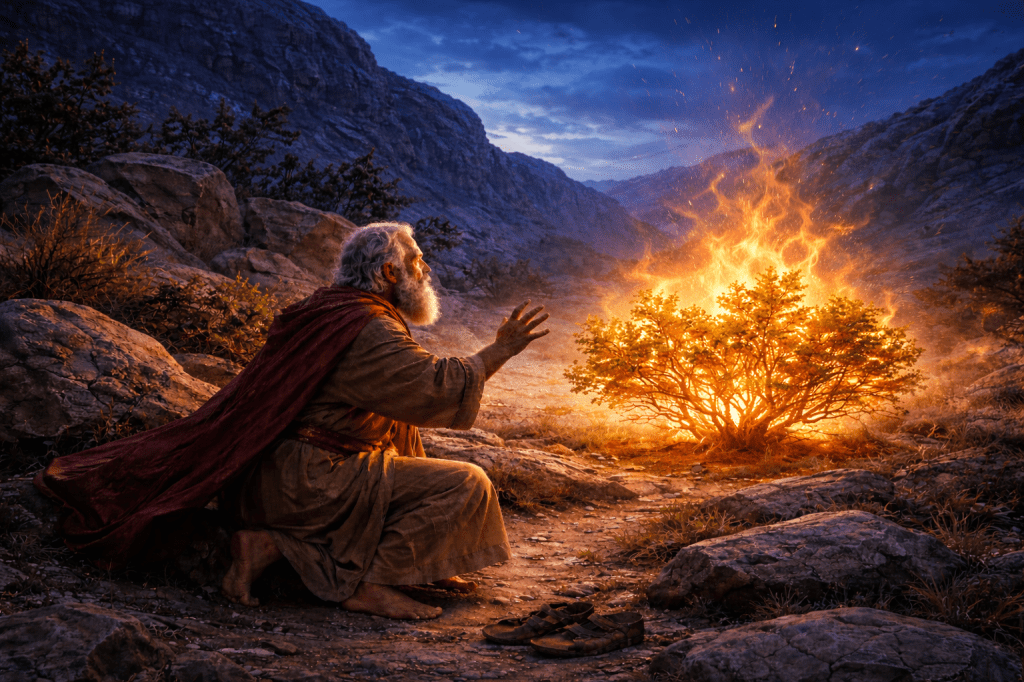
“The angel of the Lord appeared to him in a blazing fire from the midst of a bush… yet the bush was not consumed.”
After a disastrous attempt to deliver his people from bondage (Exodus 2:11–15), Moses found himself on the backside of the desert.
Once a prince in Pharaoh’s household, Moses now walked behind sheep. The man who believed he was ready to lead discovered he was not ready at all. His passion had outrun God’s timing, and the result was exile—forty years of anonymity, routine, and waiting. The deliverer became a shepherd, and the dream faded into the background of ordinary days.
God did not speak to Moses at the height of his confidence, but at the end of his self-reliance.
Then fire appeared—not in a palace, not in a temple, but in a bush along a desert path. Burning bushes were not unusual in the wilderness, but this one refused to burn out. Moses stopped. He turned aside. And when he did, God called his name.
Centuries later, the same thing happened to Blaise Pascal. A mathematical prodigy, inventor, and scientific genius, Pascal spent decades running from God. Then one night in November of 1654, after a terrifying brush with death, he encountered the living God. His life was forever changed. After his death, a note was found sewn into his coat—his private testimony. At the top of it was one word:
FIRE!
Not theory. Not intellect.
A word symbolizing: Encounter.
The living God still interrupts ordinary routines—often after failure, often in obscurity. The question is not whether God is present, but whether we will turn aside to look.
- Reflection: Where might God be inviting you to pause, turn aside, and notice His presence—especially in the wake of disappointment?
EVENING— God’s Humble Choice
- Focal Passage: Exodus 3:5
“Do not come near here; remove your sandals from your feet, for the place on which you are standing is holy ground.”
The fire drew Moses closer—but holiness stopped him short.
Before God explained His plan, He established His holiness. Shoes came off. Awe replaced familiarity. Any real encounter with God reshapes how we approach Him.
And notice where God chose to appear.
Not in a palace.
Not in a temple.
Not even in a towering tree.
Exodus says it was a bush—a low, ordinary desert shrub. The Hebrew word (seneh) emphasizes humility. God did not choose a cedar.

It is intentionally not a tree—which actually heightens the humility and surprise of God’s appearance.
Then God revealed His heart:
“I have surely seen… I have heard… I am aware… I have come down to deliver.”
A holy God sends a humble servant on a holy mission.
Moses thought he had missed his calling decades earlier. God revealed that the desert years were not wasted—they were preparation. The God who speaks from humble places sends ordinary people into holy work.
God does not need an impressive servant. He only needs a willing one.
- Reflection: What might God want to do through you—not because of your strength, but because of your availability?
- Closing Prayer: Living God, open our eyes to Your presence in the ordinary. Teach us to pause, to listen, and to approach You with reverence. Where our lives feel small or overlooked, remind us that You delight in using humble places for holy purposes. Call us, shape us, and send us—according to Your will.
Amen.

Leave a comment