
- Read Exodus 16
MORNING— Manna in the Morning
- Focal Passage: Exodus 16:4
“Then the Lord said to Moses, ‘Behold, I will rain bread from heaven for you; and the people shall go out and gather a day’s portion every day, that I may test them, whether or not they will walk in My instruction.’”
Israel leaves Elim rested, watered, and hopeful. But before long, the wilderness of Sin stretches out before them, and the joy of palm trees fades into the ache of hunger. It doesn’t take long for old memories to resurface—selective memories. Egypt begins to look better in hindsight. Slavery is remembered as comfort. Bondage is recast as abundance. “We sat by the pots of meat,” they say, forgetting the whips that stood nearby.
Grumbling always edits history.
God hears their complaints—not because they are noble, but because they are needy. And instead of rebuke, He responds with provision. “I will rain bread from heaven for you.” Not storehouses. Not surplus. Bread. Enough for today.
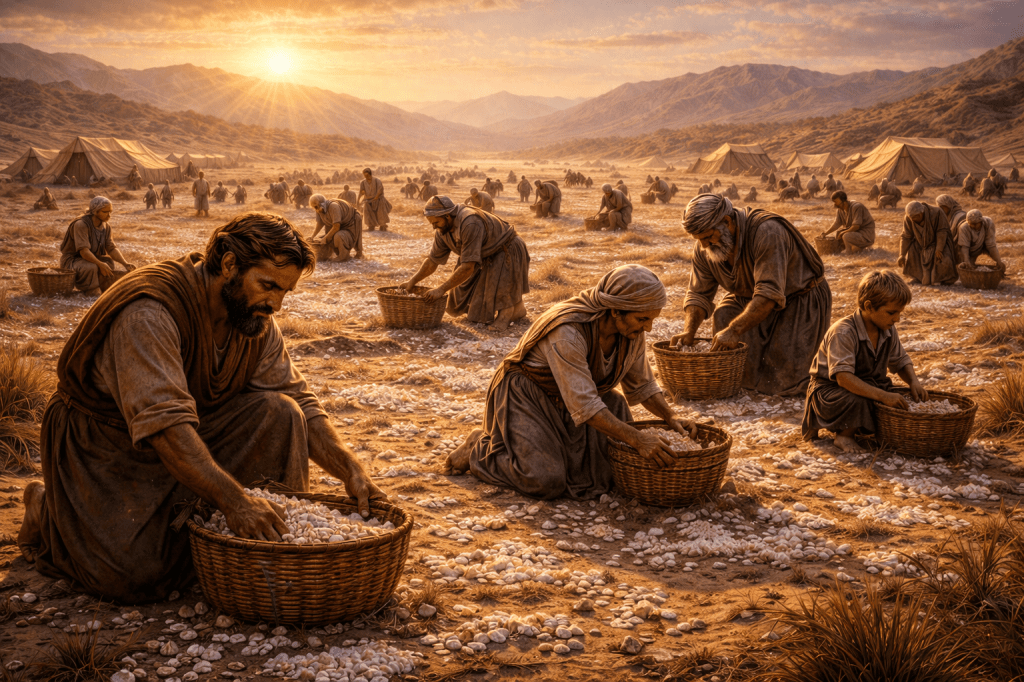
When the manna appears, it confuses them. “What is it?” they ask. The word manna simply means “What is it?“
God calls it bread from heaven. The people can only describe it by approximation: white like coriander seed, tasting like wafers with honey. It is nourishment, not indulgence. Provision, not excess.
Manna teaches a rhythm of trust. It arrives daily. It cannot be hoarded. Yesterday’s manna will not sustain today’s hunger. God gives what is needed, when it is needed, so that His people learn dependence rather than control.
Years later, Moses would command that a portion of manna be kept—not to be eaten, but remembered. The miracle was not just the food itself, but the faith it required. Manna was never meant to replace trust in God. It was meant to train it.
We often pray for “more” when God is offering “enough.” We ask for certainty when God offers daily grace. Like Israel, we sometimes stand over God’s provision and ask, “What is this?” when we should be saying, “Thank You.”
Manna reminds us that God knows what we need before we ask—and that His care arrives right on time, even if it doesn’t arrive in the form we imagined.
- Reflection: How am I responding to God’s daily provision—trusting Him for today, or worrying about tomorrow?
MORNING— Bread that Sustains
- Focal Passage: Exodus 16:18
“When they measured it with an omer, he who had gathered much had no excess, and he who had gathered little had no lack.”
Manna was not only daily—it was communal. Some gathered more. Some gathered less. But no one lacked. God’s provision was never meant to terminate on the individual. What one received became a gift for another.
Paul would later point back to this moment and call it a picture of God’s economy: abundance meeting need, not excess feeding greed. The miracle was not just bread on the ground—it was equality in the camp.
Someone on Facebook gave shout out to his new friend, Hayden. He had stopped at a McDonald’s on the way home and his card wouldn’t work. Before he could say a word, the young man behind the counter—Hayden—pulled out his own debit card and paid for his meal. No hesitation. No speech. Just generosity. When the gentleman tried to refuse, Hayden smiled and said, “I got you.” Inside the bag, he slipped back the cash the customer tried to give him, along with a receipt that read, “Have a blessed day.”
That is manna lived out. Give of your surplus.
But manna also came with limits. Even provision could be mishandled. Gather too much and it spoiled. Ignore God’s rhythm of Sabbath and the gift turned sour. God was not being restrictive—He was being protective. He knew that blessings hoarded would crowd out rest, trust, and worship. The Sabbath itself was part of the gift.
Jesus later stood before a hungry crowd and said something astonishing: “Your fathers ate the manna in the wilderness, and they died… I am the bread of life.” Manna sustained bodies for a day. Christ sustains souls forever.
The wilderness teaches us that God’s greatest gift is not what He places in our hands, but Who He places at the center of our lives. Morning by morning, His mercies still appear—quietly, faithfully, sufficiently.
Tomorrow morning, you will wake up to a choice. You can grumble at what is missing, or give thanks for what has been provided. You can worry about tomorrow’s bread, or trust the God who has never missed a morning yet.
Manna still falls. God is still faithful.
- Reflection: Where might God be inviting me to receive His provision with gratitude—and to share it freely with others?
- Closing Prayer: Father, thank You for daily bread—often simple, always sufficient. Teach me to trust You one day at a time. Guard my heart from grumbling, and shape it toward gratitude. Help me receive Your gifts wisely and share them generously, remembering that You are my true provision. Amen.

Leave a comment