
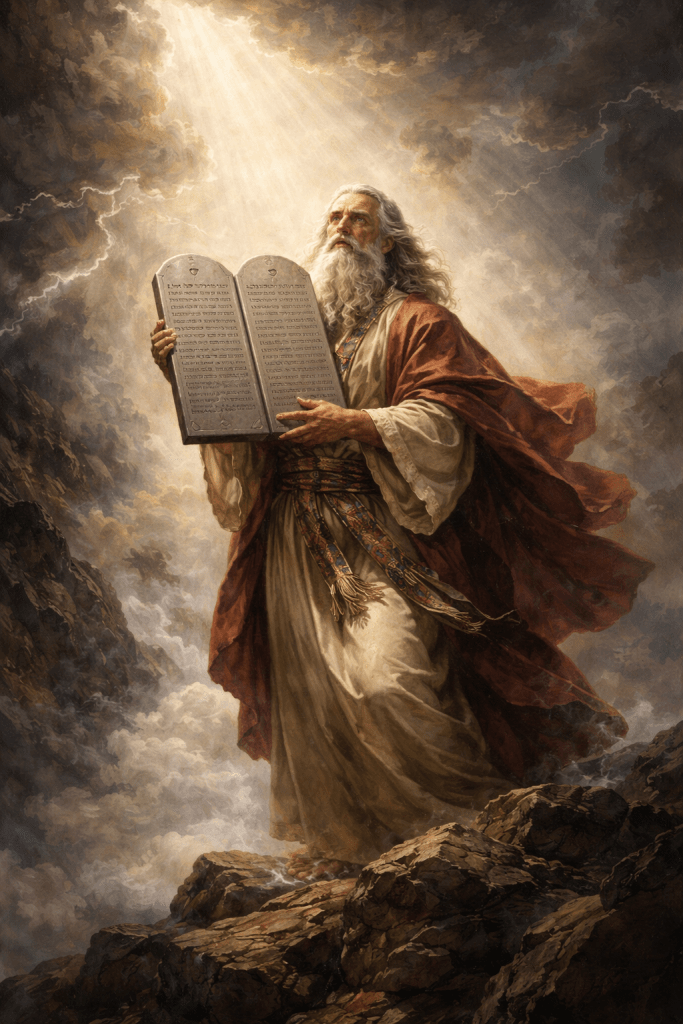
- Read Exodus 20
MORNING— Ten Commandments at the Center
- Focal Passage: Exodus 20:1-3
“Then God spoke all these words, saying, ‘I am the LORD your God, who brought you out of the land of Egypt, out of the house of slavery. You shall have no other gods before Me.”
The Ten Commandments were not given to an oppressed people trying to earn freedom. They were given to a people who had already been freed—and now needed structure.
Freedom without form does not last. A nation released from slavery still needs order, clarity, and direction if it is to endure.
The first portion of the Ten Commandments is directed upward. These commands establish who holds ultimate authority and how that authority is to be acknowledged.
They address allegiance (no other gods), representation (no idols), reverence (God’s name), and rhythm (the Sabbath). Together, they orient life toward God as the center rather than the self. Old Testament scholar Christopher J. H. Wright notes that these opening commands function as the foundation for everything that follows:
“The first four commandments establish the framework within which all human moral behavior must operate. If God is displaced, the rest of the law inevitably unravels.”
— Christopher J. H. Wright, Old Testament Ethics for the People of God
When reverence for God erodes, something else quickly assumes the highest place—power, ideology, wealth, or self.
These early commands anchor life to what does not shift.
The law begins not with human conduct, but with divine priority. Only when that order is established can anything else remain stable.
- Reflection: What currently sets the rhythm of your life—worship and reverence, or competing demands that slowly displace them?
MORNING— Ten Commandments: Rules that Guard Life
- Focal Passage: Exodus 20:12-17
“Honor your father and your mother…
You shall not murder.
You shall not commit adultery.
You shall not steal.
You shall not bear false witness against your neighbor.
You shall not covet…”
These six commandments do more than restrain evil; they preserve love in shared life. They protect trust between parents and children, neighbors and strangers, husbands and wives, the strong and the vulnerable. Where they are honored, communities hold. Where they are ignored, they fracture.
A powerful example came in the aftermath of the September 11, 2001 attacks. In New York City, thousands of ordinary citizens acted instinctively in ways that mirrored these commands. Strangers carried the injured down stairwells. Office workers stayed behind to help coworkers escape. Wallets, jewelry, and cash were later returned untouched. Families opened their homes to people they had never met. Blood donation centers overflowed.
Sociologists and journalists who studied those days noted something striking: despite fear and loss, there was an unusual absence of looting, deception, or exploitation. In a moment when order could have collapsed, people chose restraint, truth, protection of life, and sacrificial care for others.
Those actions did not happen because new laws were written that day. They happened because deeply held moral restraints—honoring life, respecting what belongs to others, telling the truth, placing people above self—rose to the surface when they were most needed.
That is what these commandments do. They hold society together not by force, but by love expressed through restraint.
- Reflection: How did your choices today contribute—however quietly—to trust, safety, and care for the people around you?
- Closing Prayer: Lord God, order our lives rightly before You—our worship, our words, and our time. From that order, govern how we live with others, guarding our actions, our speech, and our desires. Teach us to walk within Your wise commands, for through them You preserve what is good and hold life together. Amen.

Leave a comment