
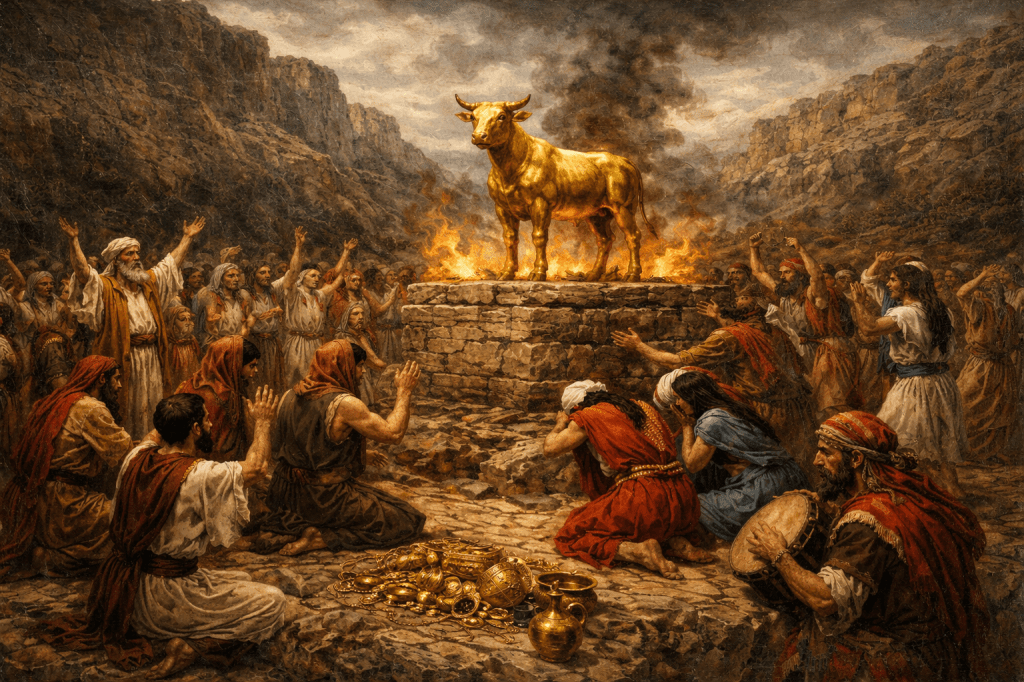
- Read Exodus 32
MORNING— The Sound of Defeat
- Focal Passage: Exodus 32:1
“Now when the people saw that Moses delayed to come down from the mountain, the people assembled about Aaron and said to him, ‘Come, make us a god who will go before us;…”
There are defeats that don’t sound like defeat. That’s what makes them so dangerous.
Israel is singing. Eating. Drinking. “Rose up to play.” If you only listened from a distance, you might assume it’s celebration—like victory has finally arrived at the base of Sinai.
But it’s the sound of a people drifting away from the God who rescued them.
Notice what triggers it: waiting.
“Now when the people saw that Moses delayed…” (v. 1). God’s timing felt like absence. Silence felt like abandonment. And the moment they started interpreting God’s delay as God’s neglect, they went looking for something they could control.
So they say, “Come, make us a god who will go before us.” The tragedy is not that they wanted guidance—the tragedy is that they wanted guidance without surrender. A god they could see. Handle. Manage. A portable deity.
And Aaron—who should have known better—lets group pressure become his compass. He takes what was meant to honor the Lord (their gold) and turns it into an image that pleases the eyes of the crowd.
Old Testament scholar Ronald Rolheiser put his finger on this restless tug-of-war in the human heart:
“We want to be a saint, but we also want to feel every sensation experienced by sinners…” (Rolheiser, The Holy Longing).
That’s the inner noise behind the golden calf. We want God—and we want a substitute god we can control. We want holiness—and we want a little idol we can baptize and keep.
Here’s how you can recognize the sound of defeat in your own life:
It often comes disguised as normal, positive affirmations!
It sounds like, “Everybody’s doing it.”
It sounds like, “It’s not that big of a deal.”
It sounds like, “I’ll come back to God later.”
But Heaven hears our defeat clearly.
- Reflection: Where has waiting—or uncertainty—tempted you to “make something” to soothe you instead of trusting the Lord who carried you this far?
EVENING— When the Party’s Over
- Focal Passage: Exodus 19:5
“On the next day Moses said to the people, ‘You yourselves have committed a great sin; and now I am going up to the Lord, perhaps I can make atonement for your sin.”
There’s a moment when the music stops.
Moses comes down and sees what the celebration really is: worship without God, religion without reverence, a feast that ends in shame. And the calf that looked so strong a few hours earlier becomes powder in Moses’ hands.
That’s what idols do. They shine until they’re tested. Then they crumble—and they leave a bitter taste.
A true story from modern Egypt helps me feel the contrast.
In Cairo there is a community sometimes called “Garbage City,” where thousands of poor trash collectors sort refuse to survive. In 1972, a wealthy young businessman lost an expensive wristwatch—reported to be worth around $11,000. An elderly garbage man found it, traced the owner, and returned it. He didn’t ask for a reward. He simply said, “My Christ told me to be honest until death.” The businessman later told a reporter that because of that act, he began to seek Christ, studied the Bible, and eventually became a Christian—later serving among the poor through church ministry. (As retold in Rick James, A Million Ways to Die)
Do you see the contrast?
At Sinai, idol-worship produces chaos that spreads—leaders rationalize, people spiral, and a whole camp “rose up to play.” But in Cairo, worship of Christ produced something sturdy: integrity.
Idols promise freedom, but they enslave.
The living God commands obedience, but He produces life.
And then comes the sweetest line in this whole wreck of a chapter:
“I am going up to the Lord, perhaps I can make atonement for your sin.” (v. 30)
That’s mercy moving toward the mess.
We are meant to hear in this passage the faint beginning of the gospel: someone going up on behalf of guilty people. Someone pleading. Someone standing in the gap. Someone making atonement on our behalf.
Tonight, don’t just hear the sound of defeat. Hear the sound of grace calling you home.
- Reflection: Where do you hear God’s grace calling you back tonight—inviting you not to hide in defeat, but to return, repent, and be restored?
- Closing Prayer: Father, thank You for mercy when I’ve wandered. Expose my idols, bring me back to true worship, and help me rest tonight knowing I belong to You. Thank you for climbing Calvary’s hill to make atonement for my sin. In Jesus’ name, Amen.

Leave a comment