
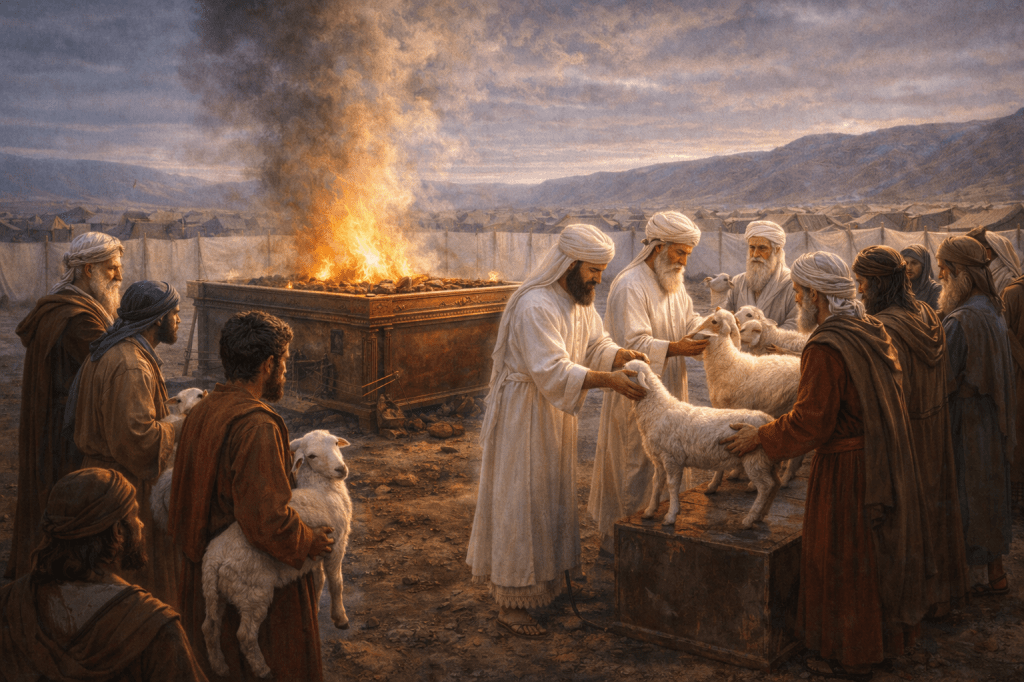
- Read Leviticus 1
MORNING— Drawing Near to God 🪵
- Focal Passage: Leviticus 1:3-4
“If his offering is a burnt offering from the herd, he shall offer it, a male without defect; he shall offer it at the doorway of the tent of meeting, that he may be accepted before the Lord. He shall lay his hand on the head of the burnt offering, that it may be accepted for him to make atonement on his behalf.”
The first sacrifice described in Leviticus is placed there by design. Before peace offerings, fellowship offerings, or celebrations, God begins with the burnt offering—because before anything else, sinful people must be made acceptable in God’s presence.
The burnt offering stood at the entrance to the tabernacle. You could not move past it. You could not go around it. Drawing near to God always began with surrender.
Aaron and his sons built the fire and arranged the wood 🪵on the altar, but the sacrifice was brought to them by the people. This offering was completely consumed. Nothing was held back. No portion was eaten. It was a declaration that approaching God required giving Him everything—and trusting Him for acceptance.
This story did not begin in Leviticus.
When Adam and Eve sinned, God Himself took the life of an animal to provide garments to cover their shame.
When Abel approached God, he brought a sacrifice of life—and God received it.
When Abraham lifted the knife over Isaac, God provided a ram in his place.
Over and over, Scripture teaches the same truth: God provides what is needed to draw near to Him.
In Leviticus 1, the worshiper laid his hand on the animal—leaning his full weight upon it—identifying himself with the sacrifice. The animal died in his place. The offering was more than about specific offenses, but about a deeper problem: the sinful condition of the human heart.
The burnt offering declared, “I cannot come to God unless another stands in my place.”
- Reflection: What does it look like for you to come to God today not holding back, but trusting Him fully for acceptance?
EVENING—The “Once for All” Sacrifice
- Focal Passage: Leviticus 1:9
“The priest shall offer up in smoke all of it on the altar for a burnt offering, an offering by fire of a soothing aroma to the Lord.”
The burnt offering was called a “soothing aroma”—not because God delighted in smoke, but because atonement had been made. God’s righteous anger was satisfied, not by human effort, but by a substitute He accepted.
From the beginning, God has been teaching His people that nearness to Him is always costly—but never earned.
Abel’s sacrifice was accepted because it trusted God’s way.
Abraham’s ram spared his son and pointed forward to a greater provision still to come.
These sacrifices were foreshadowing a greater sacrifice to come.
When John the Baptist saw Jesus, he did not say, “Behold the Lamb who helps you try harder.”
He said, “Behold the Lamb of God who takes away the sin of the world.”
In Jesus, the burnt offering has been fulfilled. Christ has been offered once for all.
We still draw near to God in like manner—surrendering, trusting, leaning fully on the provision the Father has made. The New Testament also calls us to present ourselves as living sacrifices (Romans 12:1)—not to earn acceptance, but because we already have it.
Worthy is the Lamb that was slain. (Revelation 5:12)
- Reflection: Where might God be inviting you to stop striving for acceptance and rest instead in the sacrifice He has already provided?
- Closing Prayer: Father, thank You for making a way for me to draw near to You. Teach me to trust Your provision, to surrender fully, and to rest in the sacrifice You have given for me. Jesus, thank you for making a way for me through Your shed blood. Amen.

Leave a comment