
- Read Leviticus 19:9-34
MORNING— Open Hands, Open Eyes
- Focal Passage: Leviticus 19:9-10
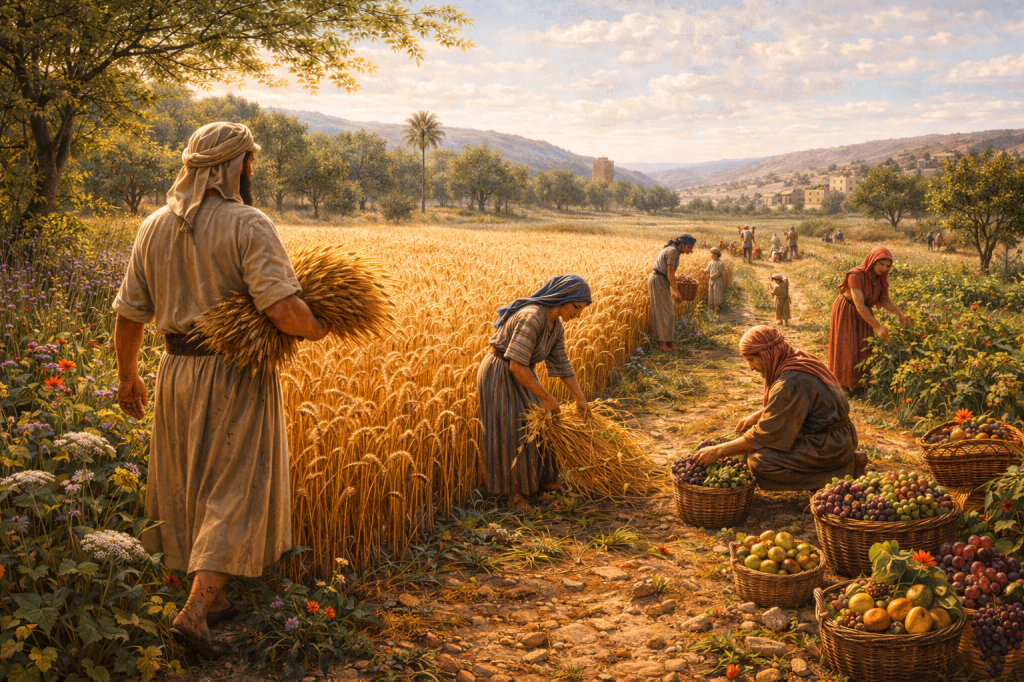
“Now when you reap the harvest of your land, you shall not reap to the very corners of your field, nor shall you gather the gleanings of your harvest. Nor shall you glean your vineyard, nor shall you gather the fallen fruit of your vineyard; you shall leave them for the needy and for the stranger. I am the LORD your God.”
Leviticus doesn’t just tell Israel to “be holy.” It shows what holiness looks like with skin on—what it looks like in a field, in a paycheck, in a conversation, in the way you treat someone who can’t “keep up.”
It’s striking that one of the most-quoted Old Testament commands in the New Testament comes from this very chapter. Leviticus 19:18 is quoted or echoed repeatedly (and has a prominent place in Jesus’ “Top Two” in Mark 12:31): “You shall love your neighbor as yourself.” And right around that command, God gives everyday, practical ways to love.
Here’s one of the simplest: leave margin. Don’t squeeze everything out of the field. Don’t live like every last stalk is yours, every last grape is owed to you, every last dollar is untouchable. God built generosity into the harvesting process itself—so that the poor could live with dignity, not with humiliation.
And holiness isn’t only about what we give—it’s also about how we treat the vulnerable.
Leviticus 19:14 (NASB 1995) says:
“You shall not curse a deaf man, nor place a stumbling block before the blind, but you shall revere your God; I am the LORD.”
In other words: God takes personally the way we treat the impaired. Reverence for God shows up in restraint, patience, honor, and protection—especially when someone’s weakness could be exploited.
Holiness is not a halo. It’s a harvest with corners left. It’s a mouth that doesn’t mock. It’s a heart that notices who is struggling—and then acts.
- Reflection: Where can you “leave the corners” today—creating margin in your time, money, attention, or schedule so a needy person isn’t squeezed out?
EVENING— Letting Grudges Go
- Focal Passage: Leviticus 19:18
“You shall not take vengeance, nor bear any grudge against the sons of your people, but you shall love your neighbor as yourself; I am the LORD.”
By evening, love has usually been tested. Not by ideas or principles, but by real people—conversations that didn’t go well, words that lingered, frustrations that followed us home. This is where loving our neighbor stops being a concept and becomes a choice.
Leviticus 19 moves from the field into the heart. It speaks to grudges held in secret, resentment nurtured slowly, and words spoken behind backs. God will not let love appear generous in public while it grows bitter in private.
“Love your neighbor as yourself” is not sentimental. It confronts how we speak, how we judge, how we forgive—or refuse to.
The New Testament repeatedly returns to this verse. Jesus calls it second only to loving God. Paul says it fulfills the whole law. James calls it the royal law. Why? Because it exposes what truly rules us—mercy or self-interest.
Loving our neighbor means refusing to keep score. It means choosing not to weaponize memory. It means allowing the grace we depend on to shape how we treat others.
This kind of love does not come naturally. It flows from a deeper reality: we are already loved. Already forgiven. Already shown mercy we did not earn.
And once again, the command ends where it began:
“I am the LORD.”
Love is not optional and holiness is not negotiable.
- Reflection: Who tested your love today—and what would it look like to respond with the same patience and mercy God has shown you?
- Closing Prayer: Holy God, You have shown us that love is not abstract—it is practiced in fields, homes, conversations, and choices. Teach us to leave room for others in what You have given us, and grace in how we respond to those around us. Shape our hearts to reflect Yours, so that loving our neighbor becomes the natural fruit of walking with You.
Amen.

Leave a comment