
- Read Leviticus 23
MORNING— Remembering Forward
- Focal Passage: Leviticus 23:2
“Speak to the sons of Israel and say to them, ‘The Lord’s appointed times which you shall proclaim as holy convocations—My appointed times are these.”
Some people learn best by hearing. Others by seeing. Still others by doing—by touching, tasting, walking through an experience. God knew that about His people.
So He gave Israel a calendar.
Leviticus 23 lays out a year-long rhythm of remembrance—weekly, annual, seasonal. Sabbaths. Feasts. Experiential rhythms that engaged the whole person. Israel didn’t just hear their story; they lived it again and again.
Seven feasts. A rhythm of sevens. A holy pattern woven through Israel’s life.
The Hebrew word for seven is tied to ideas of fullness, satisfaction, and completion. When God “sevens” something, He is saying, This is complete. This is dependable. Nothing needs to be added.
Each feast answered three questions:
- What did God do?
- How will God complete this?
- What does faithful living look like now?
These feasts were designed to look backward—to Egypt, the wilderness, God’s provision and mercy. But they were also looking forward. Each festival carried a promise Israel could not yet fully see.
By the time of Christ, that forward-looking hope was already stirring.
Paul later reminded the church—especially Gentile believers under pressure to “keep” these festivals—that they were never meant to be a burden or a test of spirituality:
“Therefore no one is to act as your judge in regard to food or drink or in respect to a festival or a new moon or a Sabbath day—things which are a mere shadow of what is to come; but the substance belongs to Christ.”
(Colossians 2:16–17, NASB 1995)
For us, the feasts are no longer obligations—but they remain teachers. They train our hearts to remember that God works through time, rhythm, waiting, and fulfillment.
The calendar itself whispers a promise:
God finishes what He starts.
- Reflection: Where has God invited you to slow down and remember—not just with your mind, but with your life?
EVENING— Living Beneath the Branches 🌳
- Focal Passage: Leviticus 23:42-43
“You shall live in booths for seven days; all the native-born in Israel shall live in booths, so that your generations may know that I had the sons of Israel live in booths when I brought them out from the land of Egypt. I am the Lord your God.”
Of all the feasts, the Feast of Booths may feel the most unusual—and the most tender.
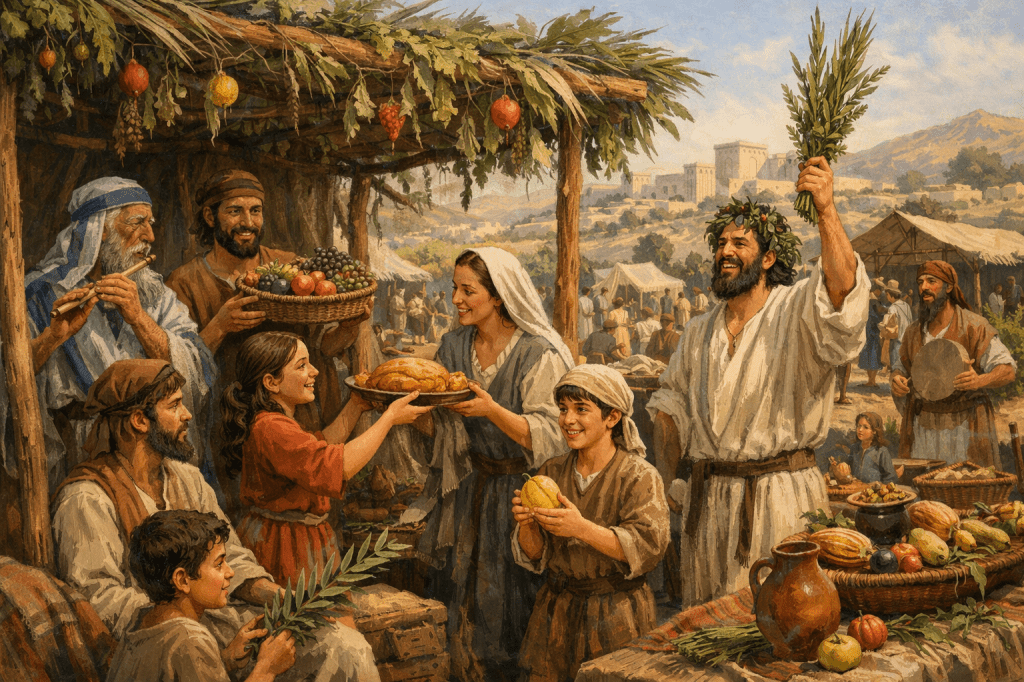
After harvest was complete, after the solemn weight of the Day of Atonement, God told His people to step outside their solid homes and live for a week in shelters made of branches, leaves, and boughs—palms, willows, trees🌳 from the land itself 🌿🪵.
It was intentional discomfort.
The booths were fragile. You could see the sky through them. You could hear the wind. You were reminded—every night—that you were once a people with no permanent shelter at all.
This feast did two things at once:
- It remembered sorrow — slavery, wandering, dependence.
- It commanded joy — “Then celebrate with joy before the Lord your God for seven days.”
Joy follows cleansing. The Feast of Booths came after the Day of Atonement. Holiness first. Then happiness. People who want joy without repentance always end up disappointed.
And yet, this feast also looked forward.
The prophet Zechariah saw a day when all nations would come to Jerusalem to celebrate the Feast of Booths—when God’s presence would again dwell openly among His people (Zechariah 14:16–19).
That future hope stepped into history during this feast.
In John 7, during the Feast of Booths, Jesus stood in the temple courts—while water was poured out and lamps blazed—and cried out:
“If anyone is thirsty, let him come to Me and drink.”
(John 7:37, NASB 1995)
The true shelter had arrived.
The branches once overhead pointed beyond themselves—to the One who would “tabernacle” among us, and who now invites us to live under the covering of His grace.
We live in fragile places. Temporary shelters. Lives where sorrow and rejoicing often share the same roof.
But we rejoice anyway—because God dwells with us even there.
- Reflection: Where has God asked you to rejoice—not because life feels secure, but because He is present?
- Closing Prayer: Lord God, You are the Author of time and the Keeper of our days. Teach us to remember Your faithfulness—not only in our minds, but in the rhythms of our lives.
When we live in temporary places, help us trust Your presence.
When we rejoice, keep our joy rooted in Your grace.
Thank You for being our true shelter, our lasting dwelling, and our sure hope—from tree to tree 🌳.
Amen.

Leave a comment