
- Read Numbers 11
MORNING— Complaint Department: Take a Number
- Focal Passage: Numbers 11:1
“Now the people became like those who complain of adversity in the hearing of the Lord…”
Have you ever started a trip—for vacation or work—and realized almost immediately that something was off?
Maybe the car wouldn’t start. Maybe traffic stalled before you reached the highway. Maybe the kids were already on edge, or the flight was delayed, or the connection was canceled. You were ready to pull your hair out—and you hadn’t even arrived yet.
That’s Numbers 11.
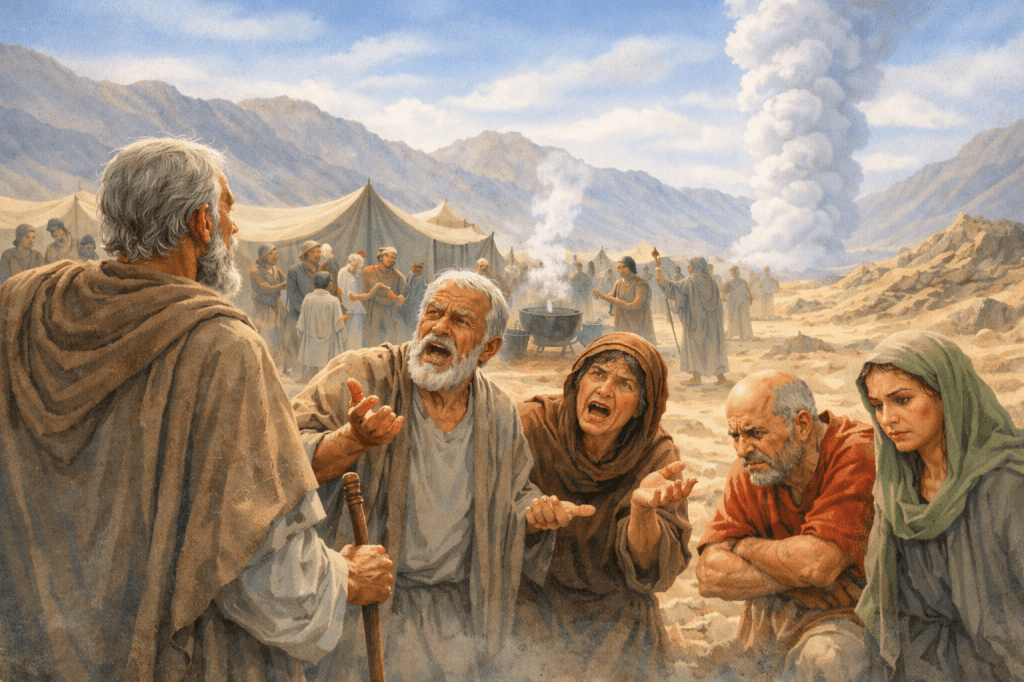
Israel has finally left Sinai. After nearly a year camped in one place, the cloud lifts and the people begin moving again. What should feel like progress quickly becomes pressure, and before long, frustration spills over into complaint.
Moses is careful with his words. He says the people became “like those who complain of adversity.” It’s a warning label. He isn’t just describing behavior; he’s naming a pattern—what people can become when hardship is interpreted as abandonment.
Their complaints aren’t trivial. They are tired. They are hungry. They miss what feels familiar. Like them, when life doesn’t unfold the way we expected, we’re tempted to assume something has gone wrong—either with our circumstances or with God.
Chuck Swindoll tells a true story from his years as a pastor about a man who came to him discouraged only weeks after committing his life to Christ. The man said, “I thought following Jesus would make things better—but everything seems harder.” Family tension had increased. Work had become more complicated. The excitement he expected had been replaced with resistance. Swindoll listened and then asked him a simple question: “If you were remodeling a house, would the noise and mess mean something was wrong—or that something important was being rebuilt?”
The man slowly realized the truth. The difficulty wasn’t a sign of failure. It was a sign of change. God hadn’t abandoned him; God had begun a deeper work.
That’s what Israel misunderstood. They mistook the discomfort of transition for divine neglect. But what felt like disorder was actually formation. God was shaping a people who could trust Him beyond comfort, beyond familiarity, beyond the past they kept romanticizing.
Early resistance does not mean the journey is wrong.
Often, it means the work is real.
- Reflection: When life becomes harder instead of easier, do you assume something is wrong—or that God may be doing something deeper?
EVENING— Don’t Run with the Rabble
- Focal Passage: Numbers 11:4-6
“The rabble who were among them had greedy desires… ‘But now our appetite is gone. There is nothing at all to look at except this manna.”
The trouble in Numbers 11 begins with the rabble—a restless minority whose dissatisfaction spreads. They are not merely unhappy; they are vocal. And their voices begin to shape the mood of the entire camp.
Before long, manna—the steady, daily provision of God—is no longer received as grace. It is dismissed with boredom and irritation. “Nothing at all… except this manna.” What once sustained them now feels insufficient simply because it is familiar.
Moses pauses the story to remind us what manna really was. It was nourishing. It was versatile. It arrived every morning without fail. The problem was never God’s provision—it was the people’s appetite.
At this point in their journey, Moses begins to crack under the weight of constant complaint. Yet there is a crucial difference between him and the rabble. Moses brings his frustration to God, not to the crowd. And God responds with mercy—sharing the burden and appointing help. Imagine the weight Moses must have been carrying that God chose to use seventy men to help him bear what he had been carrying alone!
The people, however, keep listening to the rabble. They demand something more. God gives them exactly what they insist on—until their desire for meat makes them sick. Scripture offers a sobering lesson: voices of complaint never carry you forward. They only slow you down.
Max Lucado once told about running a half-Ironman triathlon. After the 1.2-mile swim and the 56-mile bike ride, he was exhausted as he began the final 13.1-mile run. A runner beside him began to complain, saying, “This stinks. This race is the dumbest decision I’ve ever made.” Lucado listened for a moment, then said simply, “Goodbye,” and raced away. He later explained that if he listened long enough, he would start agreeing—and then he would quit. He chose to keep running.
That’s wisdom for the wilderness.
When voices around you grow bitter, don’t slow down to argue. And don’t join the chorus. Fix your eyes forward, say goodbye, and keep going. God will get you home.
- Reflection: Whose voices are you listening to—and are they helping you keep running, or tempting you to quit?
- Closing Prayer: Lord, when the road feels harder than we expected, keep us from mistaking discomfort for Your absence. Teach us to bring our burdens to You, not to the chorus of complaint around us. Give us grateful hearts for daily provision and steady courage to keep moving forward. Amen.

Leave a comment