
- Read Deuteronomy 18:15-19:21
MORNING— Jesus: A Prophet Like Moses
- Focal Passage: Deuteronomy 18:15
“The LORD your God will raise up for you a prophet like me from among you, from your countrymen, you shall listen to him.”
Israel had asked for distance.
At Mount Horeb, the people trembled as God’s voice thundered and fire wrapped the mountain. Overwhelmed by His holiness, they begged Moses to stand between them and the Lord—to hear God’s words so they would not perish. And God responded with grace: “They have spoken well.”
Rather than rebuking their fear, God promised provision. He would speak through a mediator. Moses tells them a prophet will come “like me”—one who would speak God’s words faithfully and whom the people were commanded to hear.
The New Testament identifies this promise clearly. In Acts 3:22, Peter declares that Jesus is the fulfillment of Deuteronomy 18. Yet Jesus is greater than Moses. Moses received God’s words; Jesus is the Word. Moses mediated temporarily; Jesus mediates eternally.
We often say we want to hear God—yet we prefer His voice filtered, manageable, and at a safe distance. God answered that desire by drawing near in His Son.
If you want to hear God, listen to Jesus.
He is not merely a messenger.
He is God speaking at last.
- Reflection: Am I truly listening to Jesus as God’s final word, or only when His voice agrees with me?
EVENING— Jesus: Our City of Refuge
- Focal Passage: Deuteronomy 19:2-3
“You shall set aside three cities for yourself… so that any manslayer may flee there.”
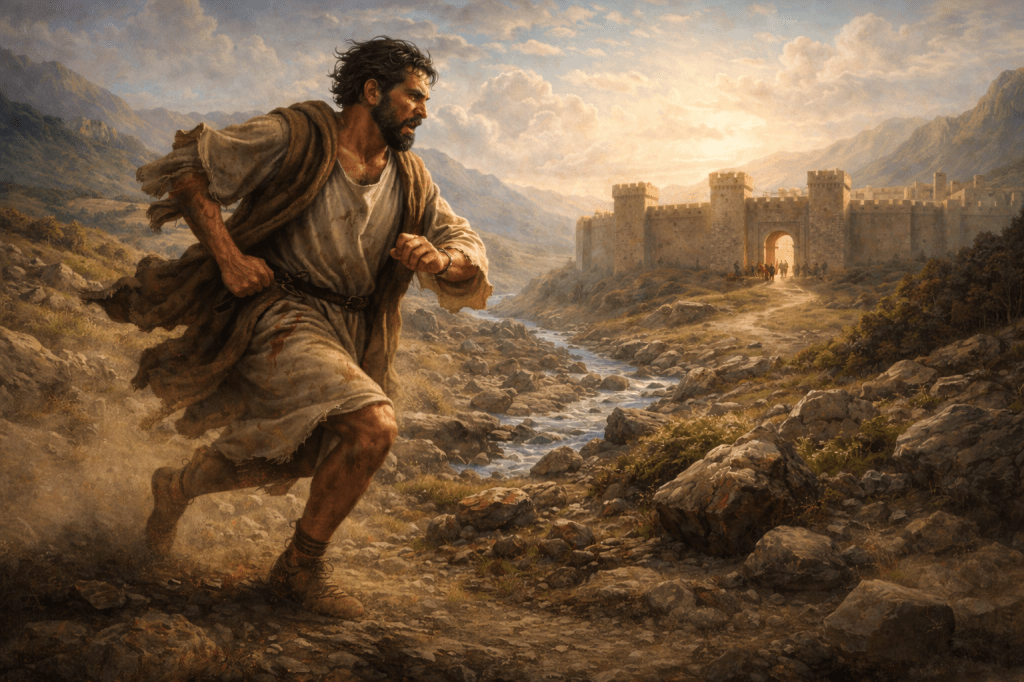
After giving the command against murder, God required Israel to distinguish between premeditated killing and accidental death. Justice was not to be driven by rage. So the Lord appointed cities of refuge—places where the accused could flee for protection and a fair hearing (Exodus 21:12–13; Numbers 35).
These cities were strategically placed. Roads were cleared. Bridges were rebuilt after storms. Signposts pointed the way. The gates were never shut. Refuge was not hidden; it was accessible.
But safety required action. The manslayer had to run. Delay could mean death. And protection existed only inside the city—until the death of the high priest.
All of this points forward.
Hebrews says we “have fled for refuge in laying hold of the hope set before us” (Hebrews 6:18). Jesus is our City of Refuge.
The ancient cities were visible on hills; Christ is the Light of the world (John 8:12).
Their gates stood open; He says, “The one who comes to Me I will certainly not cast out” (John 6:37).
The roads were kept clear; “I am the Way, the Truth, and the Life.” (John 14:6).
But while the cities protected only those guilty of unintentional death. Christ shelters even the fully guilty. If anger is murder of the heart (Matthew 5:21–22), then we all need refuge. And unlike the old system—where release came only after the high priest died—our High Priest has already died and risen. “There is now no condemnation for those who are in Christ Jesus” (Romans 8:1).
But proximity is not protection. Safety was inside, not nearby. So it is with Christ. We do not analyze the refuge—we enter it.
And having found shelter, we become signposts. The Levites were scattered throughout Israel to teach and uphold justice (Deuteronomy 33:10). In Christ, we are now a royal priesthood (1 Peter 2:9). Having received mercy, we reflect it—defending the vulnerable, guarding truth, and pointing others toward the only lasting refuge.
Jesus is our shelter.
And those who dwell in Him become light for those still running.
- Reflection: When fear or conviction presses in, do I run quickly to Christ—or hesitate, hoping danger will pass?
- Closing Prayer: Faithful God, You spoke through Your Son with clarity and grace, and You provided a place of refuge for all who flee to Him. Teach us to listen without resistance and to run without hesitation. May we cling to the hope set before us, confident that Your promises cannot fail.
Amen.

Leave a comment