
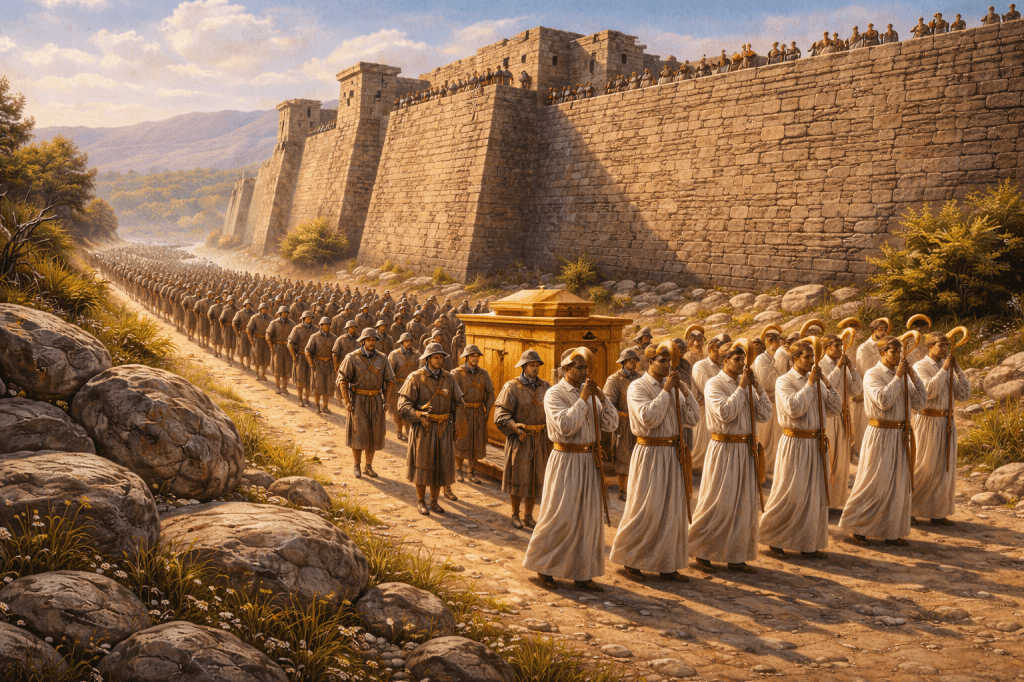
- Read Joshua 6
MORNING— When the Task is Bigger Than You
- Focal Passage: Joshua 6:2
“See! I have given Jericho into your hand, its king, and the mighty men of valor.”
Jericho stands shut tight.
High walls. Locked gates. Watchers posted. From any reasonable assessment, this is a task beyond Israel’s capacity. They are newly arrived, untested in siege warfare, and standing before a fortress designed to resist exactly this kind of threat.
Most of us know that feeling.
The diagnosis you cannot change.
The fractured relationship you cannot fix.
The ministry assignment that feels too large for your gifting.
The responsibility that arrived before you felt ready.
When the task feels overwhelming, our instinct is to ask, “What’s the smartest plan?” We gather resources, sharpen strategies, and look for leverage. Israel could have done the same.
Instead, God gives them a plan that deliberately undercuts their instincts.
March.
Slowly.
Silently. Without attacking.
God’s method does not strengthen Israel’s confidence in their own abilities—it humbles it. Day after day, they walk past walls they cannot breach. Every circuit reinforces the truth: this will not fall because of you.
God is not merely conquering Jericho. He is dismantling Israel’s reliance on preferred methods—force, speed, efficiency, control. The march teaches them patience. The silence teaches restraint. The repetition teaches endurance.
By the time the walls fall, Israel knows something essential: this victory cannot be claimed, explained, or repeated without God.
Sometimes God assigns us a task that feels too great—not to crush us, but to loosen our grip on the ways we would normally try to handle it.
- Reflection: What challenge in your life feels beyond your capacity—and how might God be using it to loosen your reliance on your own preferred solutions?
EVENING— Rahab and Mercy Inside the Walls
- Focal Passage: Joshua 6:17
“Only Rahab the harlot shall live, she and all who are with her in the house.”
Rahab is introduced in Scripture with a label.
Not her virtues.
Not her courage.
Not her faith.
She is introduced as “Rahab the harlot.”
The Bible does not soften her story. It does not tidy her past. Yet Joshua 6 makes something unmistakably clear: when Jericho falls, Rahab stands.
Long before the walls collapse, Rahab has already chosen where she will stand. She believed what she heard about the God of Israel. She acted on that belief. She tied a scarlet cord in her window—not knowing exactly how rescue would come, only trusting that it would.
When judgment arrives, mercy knows her address.
Rahab is spared not because she had lived well, but because she trusted the living God. Her household is spared with her. She is brought outside the camp, given time, and eventually welcomed fully into Israel. Through the birth of her son, Boaz, she ends up in the line of Messiah. (Matthew 1:5).
Joshua 6 holds judgment and mercy side by side. The city falls. The walls crumble. But grace does not collapse with them.
Rahab reminds us that God’s work is never only about tearing down strongholds. It is also about rescuing those who respond to Him in faith—no matter how they are introduced.
- Reflection: Where do you need to remember that God’s mercy is not limited by labels—yours or anyone else’s?
- Closing Prayer: Lord, when the task before us feels too large, teach us to trust You more than our own strategies. Thank You for mercy that reaches behind walls and beyond labels, for grace that rescues and restores. Help us walk faithfully, trust deeply, and believe that You are already at work—even when the walls still stand.
Amen.

Leave a comment