
- Read Ruth 1 & 2
MORNING— Call Me Bitter
- Focal Passage: Ruth 1:20-21a
“She said to them, ‘Do not call me Naomi; call me Mara, for the Almighty has dealt very bitterly with me. I went out full, but the Lord has brought me back empty.’”
If you were asked to teach a class at church on the subject of romance, where would you go in the Bible?
Song of Solomon? Perhaps—until the poetry requires a translator.
First Corinthians 13? Beautiful, but brief, and maybe a little too lofty.
Then you come to Ruth.
At first, it feels like the wrong choice. This story doesn’t sound romantic at all. There are funerals instead of weddings, hunger instead of abundance, tears instead of music. It doesn’t sound like any love story you’ve heard before.
And yet, underneath the sorrow and the waiting, Ruth is exactly like every real love story you’ve ever known.
And it isn’t a “sweep you off your feet” kind of romance. It is about committed love and loyalty.
And overall the short book is not really about Ruth.
The Book of Ruth could just as well be called The Book of Naomi. It is about her relationship with God being tested.
Naomi has lost everything. A famine forced her family from Bethlehem. Death followed her into Moab. Her husband is gone. Her sons are gone. The future she imagined is gone. And now she returns home with nothing but grief and a foreign daughter-in-law beside her.
Bitterness grows, fed by disappointment.
Naomi’s words reveal what grief has done to her faith. She still believes in God, but she believes He is against her. “The hand of the Lord has gone forth against me,” she says. She knows the old stories—seas that parted, walls that fell—but pain has drowned them out.
People who are hurting often expect nothing from life except more hurt. They become blind to blessing.
“Do not call me Naomi,” she says. Pleasant no longer fits. “Call me Mara.” Bitter.
And then she says the most painful thing of all: “I went out full, but the Lord has brought me back empty.”
Standing right beside her is Ruth—who has given up her homeland, her gods, her future, and her security to stay with her. Yet grief makes Naomi unable to see the gift God had already placed in her life.
Bitterness narrows our vision until sorrow is all we can see.
But even here—before Naomi can see it—God has begun his work.
- Reflection: Where has disappointment begun to shape how you speak about God? Is grief telling you a story that grace has not yet finished correcting?
EVENING— Gleanings of Hope
- Focal Passage: Ruth 2:12
“May the Lord reward your work, and your wages be full from the Lord, the God of Israel, under whose wings you have come to seek refuge.”
Hope arrives in ordinary places, through faithful people who simply keep going.
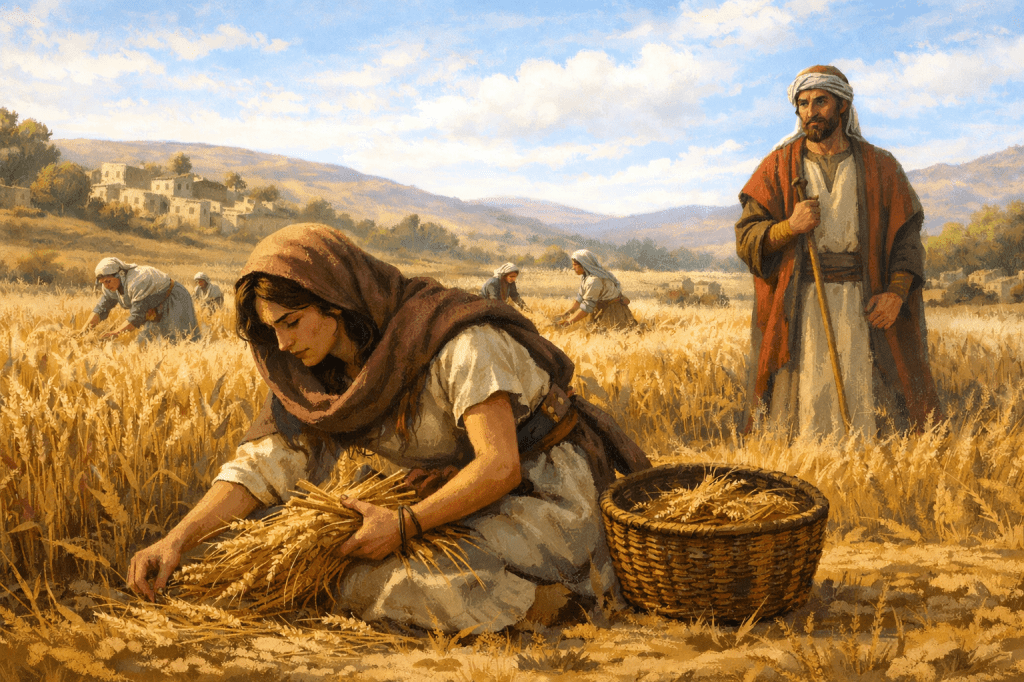
Ruth does not wait for a sign from heaven before she acts. She asks permission to glean, then goes to work. She does not know whose field she enters. Scripture only says she “happened” to come to Boaz’s land. Providence usually feels like coincidence until later.
Ruth works all day. She stops only briefly to rest. She gathers enough grain to feed two women who have no safety net and no guarantees. She does not complain. She does not keep score. She does not ask what she will get in return.
That is loyal love.
Boaz notices—faithfulness tends to reveal itself. He protects her, provides for her, and speaks kindly to her. Ruth receives it with humility, never assuming she deserves more.
And something unexpected happens.
Naomi begins to hear the music.
When Ruth returns with grain—and leftovers from Boaz’s table—Naomi finally asks a question that signals hope’s return: “Where did you glean today?” The woman who said she came back empty now recognizes that something good has found its way into her hands.
“May he be blessed of the Lord,” Naomi says, and for the first time, she speaks of God’s kindness instead of His affliction.
Hope does not erase sorrow. It interrupts it.
Sometimes hope looks like work done faithfully when life feels unfair.
Sometimes it looks like humility that receives grace without entitlement.
And sometimes hope sounds like music you can barely hear—but you strain to listen anyway.
A chaplain once sang a hymn beside a woman who had been unresponsive for years after a brain stem stroke. Nothing had reached her—no voice, no touch, no treatment. But when the words “Great is Thy Faithfulness” were sung, something stirred. Sounds came from deep within her. The song reached places untouched by everything else.
Faith, it turns out, has roots deeper than memory.
So do hope and love.
- Reflection: What kindness might God be using right now to remind you that He has not withdrawn His care? Where are the small gleanings of hope you might be overlooking?
- Closing Prayer: Faithful God, when sorrow tempts us toward bitterness, steady our hearts. Help us trust You when the way feels uncertain, and open our eyes to the gifts You place beside us. Teach us to love faithfully, receive humbly, and hope patiently.
Amen.

Leave a comment