
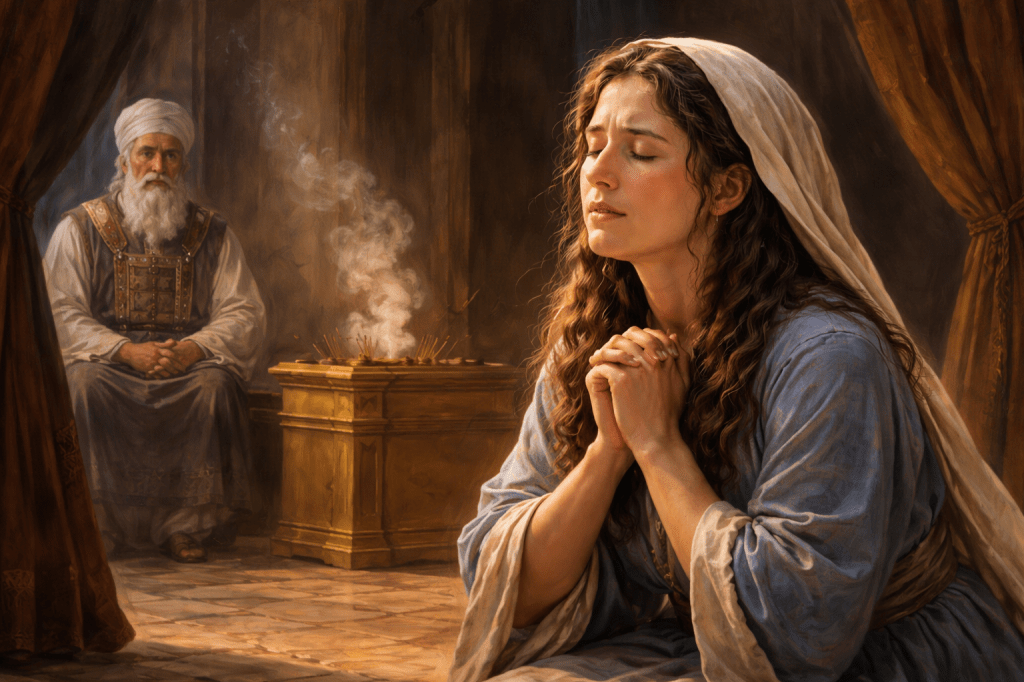
- Read 1 Samuel 1; 2:1-11
MORNING— The Lord of Hosts Hears
- Focal Passage: 1 Samuel 1:11
“She made a vow and said, ‘O Lord of hosts, if You will indeed look on the affliction of Your maidservant and remember me, and not forget Your maidservant, but will give Your maidservant a son…’”
The first time Scripture uses the name YHWH Tsaba—the LORD of Hosts—is not on a battlefield. It is whispered through tears.
Hannah stands at the threshold between the chaos of the Judges and the dawn of kingship in Israel. The nation is disordered. Worship is hollow. Leadership is weak. And in the midst of that instability, a barren woman prays.
“Hosts” (tsaba) is a word of armies, angels, and vast multitudes. It can describe soldiers in formation, the heavenly beings who serve God, or even the stars scattered across the sky. To call God the LORD of Hosts is to confess that every power—visible or invisible—stands under His command.
Hannah chooses this name deliberately. Her struggle is deeply personal, but she brings it to the God who rules all forces. What oppresses her is not beyond His reach. What shames her is not outside His authority.
Scripture does not tell us how long Hannah prayed—only that she prayed honestly, intensely, and without restraint. She poured out her soul. And when she rose from prayer, something had changed. The circumstances had not. But she had. “Her face was no longer sad.”
She did not leave with an answer. She left with peace.
That is often the gift of the LORD of Hosts—not immediate resolution, but the assurance that the battle no longer rests on our shoulders alone.
- Reflection: What personal struggle do you need to place under the authority of the LORD of Hosts today?
EVENING— Joy Given Back to God
- Focal Passage: 1 Samuel 2:8
“He raises the poor from the dust, He lifts the needy from the ash heap to make them sit with nobles and inherit a seat of honor.”
Hannah returned home, worshiped, and lived faithfully in the ordinary days that followed. She trusted the LORD of Hosts not only with her request, but with the timing of His answer. And in time, God remembered her.
Hannah’s waiting ends with receiving—but her story does not stop there. When the Lord gives, Hannah does not cling. She responds with joy that is turned upward in praise.
Her song in 1 Samuel 2 is not a lullaby whispered over a child. It is a bold confession about God Himself. She rejoices not only because she has received a son, but because she has come to know the Lord more truly. The God who once seemed silent is revealed as the One who overturns human expectations, who lifts the lowly, and who delights to give life where there was none.
Joy, for Hannah, is not mere relief. It is recognition. She sees now that the Lord was at work all along—and that realization becomes worship.
In 1738, Charles Wesley recorded that after his conversion experience at Aldersgate, he did not immediately feel triumphant. Instead, he wrote hymns—many of them during seasons of lingering doubt and weakness. Over his lifetime, he would write more than 6,000 hymns, including “And Can It Be” and “O for a Thousand Tongues to Sing.” Wesley later reflected that song was not merely the result of joy, but one of the means God used to shape it.
Receiving from the Lord is never meant to end with us. Joy matures when it is returned to God in praise.
Hannah’s song reminds us that God’s gifts are not merely answers to prayer—they are invitations to deeper worship.
- Reflection: What gift from God are you being invited to receive with joy—and then return to Him in praise?
- Closing Prayer: LORD of Hosts, teach us to praise You not only after You answer, but while we are still waiting. Let our worship shape our hearts, steady our faith, and remind us who You are when circumstances remain unresolved. Lift the lowly in Your time, and form in us a song to sing to the generations that follow. Amen.

Leave a comment