
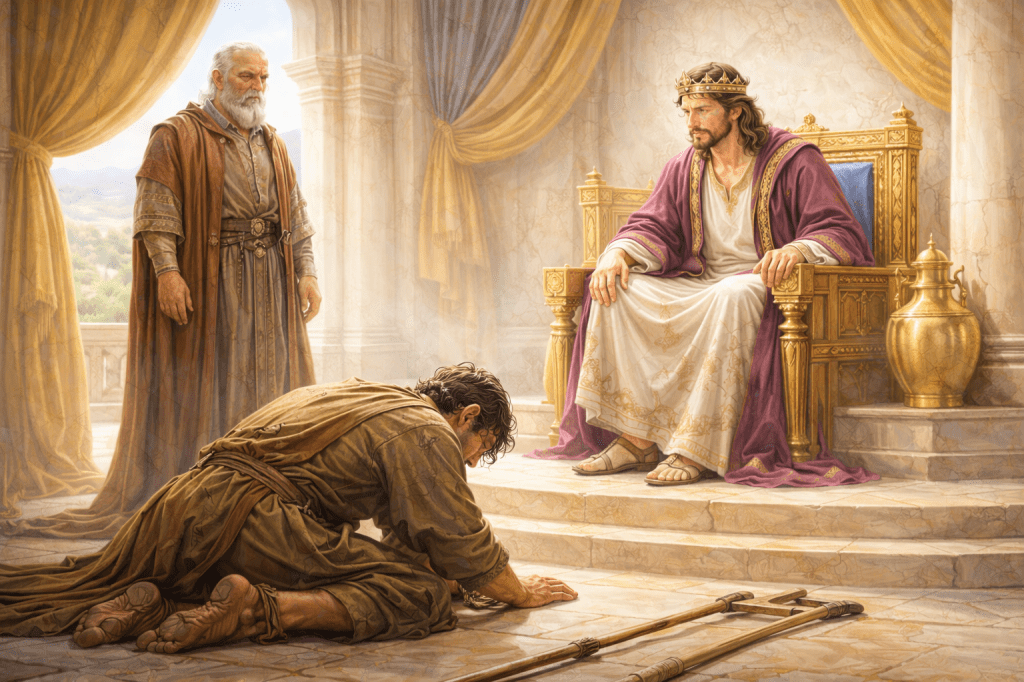
- Read 2 Samuel 9
MORNING— The King Who Remembers
- Focal Passage: 2 Samuel 9:1
“Then David said, ‘Is there yet anyone left of the house of Saul, that I may show him kindness for Jonathan’s sake?’”
In 1988, on the streets of Kampala, Uganda, a fifteen-year-old boy named Peter Mutabazi survived by remaining unseen. Known only as “Garbage Boy,” he begged, stole food, and slept wherever he could. One evening, as he approached a man he thought would be an easy target, the man turned and asked a question Peter had learned to fear:
“What is your name?”
Names mean recognition. Humanity. Risk.
But this time that question altered the course of Peter’s life.
In 2 Samuel 9, King David asks a question just as dangerous.
“Is there anyone left of the house of Saul?”
In the ancient world, that question usually preceded execution. Former dynasties were erased to prevent rebellion. But David’s question is shaped by a promise. Years earlier, Jonathan—son of Saul—had asked David to show covenant kindness to his family when God established David as king (1 Sam. 20:14–16).
The Hebrew word is hesed—steadfast love expressed toward someone who cannot repay it.
David remembers.
A servant named Ziba tells him there is still a son of Jonathan, crippled in both feet. He does not give his name. Brokenness becomes the label.
David asks only one thing:
“Where is he?”
Hesed always moves toward the forgotten.
- Reflection: Who has God brought to mind that you might be tempted to overlook—but He has not forgotten?
EVENING— Covered By Grace
- Focal Passage: 2 Samuel 9:7
“Do not fear, for I will surely show kindness to you for the sake of your father Jonathan… and you shall eat at my table regularly.”
Mephibosheth is brought from Lo-debar, a place whose name means “no pasture.” Once royalty, he now lives in obscurity, carrying shame in both body and spirit. When summoned to the king, he falls facedown, expecting judgment.
David speaks his name.
Not “the cripple.”
Not “Saul’s grandson.”
“Mephibosheth.”
Then come words that change everything: “Do not fear.”
David restores Saul’s land to him, assigns servants to work it, and invites Mephibosheth to eat at the king’s table—always. Scripture notes more than once that Mephibosheth was lame in both feet. The detail does not disappear after David’s kindness—it remains part of his story. But at the king’s table, it is no longer the defining thing. He sits there as one of the king’s sons. This is more than kindness. It is grace.
Jesus later described God’s kingdom the same way—a table where the poor, the crippled, and the overlooked are welcomed (Luke 14:12–24). Those who know their need come gladly. Those with excuses remain outside.
Peter Mutabazi eventually accepted an invitation like that. A man named Jacques Masiko welcomed him into his home, into meals, into church, into belonging. Years later, Peter would say, “My entire life hinges on receiving undeserved kindness.”
So does ours.
We are all Mephibosheth—called by name, lifted from our Lo-debar, seated not because of merit, but because of covenant love. Ours is sealed not by David’s human promise, but by Christ’s shed blood.
And those who receive such grace are sent to extend it—clearing paths so the lame may walk, and others may find their seat at the table (Heb. 12:13).
- Reflection: What would change this week if you truly lived as one already seated at the King’s table?
- Closing Prayer: Gracious King, thank You for remembering us when we were hidden and ashamed. You called us by name, told us not to fear, and gave us a place we did not earn. Teach us to live as sons and daughters of grace, and to make room at our tables for others still waiting to be invited. Through Jesus Christ, who welcomes us home.
Amen.

Leave a comment