
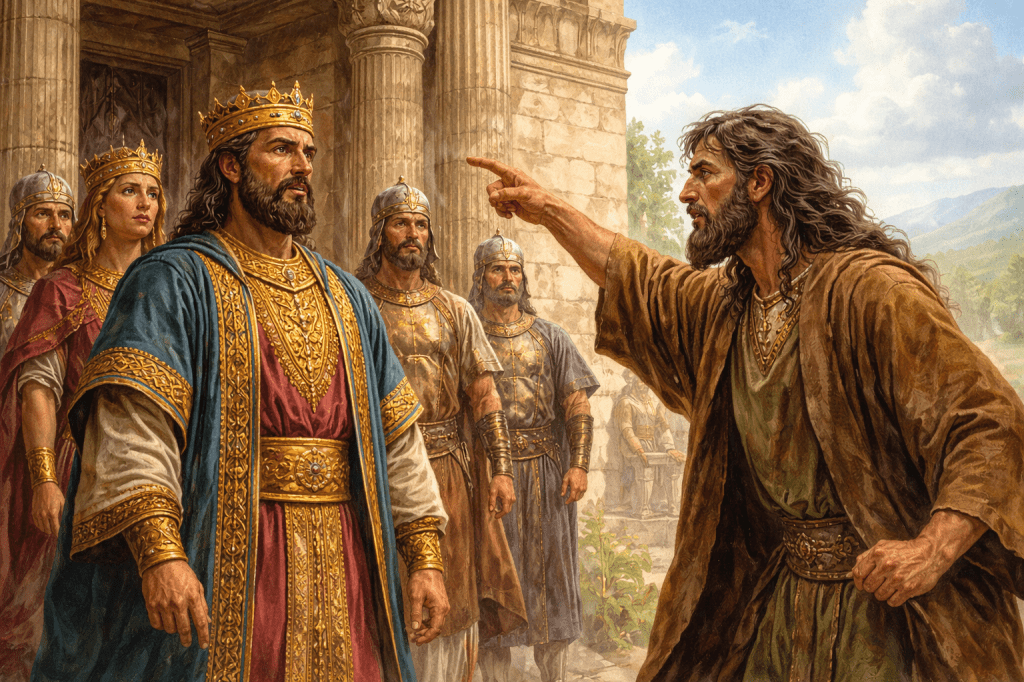
- Read 1 Kings 17
MORNING— A Man For the Times
- Focal Passage 1 Kings 17:1
“Now Elijah the Tishbite, who was of the settlers of Gilead, said to Ahab, ‘As the LORD, the God of Israel lives, before whom I stand, surely there shall be neither dew nor rain these years, except by my word.’”
The chapter opens like a headline reel.
Ahab takes the throne of Israel (the Northen Kingdom) and manages to out “evil” every evil king before him. He marries Jezebel, the Baal-worshiping princess of Sidon. Altars to Baal go up. An Asherah 🌳 is set up. Jericho—under a divine curse since Joshua’s day—is rebuilt at the cost of sons’ lives. Sin is treated as a trivial thing. The culture slides, and no one seems able to stop it.
Then, without warning, a man steps out of nowhere.
No genealogy. No tribe listed. No résumé. Just: “Elijah the Tishbite.” A man from a place no one can find on a map walks into the palace and announces a drought in the name of the living LORD. One sentence—and the nation’s weather forecast changes.
We tend to put Elijah in the “spiritual superhero” category: fire from heaven, raising the dead, a whirlwind exit. But James gives us a needed correction:
“Elijah was a man with a nature like ours…” (James 5:17a, NASB 1995)
He was not extraordinary by pedigree or position—just a man who trusted the LORD enough to speak when it mattered.
In a world that prizes being of the times—blending in, staying agreeable, avoiding friction—Elijah is something different: a man for the times. He doesn’t mirror the culture; he confronts it. He doesn’t echo Baal; he declares that the LORD still lives.
For you, it may look far less dramatic. It may be the moment you refuse to cut ethical corners at work. The decision not to join in when a group tears someone down. The conversation with a child or grandchild that says, “I know this is normal now, but this is not how we will live.” These moments don’t make headlines, but they reveal whether we are merely shaped by our time—or willing to stand for God within it.
- Reflection: Where this week might God be calling you to stand for what is right—rather than simply going along with what everyone else accepts?
EVENING— The Cutting Place
- Focal Passage: 1 Kings 17:2-3
“The word of the LORD came to him, saying, ‘Go away from here and turn eastward, and hide yourself by the brook Cherith…’”
If we were writing Elijah’s story, we might schedule a speaking tour next.
He has just delivered God’s word to the king. The cameras (if they existed) would be rolling. This is Elijah’s moment.
God’s next command? “Hide yourself.”
Elijah goes from palace steps to a ravine with no audience. The brook Cherith’s name carries the idea of “cutting.” It is a place where God whittles away self–reliance and trains a prophet to live on daily provision—water from a shrinking stream and food delivered by ravens.
It’s one thing to stand before Ahab. It is another to sit by a brook and wait.
Author Brennan Manning tells of ethicist John Kavanaugh traveling to Calcutta, asking Mother Teresa to pray that he would have clarity about his future. She refused. “Clarity,” she said, “is the last thing you are clinging to and must let go of.” She added, “I have never had clarity; what I have always had is trust. So I will pray that you trust God.”
That is Cherith.
Elijah doesn’t get a five–year plan. He gets a word: “Go there… I have commanded the ravens to provide for you there.” And he obeys. He stays even as the brook slowly shrinks—until God speaks again.
The Lord Jesus walked the same path in a deeper way. After His baptism and public affirmation, the Spirit led Him into the wilderness, away from crowds, into hunger and testing (Matt. 4:1–11). Before the public ministry came the hidden place, where trust was proved.
Maybe you feel more like you’re by a drying brook than on a stage right now. Doors are closed. Opportunities seem small. You wonder if God has shelved you.
He hasn’t. Cherith is not wasted time; it is training time. In the cutting place, God teaches us to live on His word and His provision, so that when the next public moment comes, we stand in His strength rather than our own.
- Reflection: Where might God be using a “hidden” season in your life right now—not to sideline you, but to deepen your trust in His daily provision?
- Closing Prayer: Lord, give us courage to stand for You when the moment demands it, and patience to trust You when You lead us into hidden places. Teach us to live by Your word, to wait for Your voice, and to believe that even the drying brook has been assigned as part of Your care for us. Amen.

Leave a comment