
- Read 1 Kings 18
MORNING— Called Out of the Stands
- Focal Passage 1 Kings 18:21
“How long will you hesitate between two opinions? If the LORD is God, follow Him; but if Baal, follow him.”
Elijah walks back into Israel after three and a half years of drought. The famine is severe. Ahab is desperate—but not repentant. When the king finally sees Elijah, he snaps, “Is this you, troubler of Israel?”
Elijah does not soften the moment. He names the truth plainly: the trouble belongs to Ahab and to a nation that abandoned the LORD and chased Baal instead.
Then Elijah does something dangerous. He calls for a public gathering. All Israel. All the prophets of Baal. One mountain. One altar. No hiding.
Before any fire falls, Elijah turns to the people and asks a question that stops everything:
“How long will you hesitate between two opinions?”
The response is silence.
Not confusion—delay. Surrounded by a crowd, each person can wait. Someone else will speak first. Someone else will commit. Standing still feels safer than stepping forward. Psychologists call this the bystander effect—when responsibility is spread across many, individuals feel less pressure to act. Silence multiplies because no one wants to be first.
Belief that never moves into action remains untested. We don’t truly believe something until it shapes what we do. For example, we may say we care about the poor—but that belief only proves itself when we actually help someone in need. Until then, it remains an opinion we hold, not a conviction we live.
That is what Elijah exposes on Mount Carmel. Israel claims loyalty to the LORD, but nothing in their lives has changed. Words have not led to movement. Convictions have not reached the hands or the feet.
Elijah forces the issue. Agreement without decision will no longer do.
- Reflection: Could God be calling you off the sidelines and into His world to stand against evil?
EVENING— The Fire Falls
- Focal Passage: 1 Kings 18:24
“The God who answers by fire, He is God.”
The contest exposes everything.
Four hundred fifty prophets of Baal shout, dance, and bleed. Hour after hour—nothing. No voice. No answer. No response. Baal promises power but delivers silence.
Then Elijah steps forward—one man standing faithful for the LORD, facing hundreds of Baal’s prophets, a king who has lost his way, and a crowd that will not decide. And he begins by repairing the altar of the LORD. It had been torn down—neglected during years of divided loyalty. He rebuilds it with twelve stones, one for each tribe, reminding the people that God still claims the whole nation, not just a faithful remnant.
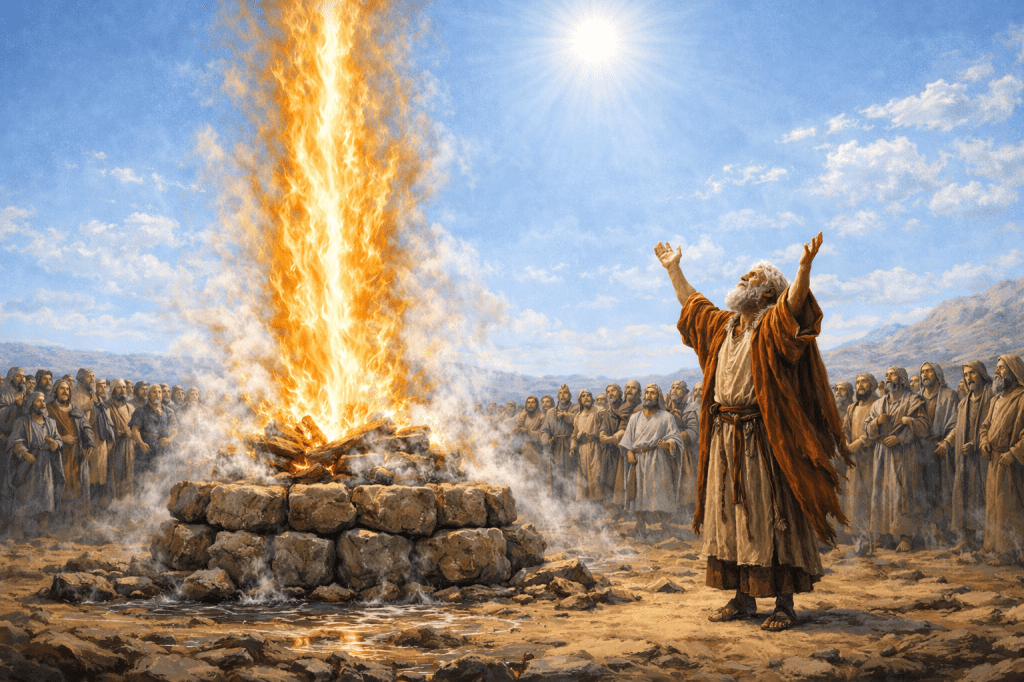
Elijah arranges the wood, places the sacrifice on it, and then does something that defies common sense. He orders water to be poured over the offering—not once, but three times. The sacrifice is soaked. The wood is drenched. The trench around the altar fills until everything is saturated.
Every shortcut is removed. There will be no suspicion of trickery, no hidden spark, no convenient explanation. If fire falls now, it will be unmistakable. The altar is restored, doubt is stripped away, and the moment is set so that only God can act.
Elijah’s prayer is brief and unadorned. He asks that the LORD would make Himself known and turn the hearts of the people back again.
And then fire falls.
It consumes the sacrifice, the wood, the stones, the dust, and even the water in the trench. God leaves no room for confusion. The people fall facedown and finally speak with one voice: “The LORD, He is God.”
Here’s the thing: God shows up in the lives of those who stand with Him. People see it—and they respond.
William Wilberforce was ridiculed in Parliament long before his persistence ended the slave trade in England. Mother Teresa was mocked before she was revered.
Billy Graham was belittled before he was beloved.
What begins with humility and the courage to stand alone often ends with others learning to mirror the very courage they once questioned.
- Reflection: Where might God be calling you to stand alone for a season—trusting that clarity and response belong to Him, not to you?
- Closing Prayer: Lord, You alone are God. Repair what has been neglected in us. Strip away divided loyalties. Remove the shortcuts we rely on. And give us the courage to stand when others hesitate—trusting that You will make Yourself known in Your time. Amen.

Leave a comment