
- Read 1 Kings 19
MORNING— It is Enough, O Lord🌳
- Focal Passage 1 Kings 19:4
“But he himself went a day’s journey into the wilderness, and came and sat down under a juniper tree; and he requested for himself that he might die, and said, ‘It is enough now, O LORD.’”
Elijah is coming off one of the most dramatic moments in Scripture. Fire fell from heaven. Baal was exposed. The people finally declared allegiance to the LORD. It was a mountaintop moment—both literally and spiritually.
And then comes Jezebel’s message: Elijah will pay for this with his life!
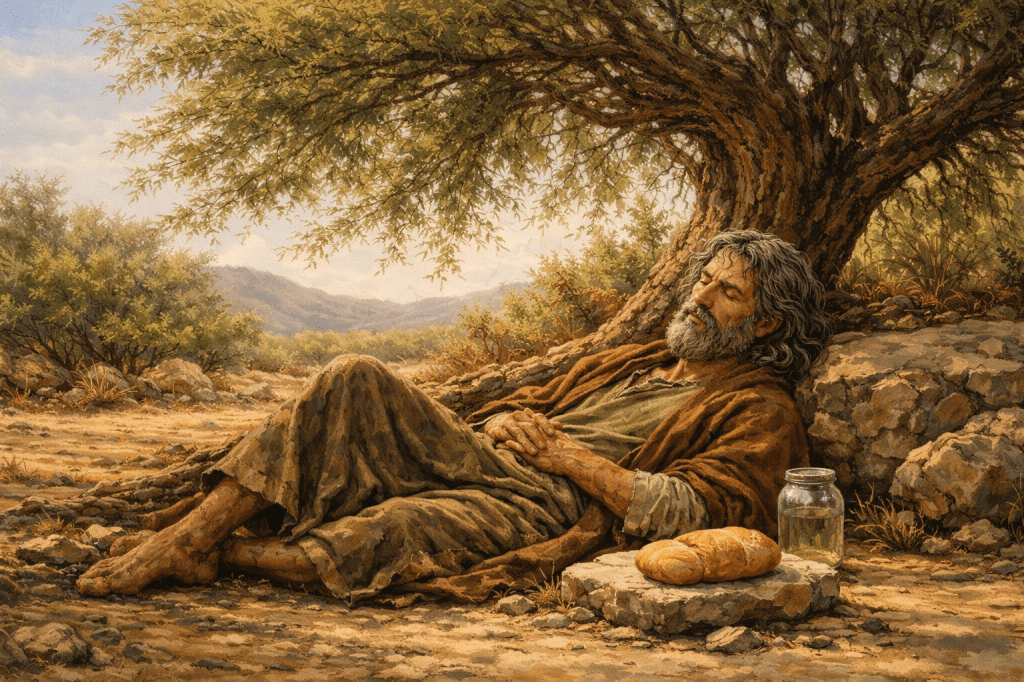
One threat is all it takes. The prophet who stood unmoved before 450 false prophets now runs for his life. He leaves his servant behind, walks alone into the wilderness, collapses beneath a broom tree🌳, and prays:
“It is enough, O LORD.”
This is what exhaustion sounds like when it finally finds words.
Deep weariness often follows intense expenditure. After emotional, spiritual, and physical strain, even great victories can leave us vulnerable. Elijah’s strength was real—but it was not unlimited.
There is a word for this kind of weariness.
The German word Lebensmüde means life-tired.
Chip Ingram observes in Holy Ambition:
“Fatigue doesn’t mean you’ve done something wrong. It may just mean you’ve done a little too much of what’s right.”
What is striking in Elijah’s story is how God responds. There is no lecture. No rebuke. No immediate demand for clarity or courage. God sends an angel with bread and water. He lets Elijah sleep. Then He does it again. Only after Elijah is rested and strengthened does God speak.
The care comes before the conversation.
God meets His weary prophet at the most basic level—body before mission, sustenance before direction. Elijah is not told to push through. He is invited to receive what he no longer has the strength to produce.
We receive that same care in much the same way—not by proving resilience, but by allowing limits. By stopping long enough to sleep, to eat, to be still. By allowing God to care for us before asking Him to explain a single thing more to us.
Weary as you face this new day today?
Find a quiet moment to lay beneath your broom tree, and God will bring the bread.
- Reflection: Where have you been pushing past your limits instead of receiving God’s care? What would it look like today to stop long enough to rest beneath your broom tree and let God tend to you first?
EVENING— What are You Doing Here, Elijah?
- Focal Passage: 1 Kings 19:9
“Then he came there to a cave and lodged there; and behold, the word of the LORD came to him, and He said to him, ‘What are you doing here, Elijah?’”
After gentle care a question comes.
What are you doing here, Elijah?
This is not about geography. God knows exactly where His prophet is. The question presses deeper, inviting Elijah to consider how he arrived in this place and what has been shaping his thinking.
Elijah answers honestly—but he also repeats the same sentence twice: “I alone am left.” Weariness has narrowed his vision. Exhaustion has written a story that feels true but is incomplete.
What happens next is a spectacle. Wind tears at the mountain. The earth shakes. Fire passes by. Yet the LORD is not found in any of the fury. Instead, His voice is made known in a gentle blowing.
Then comes new direction.
Elijah is sent back—not to relive past confrontations, but to take part in quieter, strategic work. Kings will be anointed. The future will be shaped over time, not through a single dramatic moment.
And Elijah is reminded that he is not alone. God has preserved seven thousand who have not bowed to Baal. And God will supply an apprentice in a young man named Elisha—one who will walk with Elijah, learn from him, and eventually carry the work forward long after Elijah’s strength is spent.
The burden was never meant to rest on one set of shoulders.
Burnout does not mean the story is over. Sometimes it means God is redirecting the work—and reminding His servant that the outcome has never depended on him alone.
- Reflection: Where has weariness narrowed your vision? What correction or redirection might God be offering instead of the dramatic answer you expected?
- Closing Prayer: Lord, You know where we are and how we arrived here. Meet us with Your care before You speak Your correction. Quiet our noise, restore our strength, and guide us forward according to Your wise and patient purposes. Amen.

Leave a comment