
- Read 2 Chronicles 33
MORNING— How Far a Heart Can Fall
- Focal Passage 2 Chronicles 33:9
“Thus Manasseh misled Judah and the inhabitants of Jerusalem to do more evil than the nations whom the LORD destroyed before the sons of Israel.”
Manasseh’s reign begins with a chilling summary: he knew the truth and mislead others to get them to turn from it. It wasn’t ignorance. His father Hezekiah had prayed, trusted, and seen God deliver Jerusalem. Manasseh inherited his legacy of faith—and sought to dismantle it piece by piece.
He rebuilt what had been torn down. He promoted what God had forbidden. He even placed idols inside the temple itself, dragging false worship into the very space meant for the presence of the LORD. Scripture is unsparing: “Manasseh seduced them to do evil.” His evil reign was a long one: 55 years.
God warned him. Prophets confronted him. Manasseh refused to comply. He even had some of those prophets silenced. Jewish tradition holds that the prophet Isaiah was martyred during the reign of King Manasseh, and that he was sawn in two.
This is one of the Bible’s most sobering reminders: spiritual proximity does not guarantee spiritual faithfulness. Being raised around truth does not mean we will walk in it. A heart can drift far—even with every advantage.
Manasseh reminds us that prodigals can emerge even from godly legacies. Prodigals do not always come from broken homes; sometimes they come from faithful ones. Yet Jesus’ parable of the Prodigal Son reminds us that while rebellion may run far, God remains the Father who watches the road, ready to receive those who truly turn back.
- Reflection: Have you grown so familiar with truth that you are actually now rebuilding what God once helped you tear down?
EVENING— How Far Mercy Can Reach
- Focal Passage: 2 Chronicles 33:12-13
“When he was in distress, he entreated the LORD his God, and humbled himself greatly… He prayed to Him, and He was moved by his entreaty.”
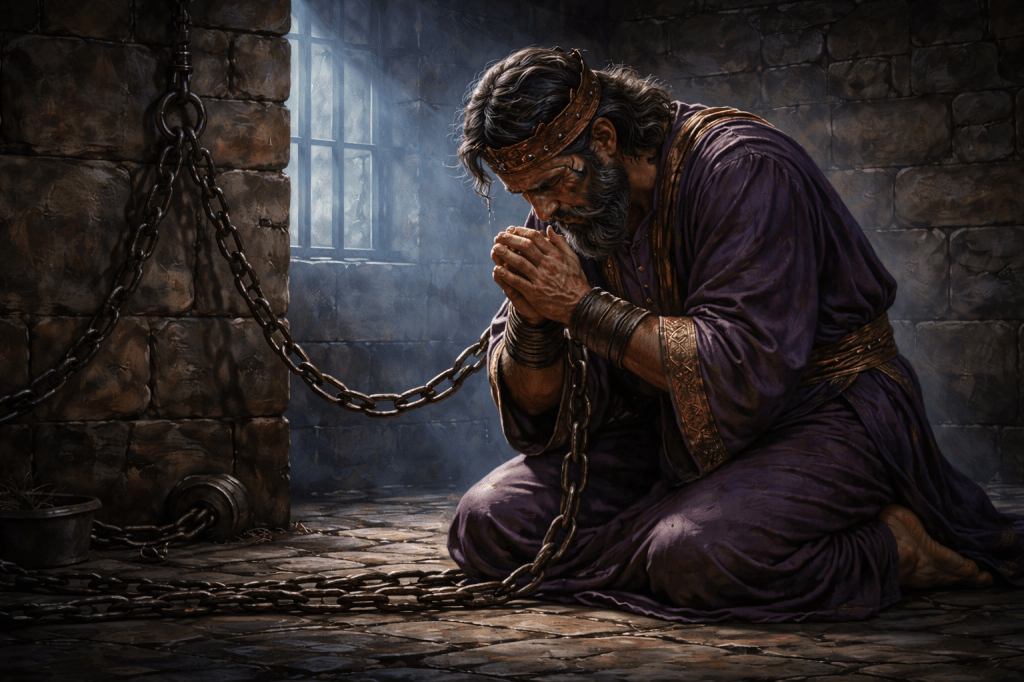
Manasseh’s story should have ended in judgment. Instead, it turns unexpectedly. The king is captured, bound with hooks, and dragged to Babylon. Power is stripped away. Pride collapses. And there—humiliated, helpless, and far from home—Manasseh prays.
The text emphasizes his posture: he humbled himself greatly. No bargaining. No self-defense. Just repentance. And astonishingly, God hears him. The LORD restores him to Jerusalem and to his kingdom.
Grace does not erase Manasseh’s past, promised punishment would fall upon the land due to his actions. But grace does reshape his future. He removes foreign gods. He repairs the altar of the LORD. He urges Judah to serve God again. The damage he caused does not disappear—but his repentance still matters.
Manasseh’s life stands as one of Scripture’s clearest testimonies that no one is beyond repentance, and no sin is beyond God’s mercy. If grace can reach him, it can reach anyone.
- Reflection: Are you willing to humble yourself fully before God—without defending, minimizing, or delaying?
- Closing Prayer: Lord, You see how far hearts can fall, and You also show how far mercy can reach. Guard us from drifting into pride, and give us courage to repent when we do. Teach us to believe that no past is too dark and no failure too great for Your grace to redeem. Turn our hearts fully back to You. Amen.

Leave a comment