
- Read 2 Kings 25:1-12; 27-30
MORNING— When the Walls Finally Fall
- Focal Passage 2 Kings 25:8-10
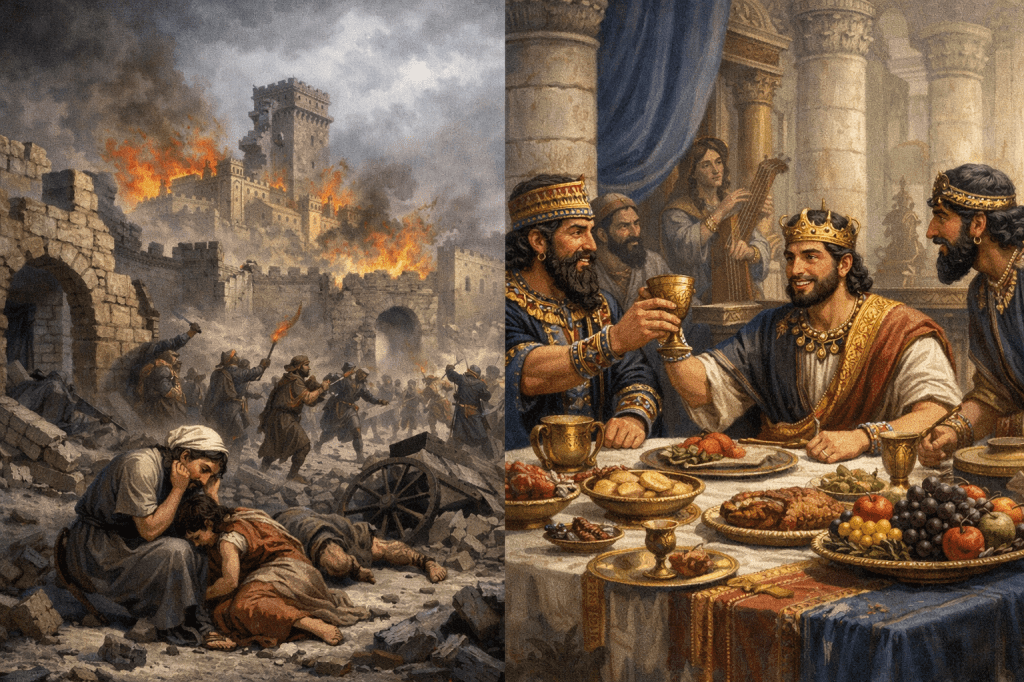
“Now on the seventh day of the fifth month… Nebuzaradan the captain of the guard… came to Jerusalem. He burned the house of the LORD, the king’s house, and all the houses of Jerusalem… So all the army of the Chaldeans… broke down the walls around Jerusalem.”
In February 2023, the ancient city of Antakya, Turkey—a city with Christian roots going back to the first century—collapsed under a massive earthquake. Entire neighborhoods and historic churches that had stood for generations were reduced to rubble. Reporters described the scene with the same stunned refrain: what we assumed would always stand… no longer does.
Jerusalem experienced that same kind of shock. Though it shouldn’t have come as surprise.
After years of warning, delay, reform, relapse, and refusal, the Babylonian siege succeeds. The temple burns. The palace collapses. The walls fall. But this is not sudden judgment; it is accumulated consequence finally arriving.
The city that believed itself secure learns otherwise.
Even in this God proves faithful to His word, even when that word is hard. The same God who promised blessing for obedience also warned of exile for rebellion. His faithfulness cuts both ways.
Jesus later wept over Jerusalem, saying, “If you had known… the things which make for peace” (Luke 19:42). The fall of Jerusalem in Kings stands as an early echo of that grief: truth ignored always costs more in the end.
- Reflection: What warnings have you grown used to hearing without taking seriously? Is there some step of obedience you need to take today? Would today be a good day to pray for our own country to hear God?
EVENING— Hope Amidst the Ashes
- Focal Passage: 2 Kings 25:27-28
“Now it came about in the thirty-seventh year of the exile of Jehoiachin king of Judah… he released Jehoiachin king of Judah from prison; and he spoke kindly to him…”
Kings could have ended with smoke and silence. Instead, it ends with a small, almost overlooked mercy.
Jehoiachin—David’s descendant, long imprisoned and largely forgotten—is released. He is given a seat of honor at the king’s table. His chains are removed. His life, though still shaped by exile, is no longer defined by captivity alone.
Old Testament scholar Iain Provan observes that “Kings closes not with resolution, but with expectation. The story is unfinished because God is not finished.” That is exactly what this final scene offers—not restoration yet, but hope that has survived judgment.
Jerusalem remains in ruins. The people remain displaced. But the royal line is preserved. The promise to David has not been erased. Hope survives even in exile.
Matthew’s Gospel will later trace that same line—from a displaced king, Jehoiachin to Joseph, the carpenter and legal heir in David’s line, and through Mary to Jesus, the Savior of the world (Matt. 1:11–16).
Judgment was real, but it was not the end. It prepared the ground for longing, repentance, and ultimately redemption.
- Reflection: Where do you see God preserving hope—even faintly—when circumstances look final?
- Closing Prayer: Faithful God, You keep Your word in judgment and in mercy. When we see the cost of rebellion, teach us humility. When we glimpse hope in the ruins, give us courage to trust You again. Thank You that You are never finished with Your people, and that even in exile, You are still at work. Through Jesus, our true King and lasting hope. Amen.

Leave a comment