
- Read Nehemiah 4 & 5
MORNING— Opposition from the Outside
- Focal Passage Nehemiah 4:14-15
“Do not be afraid of them; remember the Lord who is great and awesome, and fight for your brothers, your sons, your daughters, your wives and your houses… Then all of us returned to the wall, each one to his work.’”
Advancement rarely goes unnoticed—and it is rarely welcomed by everyone. Opposition comes from the outside first. Mockery. Threats. Intimidation. Sanballat and Tobiah apply pressure both verbally and militarily, hoping fear will do what force cannot.
Nehemiah responds with clarity and courage. He reminds the people who they are fighting for and who is fighting for them. The result is remarkable: “Then they all returned to the wall.” The wall was not yet thick, but their resolve was.
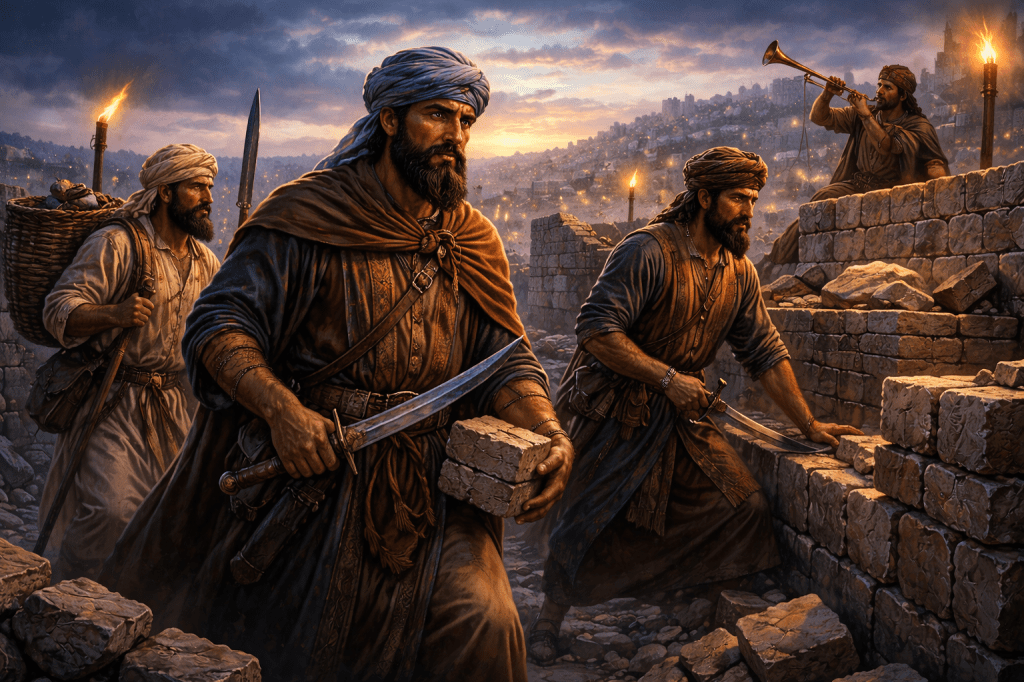
Precautions followed. Builders worked with a trowel in one hand and a sword in the other. Guards stood watch. Trumpets were ready. Caution became part of daily life—not paranoia, but wisdom. As the Jewish historian Josephus later observed, Nehemiah himself never tired—working by day, watching by night, eating and sleeping only as necessary. (Anyone who has ever lived on caffeine and good intentions for a stretch knows that kind of exhaustion.)
From the first rallying cry—“Come, let us rebuild”—to this declaration—“Our God will fight for us”—Nehemiah had become the visible embodiment of the work. The enemy outside had failed.
But that is not the end of the story.
- Reflection: When resistance comes, do you return to the work with faith—or retreat into fear?
EVENING— Implosion from the Center
- Focal Passage: Nehemiah 5:6-7a
“Then I was very angry when I had heard their outcry and these words. I consulted with myself and contended with the nobles and the rulers…”
Just when momentum is building, Nehemiah does something shocking.
He stops the work.
Chapter 5 opens with a “great outcry”—not from enemies, but from their own people. Economic pressure has turned brother against brother. Homes are mortgaged. Children are sold into slavery. Legal rights are being used without moral restraint.
The enemy is no longer outside the wall.
The enemy is within.
Gordon MacDonald writes, “Most spiritual breakdowns are not explosions from the outside but implosions from within.” Nehemiah recognizes the danger immediately. He listens carefully. He allows the injustice to affect him—Scripture says he “sizzled inside.” Then he pauses. He thinks. And he acts.
He confronts the leaders directly. He appeals not to legality, but to brotherhood. Not to efficiency, but to the fear of God. He invites them to join the solution—and then demands restitution.
Most leaders fear stopping the work. What if momentum is lost? What if donors get upset? What if progress stalls?
Great leaders know character is as important as accomplishment. Nehemiah could have thought: “Let’s just get this thing up and then we can deal with this issue.” That would have created a functional wall but kept a dysfunctional people.
So, the work halts until repentance takes root.
Amazingly, the people respond. Property is restored. Promises are sworn. Worship erupts. Justice is reestablished. Only then does the rebuilding resume.
Later, Nehemiah himself models the lesson. Though entitled to privileges as governor, he refuses them. He sacrifices what is lawful for the sake of what is right. His motivation is simple and stated plainly: “Because of the fear of God.”
God allowed famine and pressure because He knew something vital—a wall can be rebuilt faster than a people can be healed.
- Reflection: Is there any area where progress is being protected at the expense of character—or where God may be calling you to stop and address what is happening within?
- Closing Prayer: God of justice and mercy, guard us from fighting only the enemies we can see. Search our hearts, correct our motives, and give us the courage to pause when repentance is needed. Shape us into people whose character can support the work You entrust to us. For Your glory and the good of others. Amen.

Leave a comment