
- Read Nehemiah 9; 12:27-47
MORNING – A Time to Mourn
- Focal Passage Nehemiah 9:1-3
“Now on the twenty-fourth day of this month the sons of Israel assembled with fasting, in sackcloth and with dirt upon them… They read from the book of the law of the LORD their God for a fourth of the day; and for another fourth they confessed and worshiped the LORD their God”
Fyodor Dostoyevsky once described the moment his prison chains were struck from his ankles. The fetters clattered to the floor, still warm from his body. He picked them up, hardly believing they had bound him moments before. “Yes, God be with us,” he wrote. “There would be freedom, a new life, resurrection.”
Israel knows that feeling.
By Nehemiah 9, the walls are standing, but the people are still sorting through the weight of exile—years of loss, failure, and stubborn rebellion. So they gather, not to celebrate yet, but to remember. They fast. They wear sackcloth. They put dirt on themselves. This is not performative humility. It is honest grief.
For six hours, they do two things:
They listen to God’s Word.
They respond to God in prayer.
The prayer itself walks carefully through history—creation, covenant, Egypt, wilderness, kings, rebellion, exile. Over and over, the pattern repeats: God is faithful; the people are not. And yet, again and again, God pursues them.
They confess more than isolated sins. They confess forgetting. They confess stubbornness. They admit that exile did not come from bad luck, but from real disobedience. Still, the dominant note of the prayer is not despair—it is hope.
“But You are a God of forgiveness, gracious and compassionate, slow to anger and abounding in lovingkindness; and You did not forsake them.”
Chains fall off when truth is told.
Freedom begins when memory is honest.
- Reflection: What parts of your story need to be remembered truthfully—not to shame you, but to remind you how faithful God has been?
EVENING – A Time to Dance
- Focal Passage: Nehemiah 12:43
“And on that day they offered great sacrifices and rejoiced because God had given them great joy… so that the joy of Jerusalem was heard from afar.”
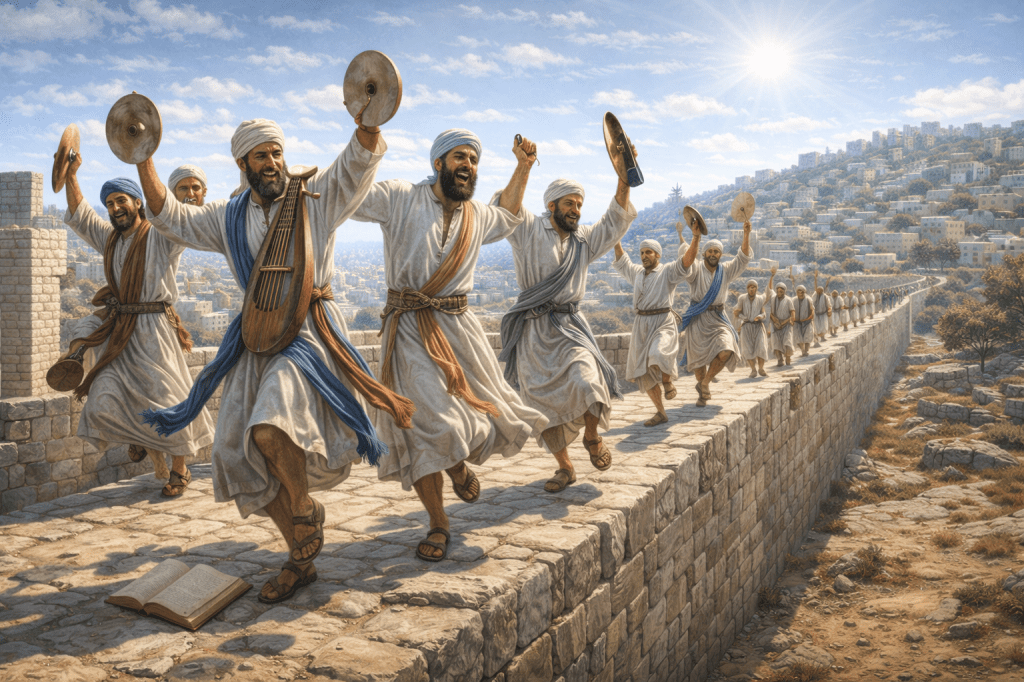
The dedication of the wall is anything but restrained. Singers are gathered from the surrounding towns. Instruments ring out. Two choirs climb the wall and move in opposite directions—Ezra leading one, Nehemiah the other—until praise circles the city like a living crown.
This is not private devotion; it is public thanksgiving. The wall that once symbolized fear now carries song. The city that once echoed with taunts now resounds with joy. And the text goes out of its way to tell us that everyone joins in—men and women, adults and children. Joy is shared, not reserved.
The priests purify the people, the gates, and even the stones. Not because joy is fragile, but because it is holy. What God restores is not treated casually. Celebration itself becomes an act of reverence.
The joy is so full that it travels beyond Jerusalem. It spills over into generosity, into provision for worship, into daily rhythms of praise. This is not a momentary high; it is a city learning how to live again.
There are seasons when prayer sounds like weeping. And there are seasons when prayer sounds like singing. Nehemiah 12 reminds us that both belong. God not only hears cries for mercy—He delights in songs of gratitude.
Walls were rebuilt. Chains were gone. And joy—real, audible joy—rose where ruin once stood.
- Reflection: Where has God brought restoration that deserves not just gratitude, but joyful celebration?
- Closing Prayer: Lord God, You are the giver of great joy. What You restore, You fill with song; what You rebuild, You crown with praise. Teach us to celebrate Your faithfulness with glad hearts and generous lives, and to let our joy rise not only in private gratitude but in public witness. May the joy You give be heard far beyond us, for Your glory. Amen.

Leave a comment