
- Read Job 1
MORNING— A Good Man, A Hard Test
- Focal Passage: Job 1:1
“There was a man in the land of Uz whose name was Job; and that man was blameless, upright, fearing God and turning away from evil.”
Years ago, I was standing in a checkout line at the grocery store. The man in front of me had only two items: a book titled Where Is God When It Hurts? and a six-pack of beer. The contrast caught my attention, so I commented on it.
He looked back and said, “I figured either one or the other would help.”
Then adding, almost as an afterthought, “I don’t know why my grandson doesn’t love me anymore.”
The pain on his face has stayed with me ever since.
We meet people with questions like that more often than we realize. Sometimes those questions are spoken aloud. Other times they are carried into the night, waking us when sleep should come. When suffering presses in, many turn to whatever might dull the ache. Others—sometimes even those with no faith background—reach for the book of Job.
Not because it explains everything, but because it takes pain seriously.
Job’s story opens without a date or a familiar location. Uz is not Israel. Job is not introduced as a covenant figure. That lack of specificity is intentional. Suffering does not belong to one culture, one generation, or one kind of person.
Job himself is described as blameless. The Hebrew word tam does not mean sinless. It describes a life that is whole and sincere, without hidden compartments. Job feared God. He turned away from evil. His faith shaped how he lived, how he worked, and how he cared for his family.
For a season, life followed the pattern Proverbs often describes.
Job had children.
He possessed great wealth gained honestly.
He was respected among his peers.
He prayed consistently for his sons and daughters.
In a skeptical world, we expect a flaw. Someone so steady must be hiding something. Scripture removes that suspicion quickly.
God Himself draws attention to Job.
“Have you considered My servant Job?” (Job 1:8)
Job is neither warned nor corrected. He is commended. That is what makes what follows so unsettling. Satan challenges the sincerity of Job’s faith, arguing that devotion thrives because protection surrounds it. Remove the hedge, he claims, and faith will collapse.
The hedge was real.
And the hedge came down.
This does not happen because God stops caring. It happens because faith is about to be tested in a way prosperity never could. The opening of Job does not rush us toward answers. It slows us down long enough to ask what suffering reveals about the faith we carry into it.
- Reflection: When pain enters your life, where do you instinctively reach for help? And what questions surface that you may not yet have words for?
EVENING— Enduring Faith When it Hurts the Most
- Focal Passage: Job 1:20
Then Job arose and tore his robe and shaved his head, and he fell to the ground and worshiped.
The losses come without pause.
Four messengers arrive in succession. Each report compounds the last. Before grief can settle, it is overtaken by more devastation. By the end of the day, Job has lost his livelihood, his servants, and his children.
Scripture does not soften the moment.
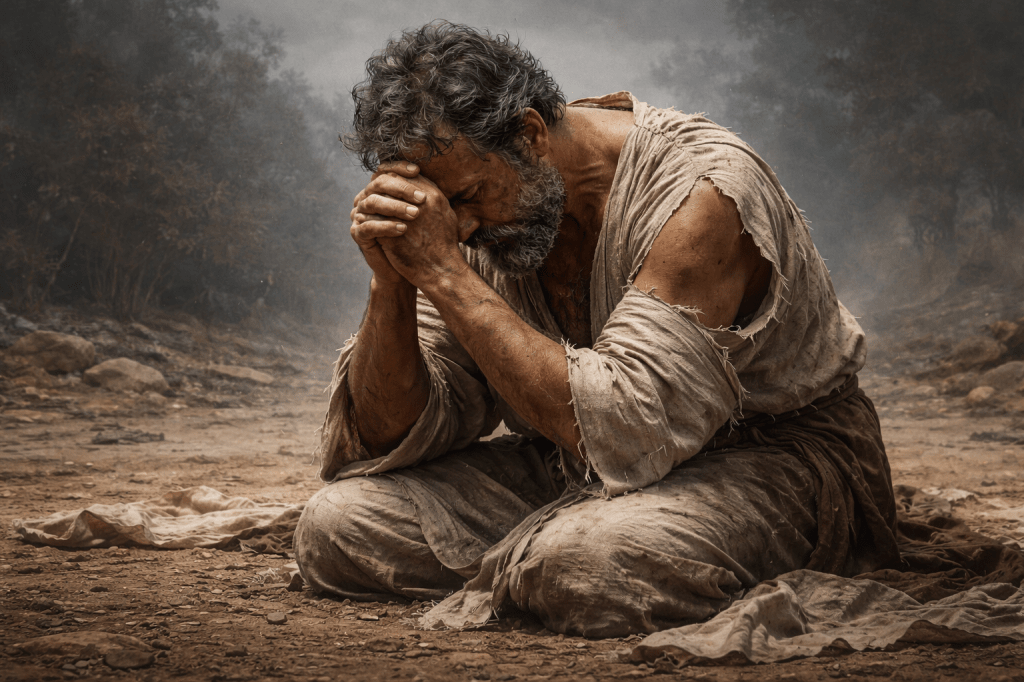
Job responds physically and visibly. His robe is torn. His head is shaved. His body reflects what has been taken from him. Then he falls to the ground and worships.
“Naked I came from my mother’s womb,
And naked I shall return there.
The LORD gave and the LORD has taken away.
Blessed be the name of the LORD.” (Job 1:21)
Job does not yet know what the reader knows. He is unaware of the heavenly exchange. He does not understand the scope of what has been permitted. Even so, Scripture offers a clear evaluation:
“Through all this Job did not sin nor did he blame God.” (Job 1:22)
That assessment matters.
Diane Komp, a pediatric oncologist, once asked a grieving father during a stalled bone marrow search, “What kind of terms are you and God on these days?”
He paused before answering, then said, “You really went to the heart of the matter.”
That question reaches the core of Job. Reading his story is to examine faith under pressure.
In the aftermath of tragedy people are not chiefly asking for airtight explanations or theological debates. They are asking where they can bring their grief without being corrected, rushed, or told to move on. Job provides that space. He grieves openly. He does not deny pain or minimize loss. At the same time, he, at least in chapter 1, refuses to place God in the dock as the accused.
Augustine once wrote that the same fire refines gold and consumes straw. The difference lies not in the trial itself, but in what the trial reveals.
Before the debates with friends begin.
Before the questions multiply.
Before God speaks from the whirlwind.
Job’s faith endures.
- Reflection: When suffering removes stability and explanation, where does your faith settle?
- Closing Prayer: Faithful God, You are present when life is full and when it is stripped bare. Teach us not to measure Your goodness by our circumstances or Your faithfulness by our comfort. When grief overwhelms us, draw us toward worship.
Amen.

Leave a comment