
- Read Job 14 & 19
MORNING— At the Scent of Water 🌳
- Focal Passage: Job 14: 7, 9
“For there is hope for a tree, when it is cut down, that it will sprout again… at the scent of water it will flourish.”
Suffering has a way of turning our thoughts toward mortality.
Job looks at the natural world and notices something unsettling. A tree can be cut down to a stump, its roots aged and buried in dry soil, and yet—given water—it lives again. In the ancient Near Eastern world, this was not sentimental poetry but observed reality. Trees 🌳 in arid regions could appear completely dead: cut down, roots dried, stump lifeless. And yet when moisture returned, even a trace of water in the soil could trigger new growth.
The tree 🌳 does not need a flood.
A suggestion of water is enough.
The Hebrew image emphasizes sensitivity and responsiveness—life awakening at the faintest hint of provision. At the scent of water, the tree stirs. Shoots push upward. What looked finished is not.
Job sets that image against human life.
As water slowly drains from the sea and a river thins until it runs dry, so human life ebbs. Strength fades. Breath lessens. Time slips away. And once a person lies down in death, they do not rise—at least not within the visible order of this world. From Job’s vantage point, trees appear more resilient than people.
That contrast sharpens his lament.
Trees 🌳 revive with minimal hope.
Humans seem far more fragile—dependent on a hope that lies beyond what can be seen.
And yet, even here, Job does not let go completely. He asks whether a man who dies will live again, and then answers himself—not with certainty, but with resolve: all the days of my struggle I will wait, until my change comes.
Job does not yet speak clearly of resurrection. But he waits. And waiting, in this chapter, is faith holding on by its fingertips. Life may feel reduced to a stump. Hope may be almost imperceptible. But Job believes—however faintly—that change will come.
“At the scent of water” becomes more than a botanical observation.
It is an image of life rising again when hope can barely be detected.
- Reflection: When hope feels almost imperceptible, what helps you recognize the “scent of water” God is providing?
EVENING— My Redeemer LIVES
- Focal Passage: Job 19:25
“As for me, I know that my Redeemer lives.”
Earlier, Bildad had reached for tree 🌳 imagery to explain Job’s suffering. He spoke of the wicked as trees whose roots dry up below and whose branches wither above—cut off, finished, forgotten (Job 18:16). It was meant as a warning.
By chapter 19, Job has absorbed that image—and turned it inward. He says his own hope has been uprooted like a tree 🌳, torn from the ground, exposed, dying (Job 19:10). What Bildad used as a warning, Job experiences as a reality.
But Job does not stop there.
Suddenly, the book pivots. Out of pain and isolation, Job speaks words he wants preserved forever: “Oh that my words were written… engraved in the rock” (Job 19:23–24). Look down at your Bible for a moment. His request was granted.
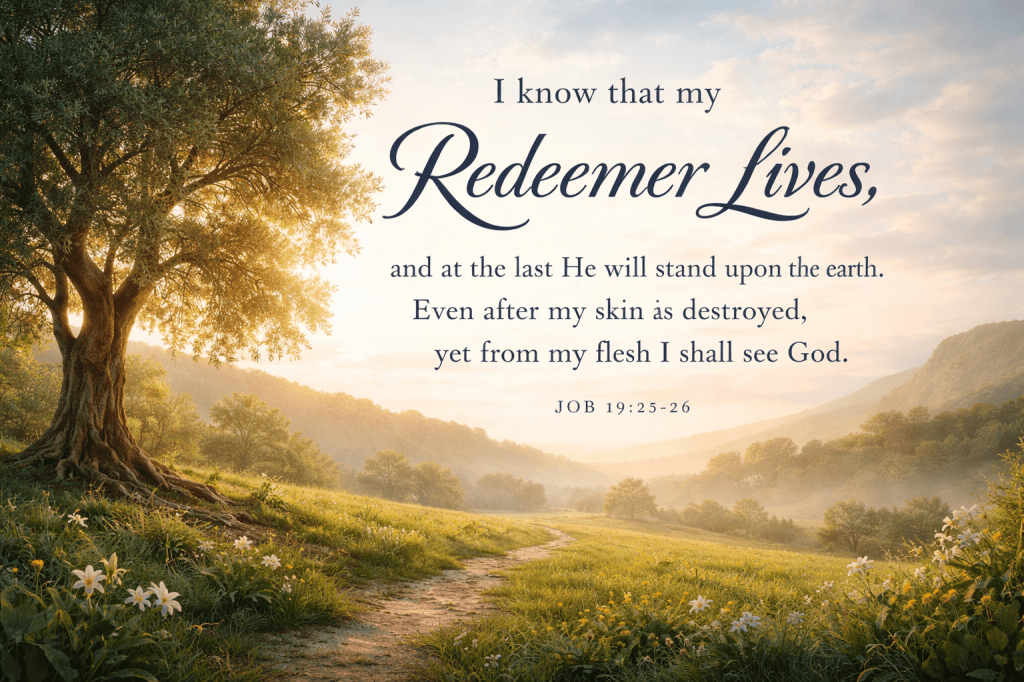
Then comes one of the most astonishing confessions in the Old Testament: “As for me, I know that my Redeemer lives, and at the last He will take His stand on the earth” (Job 19:25). The “I” is emphatic—I, even I, know. This is intimate, hard-won conviction.
The word Redeemer is goel—the nearest relative who stepped in to rescue, defend, or reclaim what was lost. Job has already given up on human advocates. His Redeemer must be someone greater—someone who can stand between him and God, someone who will still be standing at the last. This Redeemer cannot die.
Job presses even further. “Even after my skin is destroyed, yet from my flesh I shall see God” (Job 19:26–27). After death. From his own flesh. With his own eyes. This is resurrection language—spoken centuries before Easter morning. Job declares that his hope does not merely survive suffering—it survives death.
The thought overwhelms him. His heart faints within him.
What Job sees dimly, we see clearly. This Kinsman-Redeemer is Christ. Through Him, Peter writes, we are born again to a living hope through the resurrection of Jesus Christ from the dead (1 Peter 1:3).
The worst-case scenario in suffering is death itself. Job stares that reality down—and refuses to let it have the final word.
Hope will not end at the grave.
It passes through it.
The hope our Redeemer brings is living, certain, and stronger than death.
- Reflection: How does the promise of resurrection through Christ reshape the way you face even the worst possible outcome?
- Closing Prayer: Redeeming God, when our lives feel reduced to stumps and our hope feels faint, train us to wait for the scent of water. Root us deep in Christ, our living Redeemer. Amen.

Leave a comment