• Read Deuteronomy 8

    MORNING— Love That Remembers

    • Focal Passage: Deuteronomy 8:2-3

    “You shall remember all the way which the LORD your God has led you in the wilderness these forty years, that He might humble you, testing you, to know what was in your heart, whether you would keep His commandments or not.  He humbled you and let you be hungry, and fed you with manna which you did not know, nor did your fathers know, that He might make you understand that man does not live by bread alone, but man lives by everything that proceeds out of the mouth of the LORD.”

    February 14 carries a long and layered history. Long before it became associated with cards, candy, and romance, it was connected to the memory of a Christian priest named Valentinus in third-century Rome. Under Emperor Claudius II, marriages were restricted out of the belief that unmarried men made better soldiers. Valentinus defied the decree, performing Christian marriages in secret. When discovered, he was imprisoned and eventually executed around A.D. 269.

    What made his witness memorable was not romance, but faithful love under pressure—love that clung to what mattered when forgetting would have cost less. Centuries later, his story became associated with remembrance: honoring love that endured rather than love that merely felt good in the moment.

    That idea sits at the heart of Deuteronomy 8.

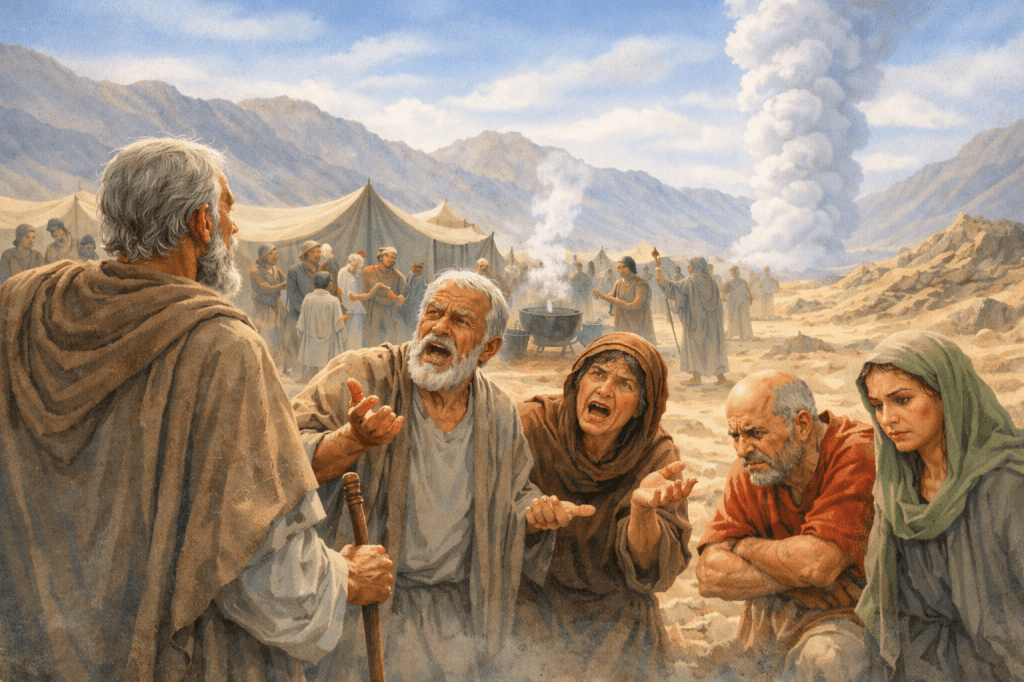
    Moses speaks to a people standing on the edge of abundance. The wilderness is behind them. Ahead lie houses they did not build and food they did not grow. And so Moses calls them backward before they move forward:

    “You shall remember all the way which the LORD your God has led you in the wilderness these forty years

    God had sustained them daily—manna, water, guidance, and protection. Hunger taught them dependence. Manna taught them trust. The danger Moses sees ahead is not hardship, but comfort. When fullness arrives, gratitude can fade into assumption.

    Centuries later, the Lord spoke tenderly through the prophet Hosea to that same forgetful people:

    “Yet it is I who taught Ephraim to walk,
    I took them in My arms;
    But they did not know that I healed them.
    I led them with cords of a man, with bonds of love.”
    Hosea 11:3–4 (NASB 1995)

    The wilderness was never evidence of God’s absence. It was proof of His care. Hunger did not cancel His love; it revealed it. To remember how God sustained them was to remember they were never abandoned—even when they failed to recognize His hand.

    Love forgotten becomes entitlement.
    Love remembered becomes trust.

    • Reflection:  What season of God’s past faithfulness do you need to intentionally remember today?

    EVENING— Life is More Than Bread

    • Focal Passage: Deuteronomy 8:11-14

    “Beware that you do not forget the LORD your God by not keeping His commandments…
    otherwise, when you have eaten and are satisfied… then your heart will become proud and you will forget the LORD your God.”

    Valentine’s Day did not begin as a celebration of ease or indulgence. It began with remembrance—honoring faithful love that endured cost. That same danger Moses warns against in Deuteronomy 8 is still with us today. Forgetting God rarely begins with rejection. It begins with satisfaction.

    Israel’s hearts were most at risk not when they were hungry, but when they were full. Pride grows quietly when gratitude fades. Love erodes not through rebellion, but neglect.

    Jesus later returned to this very warning when He faced temptation in the wilderness. Hungry, alone, and pressed to turn stones into bread, He answered by quoting Deuteronomy 8:3 itself:

    “Man shall not live on bread alone, but on every word that proceeds out of the mouth of God.”
    Matthew 4:4 (NASB 1995)

    Jesus did not quote Moses by accident. He was deliberately placing Himself within Israel’s story—where they failed, He would remain faithful. In the wilderness, Israel forgot that life was sustained by God’s word, not merely by His provision. Jesus, standing in that same wilderness, refused to repeat their mistake. He chose trust over appetite, obedience over immediacy, remembrance over relief.

    Moses warned that fullness could make God forgettable. Jesus showed that faithfulness begins long before abundance arrives.

    Faithful love—whether toward God or toward others—does not survive on memory alone. It must be guarded, remembered, and practiced.

    • Reflection:  Where might comfort or routine be quietly dulling your gratitude toward the Lord?
    • Closing Prayer:  Loving Father, You have carried us through seasons we could not sustain on our own.  Keep our hearts attentive, our gratitude alive, and our trust anchored in You—that we may walk forward without forgetting who has held us all along.
      Amen.
    • Read Deuteronomy 6

    MORNING— Allegiance Before Everything

    • Focal Passage: Deuteronomy 6:4-5

    “Hear, O Israel! The LORD is our God, the LORD is one!  You shall love the LORD your God with all your heart and with all your soul and with all your might.”

    In 1983, the United States House of Representatives ended a long-standing tradition. For fifty years, George Washington’s Farewell Address had been read aloud on his birthday. The reason it was dropped was not controversy or disagreement—but neglect. By the end, it was being read to an almost empty chamber.

    Washington’s final words warned of dangers he believed could undo the nation: division, loss of moral restraint, and forgetting the principles that had held the young country together. His concern was simple—what would happen if future generations stopped listening?

    Scripture opens Deuteronomy with a similar moment.

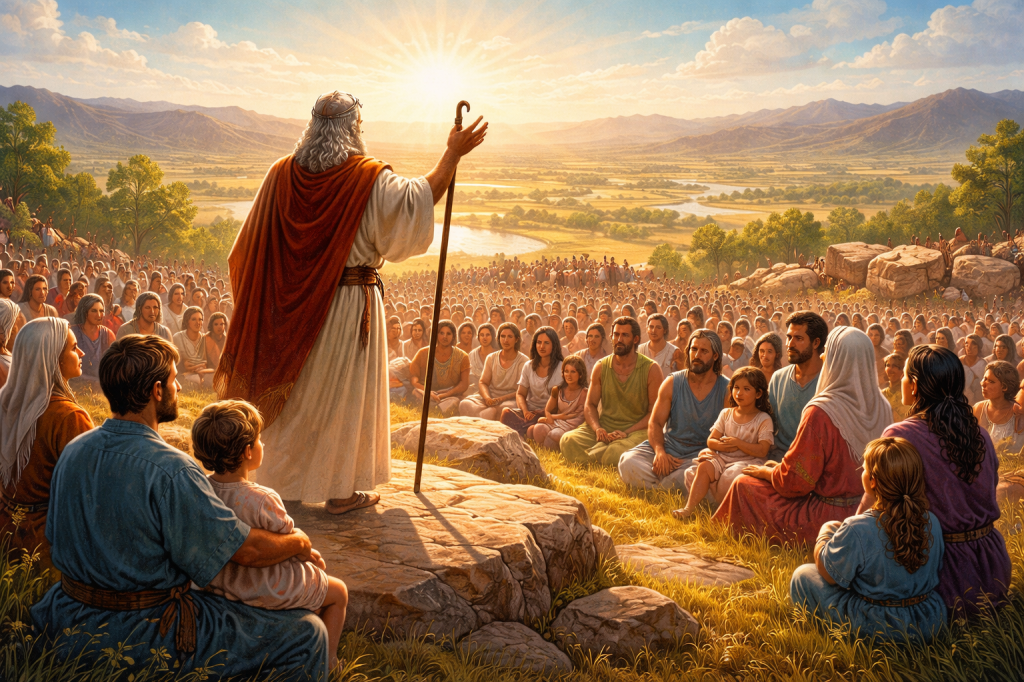
    The wilderness years are ending. Moses, near the end of his life, gathers a new generation—children of those who left Egypt but never entered the land. Deuteronomy is not new law; it is remembered law. It is Moses’ farewell address, spoken with urgency, because he knows what is at stake.

    Israel is about to move from tents to houses, from manna to abundance, from survival to settlement. And Moses understands something crucial: prosperity often erodes memory.

    So he begins not with strategy, but with allegiance.

    “Hear, O Israel!”
    Not merely listen—but give full attention.
    The LORD alone is God. No rivals. No substitutes. No divided loyalty.

    This confession shapes everything else. Love for God is not an accessory to life; it is the center. Heart, soul, and strength are to be aligned toward Him. Moses knows that unless this truth grips the present generation, it will never reach the next one.

    Faith does not survive on nostalgia. It survives when it is owned.

    • Reflection:  What claims your deepest loyalty right now—and how does that shape the way you live?

    EVENING— Faith Lived Out in the Ordinary

    • Focal Passage: Deuteronomy 6:7

    “You shall teach them diligently to your sons and shall talk of them when you sit in your house and when you walk by the way and when you lie down and when you rise up.”

    Having established who God is and where love must be centered, Moses turns to how faith endures.

    It endures through repetition. Through conversation. Through presence.

    Faith is not sustained by grand moments alone, but by ordinary ones. Moses does not point Israel to formal settings or sacred events. Instead, he names the rhythms of everyday life—sitting at home, walking along the road, lying down at night, rising in the morning. These are the places where belief either takes root or fades away.

    Some later generations took these instructions with strict literalness:

    “You shall bind them as a sign on your hand and they shall be as frontals on your forehead.
    You shall write them on the doorposts of your house and on your gates.”
    Deuteronomy 6:8–9 (NASB 1995)

    They literally wore the Scriptures. They literally posted them on their doorposts. These practices, at first sincere, were misguided. God was never interested in decoration for its own sake. He was not asking Israel merely to display His Word, but to inhabit it. The danger was subtle: visible reminders could replace lived obedience. Faith could be worn or posted—yet no longer spoken, wrestled with, or practiced.

    Moses’ vision was not of homes filled with religious objects, but of lives shaped by faithful conversation—where God’s truth naturally surfaced in decisions, reactions, and shared stories. Faith was meant to be heard at the table, along the road, and at day’s end, not confined to special occasions.

    What is repeated becomes normal. What is normal becomes formative. And what forms us shapes those who walk alongside us.

    • Reflection:  In the ordinary rhythms of your day, where does faith naturally surface—and where might it need to be spoken again?
    • Closing Prayer:  Faithful God, fix our hearts firmly on You alone. Teach us to love You not only in words, but in the patterns of daily life. Let Your truth shape our conversations, our choices, and our shared moments, so that those around us learn to walk with You.
      Amen.
    • Read Numbers 21

    MORNING— When Bitterness Bites

    • Focal Passage: Numbers 21:4-5

    “Then they set out from Mount Hor by the way of the Red Sea, to go around the land of Edom; and the people became impatient because of the journey. The people spoke against God and Moses…”

    Scripture literally says “the soul of the people was short.”
    They were worn down—not by a single crisis, but by the journey itself.

    Nothing new had failed. God was still providing. Manna still appeared each morning. The cloud still guided them. Yet impatience narrowed their vision, and weariness turned into resentment. What began as frustration with the road quietly became accusation against the Lord.

    This is often how rebellion takes shape. We think we are protesting circumstances, but Scripture sees more clearly: complaint aimed at life eventually strikes at God Himself.

    The Lord responds decisively. Fiery serpents enter the camp, and suddenly the danger the people feared becomes real. Judgment exposes what complaint had minimized. The wilderness they accused God of using to kill them now becomes the place where death actually spreads.

    But something finally changes. The people come to Moses and say, “We have sinned.”
    There is no explanation, no justification—only confession. That simple admission becomes the turning point. Healing begins not when the danger disappears, but when pride does.

    God does not remove the serpents. Instead, He provides a way to live in the presence of judgment.

    • Reflection:  Where has weariness turned your trust into complaint?  Could repentance be in order?

    EVENING— Look and Live

    • Focal Passage: Numbers 21:8-9

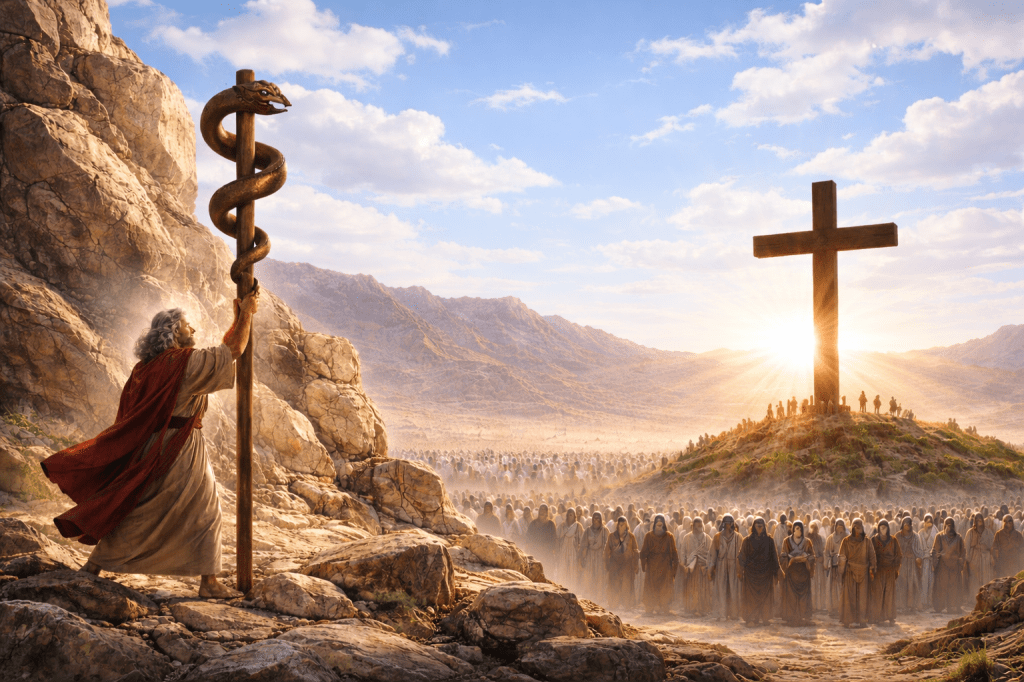
    “Then the Lord said to Moses, ‘Make a fiery serpent, and set it on a standard; and it shall come about, that everyone who is bitten, when he looks at it, he will live.’  …and it came about, that if a serpent bit any man, when he looked to the bronze serpent, he lived.”

    God’s remedy is as surprising as it is simple.

    The serpents remain. The camp does not move. No antidote is prepared, no strategy explained. Instead, God commands Moses to raise a single object in the center of the camp and attaches a promise to it: life will come through looking.

    Healing does not flow from effort, resistance, or clever solutions. It comes through trust. Those who are bitten are not asked to prove themselves worthy or strong. They are asked to lift their eyes toward what God has provided.

    The bronze serpent has no power in itself. It does not draw out venom or close wounds. Its significance rests entirely on this truth: God binds His promise to it. Life comes not from the object, but from faith in the God who appointed it.

    When Jesus later speaks with Nicodemus, He reaches back to this moment. He explains that the wilderness scene was never only about snakes. Just as the serpent was lifted up so that the dying might live, so the Son of Man would be lifted up for the life of the world.

    The point is sobering. Humanity is not spiritually neutral, waiting to be persuaded. We are already wounded by sin, already facing death apart from God’s intervention. Jesus does not come to increase judgment, but to rescue those already under it.

    The pattern remains the same.

    To refuse to look was to choose death. To look was to live.

    That is what made the command so difficult. Looking required admission—I cannot fix this. Many would have preferred action: fighting the serpents, treating the wounds, doing something that felt productive or strong. But God’s remedy dismantled every illusion of self-salvation.

    The cross does the same.

    Looking to Christ feels too simple. Surely there must be more—something to earn, something to manage, something to prove. But the gospel insists otherwise. Life is not achieved. It is received.

    The Israelites lifted their eyes.
    We are asked to do the same.

    • Reflection:  Where are you still trying to heal yourself instead of turning toward what God has given in Christ?
    • Closing Prayer:  Gracious God, turn our attention toward what You have already provided in the Cross of Christ.  When we are wounded and weary, quiet our striving and teach us to rest in You.  Let the life You offer steady our hearts and shape our steps.
      Amen.


    • Read Numbers 20

    MORNING— When Anger Goes Untended

    • Focal Passage: Numbers 20:10-11

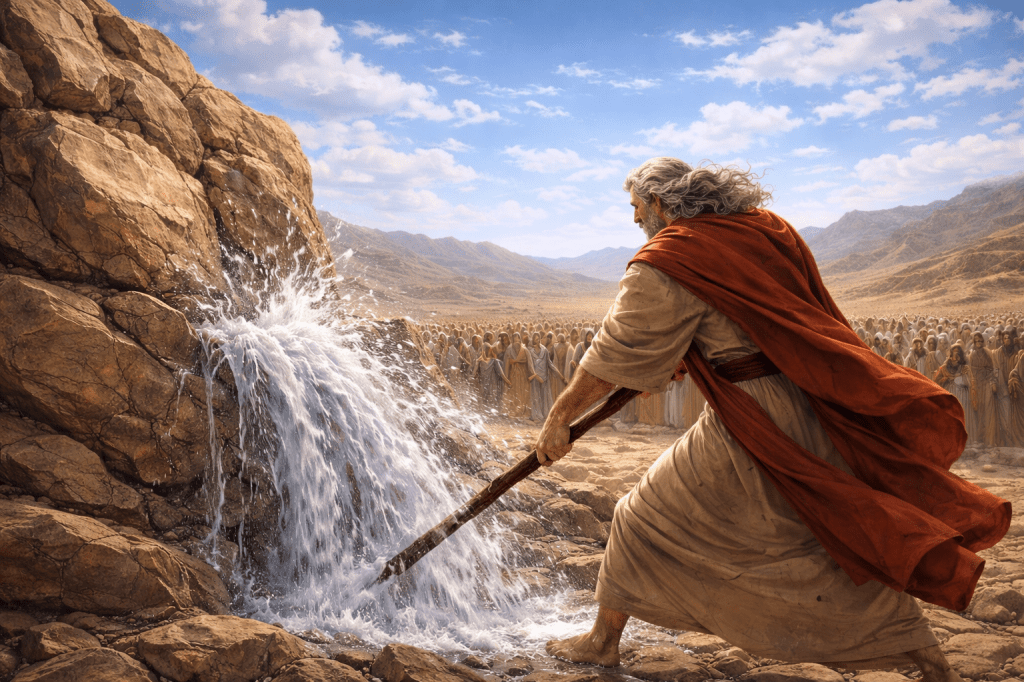
    “And he said to them, ‘Listen now, you rebels; shall we bring forth water for you out of this rock?’  Then Moses lifted up his hand and struck the rock twice with his rod…”

    Moses does not lose his temper out of nowhere.

    The moment at Meribah is the breaking point of a long, familiar struggle. Anger has surfaced in Moses’ life before—early in Egypt, later before Pharaoh, again at Sinai when he shattered the tablets of the covenant. Each time, it appeared justified. Each time, it went largely unaddressed.

    Now the pressures converge.

    Miriam has died.
    The people are no longer murmuring; they are contending—openly confronting Moses and Aaron.
    Decades of leadership strain press in all at once.

    Moses begins well. He falls on his face before the Lord and receives clear instructions. But when he stands before the people, restraint gives way to rage. He lashes out with his words. Then he strikes the rock—twice.

    What makes this moment so sobering is that it works.

    Water flows. The people drink. From the outside, the crisis appears solved. But Scripture makes clear that effectiveness is not the same as faithfulness. God names the issue plainly: Moses did not believe Him or treat Him as holy.

    James would later write, “The anger of man does not achieve the righteousness of God” (James 1:20). Moses’ story proves that truth. Anger can produce results, but it erodes trust, credibility, and character.

    A personality flaw left unchecked will not remain contained. Under pressure, it will surface—and the cost is often greater than we imagined.

    • Reflection:  Is there a pattern in your life you’ve excused for years that pressure is now exposing?

    EVENING— Striking the Rock

    • Focal Passage: Numbers 20:12

    “But the Lord said to Moses and Aaron, ‘Because you have not believed Me, to treat Me as holy in the sight of the sons of Israel…’”

    God identifies Moses’ failure with precision: “You did not believe Me.”

    This was not merely about anger. It was about trust. God had asked Moses to act differently—to speak rather than strike—in order to reveal His holiness to a new generation. Moses reverted to what had worked before. Familiar methods replaced present obedience.

    The apostle Paul later sheds light on this moment when he writes, “They drank from the spiritual rock which followed them; and the rock was Christ” (1 Corinthians 10:4).

    That connection sharpens the warning.

    Paul reminds us that the rock in the wilderness pointed forward to Christ. Moses was not merely disobedient—he misrepresented what God was revealing. God intended the rock to give life by a word, not by a blow.

    Water still flowed, but the Moses failed to treat the Lord as holy before the people. God was seen as harsh rather than holy. Leadership matters because it shapes theology for those who are watching.

    Here is the sobering truth: God may still act graciously even when His servants act wrongly—but that does not mean He approves of the method. Grace flowing does not equal God’s endorsement.

    • Reflection:  Where might God be calling you to trust Him afresh rather than repeat what once worked?
    • Closing Prayer:  Father, search our hearts where anger hides beneath success.  Teach us to trust You in the moment, not the method, and to honor You rightly before those who are watching.
      Amen.
    • Read Numbers 17:1-11

    MORNING— Life Where God Chooses🌿

    • Focal Passage: Numbers 17:8

    “Now on the next day Moses entered the tent of the testimony, and behold, the staff of Aaron for the house of Levi had sprouted and put forth buds and produced blossoms, and it bore ripe almonds.”

    The rebellion of Numbers 16 left Israel divided and dangerous. Every tribe had a voice. Every leader had a claim. Words multiplied. Accusations flew. Authority was contested.

    So God ended the argument—not with a speech, but with life.

    Each tribe placed a dead staff before the Lord. Overnight, nothing changed for eleven of them.

    By morning, one staff is different.

    Aaron’s rod—once nothing more than dead wood🪵—has come to life. It has not merely sprouted. It has budded, blossomed, and borne fruit. Almonds. Fully formed.

    This miracle echoes a later word the Lord spoke to Jeremiah:

    “The word of the Lord came to me saying, ‘What do you see, Jeremiah?’ And I said, ‘I see a rod of an almond tree.’ Then the Lord said to me, ‘You have seen well, for I am watching over My word to perform it.’”
    Jeremiah 1:11–12 (NASB 1995)

    The almond tree 🌳was the first to bloom in Israel each year—a sign that life was returning after winter. By choosing almonds, God is saying more than “This is my man.” He is saying, “I am awake. I am watching. I am acting.”

    God did not ask Israel to evaluate Aaron’s leadership. He did not call for speeches, votes, or debate. He caused life to appear where there had been none.

    As Blaise Pascal observed, “It is not in man to give life to himself.”
    And it is certainly not in man to give life to his authority. Only God can do that.

    Aaron did not argue for his role. He did not campaign for leadership. God brought life to what—and to whom—He had chosen.

    • Reflection:  Where might God be asking you to trust His choice rather than press your own claim?

    EVENING— A Clear Warning

    • Focal Passage: Numbers 17:10

    “But the Lord said to Moses, ‘Put back the staff of Aaron before the testimony to be kept as a sign against the rebels.”

    After the miracle, God gives a command: Put the staff back.

    That instruction is a warning.

    Aaron’s rod is not handed to him as a symbol to wield. It is not meant to be displayed or defended. God commands that it be placed before the testimony—kept in His presence—as a lasting reminder.

    The message is unmistakable. Authority does not belong to the one who holds the staff. Life belongs to the God who caused dead wood to bloom.

    By preserving the rod, God is saying, “This matter is settled.” The people are not to reopen the argument. When questions rise again, they are to remember where life appeared.

    Jesus later spoke this same truth, using different imagery but the same warning:

    “I am the vine, you are the branches; he who abides in Me and I in him, he bears much fruit, for apart from Me you can do nothing.”
    John 15:5 (NASB 1995)

    Life does not originate in the branch.
    Authority does not originate in the staff.
    Both depend entirely on nearness to the source.

    If the branch is separated, it withers.
    If the staff is removed from God’s presence, it is only wood again.

    As Dallas Willard wrote, “Fruit is not something we produce; it is what God produces in us as we live in His presence.”

    God’s work does not need to be forced.
    It does not need to be defended.
    If it is from Him, life will appear—clearly and unmistakably. 🪵

    • Reflection:  Where might God be calling you back to simple dependence—abiding where life truly comes from?
    • Closing Prayer:  Lord God, You are the One who brings life where there was none.  Teach us to trust Your choice and remain in Your presence,
      so that what grows in us is truly from You.
      Amen.
    • Read Numbers 14

    MORNING— Accepting the Majority Report

    • Focal Passage: Numbers 14:1-2

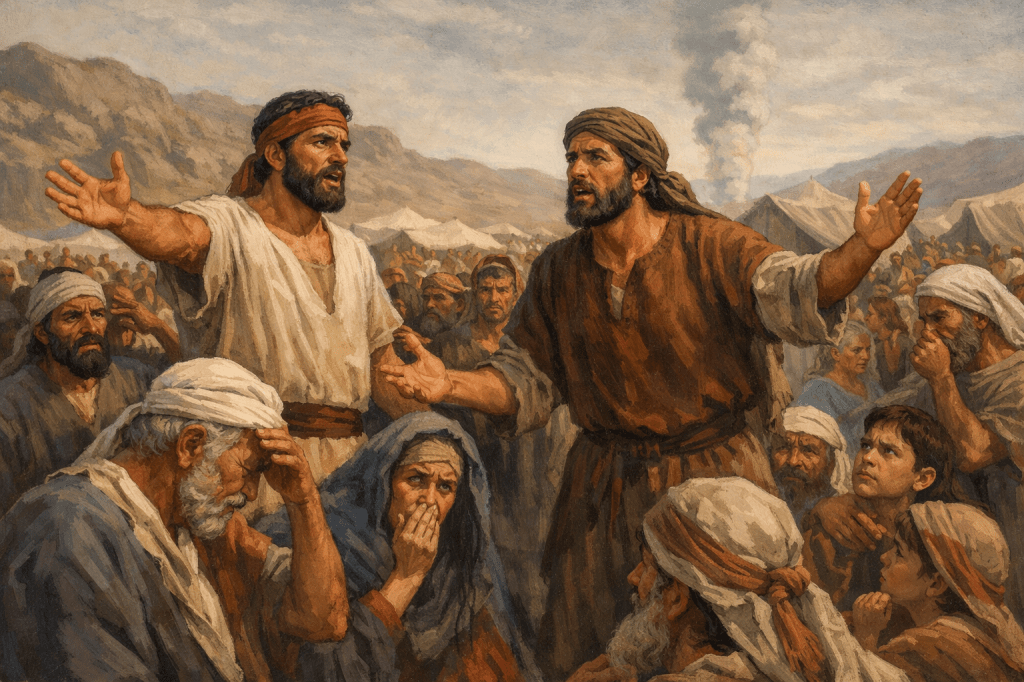
    “Then all the congregation lifted up their voices and cried, and the people wept that night. All the sons of Israel grumbled against Moses and Aaron…”

    Numbers 14 opens with a sound—the sound of a nation crying out in fear.

    By nightfall, the people are no longer uncertain. Fear has done its work. What began as concern has hardened into conviction. The majority has spoken, and its verdict feels settled: “We are going to die.”

    Fear thrives in groups. Once enough voices repeat the same conclusion, it begins to feel irresponsible to disagree. Doubt starts to masquerade as wisdom, and retreat begins to sound like logical.

    In March 2021, the massive container ship Ever Given became wedged sideways in the Suez Canal, halting nearly 12 percent of global trade. Early assessments were grim. Experts warned the ship could be stuck for weeks or even months. Analysts predicted severe economic consequences. The majority report was clear: this would be a long-term crisis.

    But while that consensus settled in, a small team of engineers and salvage crews kept working—dredging, redistributing weight, watching tides, refusing to give up. Against widespread expectations, the ship was freed in just six days.

    The early predictions sounded confident.
    They simply weren’t final.

    At Kadesh Barnea, Israel accepted the majority report too quickly. Fear spread through the camp, and by morning the people reached a devastating conclusion: God’s promise was no longer worth trusting.

    Once fear took hold, truth mattered less than consensus.

    • Reflection:  Where might you be treating fear as wisdom simply because “everyone agrees”?

    EVENING— Rejecting the Minority Report

    • Focal Passage: Numbers 14:6-9

    “Joshua the son of Nun and Caleb the son of Jephunneh… said, ‘Only do not rebel against the Lord… the Lord is with us; do not fear them.”

    While fear dominated the camp, two voices rose against it.

    Joshua and Caleb offered a minority report. They remembered what God had promised long before this moment: a land flowing with milk and honey. They had just seen that land with their own eyes and they refused to let fear decide the future.

    History shows how powerful a single courageous voice can be.

    During the 2011 NFL season, the New York Giants were written off early. They started 0–2, and criticism came quickly. Commentators questioned leadership, chemistry, and whether the team was even capable of contending.

    Not long after that rough start, the Giants heard from Lieutenant Colonel Greg Gadson, a U.S. Army veteran who had lost both legs in Iraq when his Humvee was struck by an explosive device. Gadson spoke to the team about perseverance, sacrifice, and refusing to quit when circumstances seem overwhelming.

    Players later said his message put everything into perspective. Complaints quieted. Focus returned. One man’s courage helped steady the room.

    Over time, the Giants rallied—winning difficult games, surviving the playoffs, and reaching the Super Bowl. Their opponent, the New England Patriots, entered the game undefeated and were widely expected by experts to win.

    But the Giants did not accept the majority report. They played with resolve, overcame the odds, and defeated the Patriots in Super Bowl XLVI.

    Israel was given the same opportunity.

    Joshua and Caleb urged the people forward. They reminded them that the Lord was with them. But Israel refused to listen—not just to the minority report, not merely to God’s servants here, but ultimately to the Lord Himself.

    Fear won the vote.

    • Reflection:  When faith speaks against fear, do you lean toward the crowd—or toward God?
    • Closing Prayer:  Lord, guard our hearts when fear grows loud.   Keep us from tuning out Your voice. We will not give into the crowd or the fear within us, but will listen to You alone.
      Amen.
    • Read Numbers 13

    MORNING— Hesitation at the Edge of Promise

    • Focal Passage: Numbers 13:2

    “Send out for yourself men so that they may spy out the land of Canaan, which I am going to give to the sons of Israel…”

    Kadesh Barnea marks a critical pause in Israel’s story—a moment when information and faith intersect.

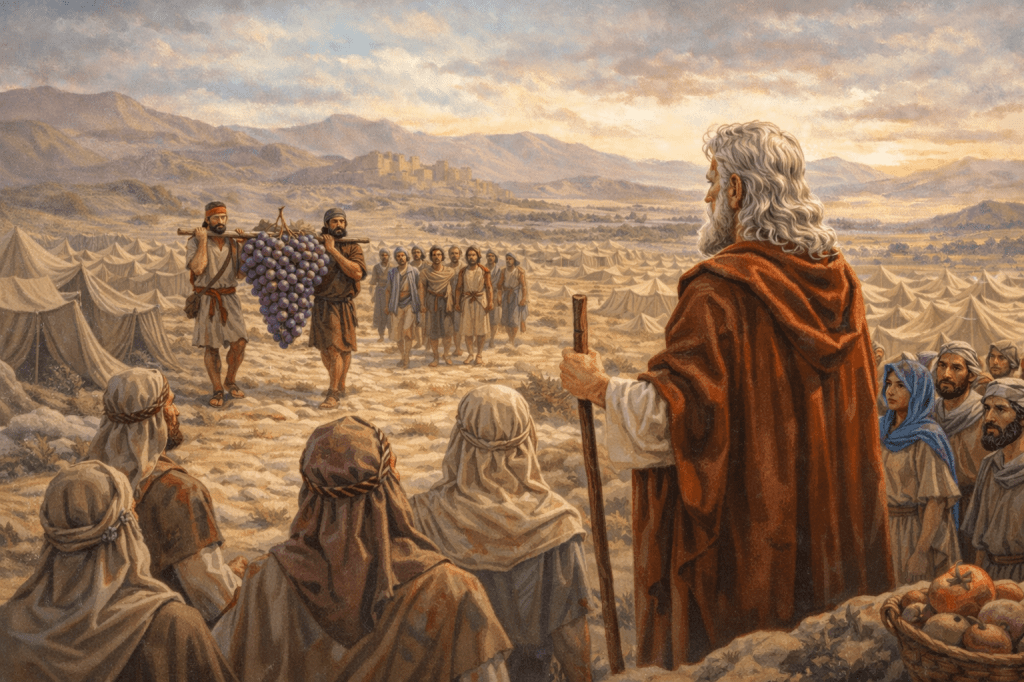
    Twelve leaders are sent to scout the land. These men were the cream of the crop of the fledgling nation.  They are not sent to decide whether God’s promise is trustworthy. That part has already been settled. Their task is simply to observe—to gather facts that would help the nation move forward wisely.

    For forty days they do exactly that. They see fertile land. They carry back fruit heavy with promise. Everything God said about the land proves true.

    The trouble begins when observation turns into evaluation.

    They were meant to report what they saw—not to determine whether obedience felt reasonable. Somewhere along the way, information stopped serving faith and started competing with it.  They hesitate. 

    That tension is not unique to Israel.

    In his book, Renovation of the Heart, Dallas Willard points out that we don’t believe something by merely saying “I believe it” or even by believing that you believe it.  Something becomes belief when you act as if that something were true.

    The land was exactly as God had promised—and the challenges were exactly as expected.
    The question was would they believe God when He said it would be theirs.

    Faith does not deny reality.
    It refuses to let reality overrule what God has already said.

    • Reflection:  Where in your life has observation been leading you to hesitation in your faith journey?

    EVENING— When Fear Rewrites the Story

    • Focal Passage: Numbers 13:32-33

    “So they gave out to the sons of Israel a bad report of the land… ‘We became like grasshoppers in our own sight…’”

    Something shifts near the end of the spies’ report.

    At first, they simply describe what they saw. But slowly, observation turns into interpretation. The land that flowed with promise is now portrayed as threatening. The people grow larger with every sentence. And most telling of all, the spies begin to describe themselves.

    “We became like grasshoppers in our own sight.”

    Fear doesn’t usually begin by challenging God’s promises. It begins by reshaping how we see ourselves. Once identity shrinks, courage soon follows.

    Nothing in the land had changed. The cities were no stronger than before. The people were no taller than when the spies first saw them. What changed was perception. Fear took hold of the narrative and rewrote the story before a single step forward was taken.

    That is the danger of fear left unchecked. It does not wait for evidence of defeat. It convinces us we are already beaten.

    During the darkest days of World War II, when defeat seemed inevitable, Winston Churchill stood before a nation tempted to despair and said:

    “Never give in—never give in—never, never, never, never, in nothing, great or small, large or petty, never give in except to convictions of honor and good sense. Never yield to force; never yield to the apparently overwhelming might of the enemy.”

    Israel stood at Kadesh Barnea before any battle was fought. Fear urged retreat before obedience had even begun.

    Kadesh Barnea reminds us that fear does not need proof to paralyze—it only needs permission.

    • Reflection:  Where are you tempted to give in—not because God has failed, but because fear feels overwhelming?
    • Closing Prayer:  Father, when fear speaks louder than faith, remind us of Your promises.  Guard our hearts from shrinking back when You call us forward.  Help us trust You fully and move ahead with courage.
      Amen.


    • Read Numbers 11

    MORNING— Complaint Department: Take a Number

    • Focal Passage: Numbers 11:1

    “Now the people became like those who complain of adversity in the hearing of the Lord…”

    Have you ever started a trip—for vacation or work—and realized almost immediately that something was off?

    Maybe the car wouldn’t start. Maybe traffic stalled before you reached the highway. Maybe the kids were already on edge, or the flight was delayed, or the connection was canceled. You were ready to pull your hair out—and you hadn’t even arrived yet.

    That’s Numbers 11.

    Israel has finally left Sinai. After nearly a year camped in one place, the cloud lifts and the people begin moving again. What should feel like progress quickly becomes pressure, and before long, frustration spills over into complaint.

    Moses is careful with his words. He says the people became “like those who complain of adversity.” It’s a warning label. He isn’t just describing behavior; he’s naming a pattern—what people can become when hardship is interpreted as abandonment.

    Their complaints aren’t trivial. They are tired. They are hungry. They miss what feels familiar. Like them, when life doesn’t unfold the way we expected, we’re tempted to assume something has gone wrong—either with our circumstances or with God.

    Chuck Swindoll tells a true story from his years as a pastor about a man who came to him discouraged only weeks after committing his life to Christ. The man said, “I thought following Jesus would make things better—but everything seems harder.” Family tension had increased. Work had become more complicated. The excitement he expected had been replaced with resistance. Swindoll listened and then asked him a simple question: “If you were remodeling a house, would the noise and mess mean something was wrong—or that something important was being rebuilt?”

    The man slowly realized the truth. The difficulty wasn’t a sign of failure. It was a sign of change. God hadn’t abandoned him; God had begun a deeper work.

    That’s what Israel misunderstood. They mistook the discomfort of transition for divine neglect. But what felt like disorder was actually formation. God was shaping a people who could trust Him beyond comfort, beyond familiarity, beyond the past they kept romanticizing.

    Early resistance does not mean the journey is wrong.
    Often, it means the work is real.

    • Reflection:  When life becomes harder instead of easier, do you assume something is wrong—or that God may be doing something deeper?

    EVENING— Don’t Run with the Rabble

    • Focal Passage: Numbers 11:4-6

    “The rabble who were among them had greedy desires… ‘But now our appetite is gone. There is nothing at all to look at except this manna.”

    The trouble in Numbers 11 begins with the rabble—a restless minority whose dissatisfaction spreads. They are not merely unhappy; they are vocal. And their voices begin to shape the mood of the entire camp.

    Before long, manna—the steady, daily provision of God—is no longer received as grace. It is dismissed with boredom and irritation. “Nothing at all… except this manna.” What once sustained them now feels insufficient simply because it is familiar.

    Moses pauses the story to remind us what manna really was. It was nourishing. It was versatile. It arrived every morning without fail. The problem was never God’s provision—it was the people’s appetite.

    At this point in their journey, Moses begins to crack under the weight of constant complaint. Yet there is a crucial difference between him and the rabble. Moses brings his frustration to God, not to the crowd. And God responds with mercy—sharing the burden and appointing help. Imagine the weight Moses must have been carrying that God chose to use seventy men to help him bear what he had been carrying alone!

    The people, however, keep listening to the rabble. They demand something more. God gives them exactly what they insist on—until their desire for meat makes them sick. Scripture offers a sobering lesson: voices of complaint never carry you forward. They only slow you down.

    Max Lucado once told about running a half-Ironman triathlon. After the 1.2-mile swim and the 56-mile bike ride, he was exhausted as he began the final 13.1-mile run. A runner beside him began to complain, saying, “This stinks. This race is the dumbest decision I’ve ever made.” Lucado listened for a moment, then said simply, “Goodbye,” and raced away. He later explained that if he listened long enough, he would start agreeing—and then he would quit. He chose to keep running.

    That’s wisdom for the wilderness.

    When voices around you grow bitter, don’t slow down to argue. And don’t join the chorus. Fix your eyes forward, say goodbye, and keep going. God will get you home.

    • Reflection:  Whose voices are you listening to—and are they helping you keep running, or tempting you to quit?
    • Closing Prayer:  Lord, when the road feels harder than we expected, keep us from mistaking discomfort for Your absence.  Teach us to bring our burdens to You, not to the chorus of complaint around us.  Give us grateful hearts for daily provision and steady courage to keep moving forward. Amen.
    • Read Leviticus 23

    MORNING— Remembering Forward

    • Focal Passage: Leviticus 23:2

    “Speak to the sons of Israel and say to them, ‘The Lord’s appointed times which you shall proclaim as holy convocations—My appointed times are these.”

    Some people learn best by hearing. Others by seeing. Still others by doing—by touching, tasting, walking through an experience. God knew that about His people.

    So He gave Israel a calendar.

    Leviticus 23 lays out a year-long rhythm of remembrance—weekly, annual, seasonal. Sabbaths. Feasts. Experiential rhythms that engaged the whole person. Israel didn’t just hear their story; they lived it again and again.

    Seven feasts. A rhythm of sevens. A holy pattern woven through Israel’s life.

    The Hebrew word for seven is tied to ideas of fullness, satisfaction, and completion. When God “sevens” something, He is saying, This is complete. This is dependable. Nothing needs to be added.

    Each feast answered three questions:

    • What did God do?
    • How will God complete this?
    • What does faithful living look like now?

    These feasts were designed to look backward—to Egypt, the wilderness, God’s provision and mercy. But they were also looking forward. Each festival carried a promise Israel could not yet fully see.

    By the time of Christ, that forward-looking hope was already stirring.

    Paul later reminded the church—especially Gentile believers under pressure to “keep” these festivals—that they were never meant to be a burden or a test of spirituality:

    “Therefore no one is to act as your judge in regard to food or drink or in respect to a festival or a new moon or a Sabbath day—things which are a mere shadow of what is to come; but the substance belongs to Christ.”
    (Colossians 2:16–17, NASB 1995)

    For us, the feasts are no longer obligations—but they remain teachers. They train our hearts to remember that God works through time, rhythm, waiting, and fulfillment.

    The calendar itself whispers a promise:
    God finishes what He starts.

    • Reflection:  Where has God invited you to slow down and remember—not just with your mind, but with your life?

    EVENING— Living Beneath the Branches 🌳

    • Focal Passage: Leviticus 23:42-43

    “You shall live in booths for seven days; all the native-born in Israel shall live in booths, so that your generations may know that I had the sons of Israel live in booths when I brought them out from the land of Egypt. I am the Lord your God.”

    Of all the feasts, the Feast of Booths may feel the most unusual—and the most tender.

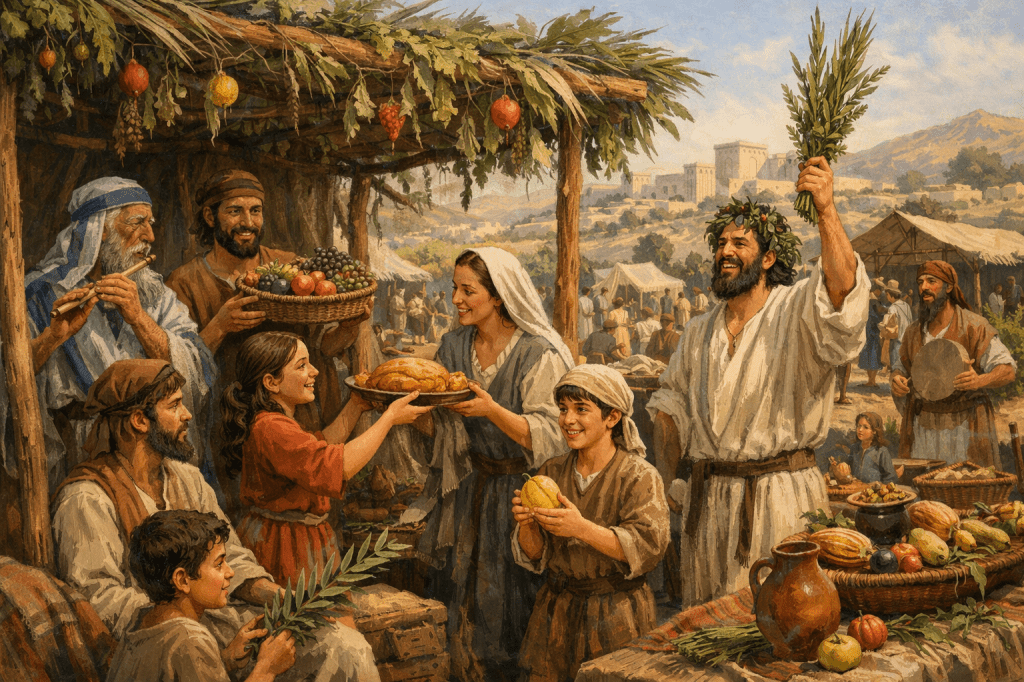
    After harvest was complete, after the solemn weight of the Day of Atonement, God told His people to step outside their solid homes and live for a week in shelters made of branches, leaves, and boughs—palms, willows, trees🌳 from the land itself 🌿🪵.

    It was intentional discomfort.

    The booths were fragile. You could see the sky through them. You could hear the wind. You were reminded—every night—that you were once a people with no permanent shelter at all.

    This feast did two things at once:

    • It remembered sorrow — slavery, wandering, dependence.
    • It commanded joy — “Then celebrate with joy before the Lord your God for seven days.”

    Joy follows cleansing. The Feast of Booths came after the Day of Atonement. Holiness first. Then happiness. People who want joy without repentance always end up disappointed.

    And yet, this feast also looked forward.

    The prophet Zechariah saw a day when all nations would come to Jerusalem to celebrate the Feast of Booths—when God’s presence would again dwell openly among His people (Zechariah 14:16–19).

    That future hope stepped into history during this feast.

    In John 7, during the Feast of Booths, Jesus stood in the temple courts—while water was poured out and lamps blazed—and cried out:

    “If anyone is thirsty, let him come to Me and drink.”
    (John 7:37, NASB 1995)

    The true shelter had arrived.

    The branches once overhead pointed beyond themselves—to the One who would “tabernacle” among us, and who now invites us to live under the covering of His grace.

    We live in fragile places. Temporary shelters. Lives where sorrow and rejoicing often share the same roof.

    But we rejoice anyway—because God dwells with us even there.

    • Reflection:  Where has God asked you to rejoice—not because life feels secure, but because He is present?
    • Closing Prayer:  Lord God, You are the Author of time and the Keeper of our days.  Teach us to remember Your faithfulness—not only in our minds, but in the rhythms of our lives.
      When we live in temporary places, help us trust Your presence.
      When we rejoice, keep our joy rooted in Your grace.
      Thank You for being our true shelter, our lasting dwelling, and our sure hope—from tree to tree
      🌳.
      Amen.
    • Read Leviticus 19:9-34

    MORNING— Open Hands, Open Eyes

    • Focal Passage: Leviticus 19:9-10

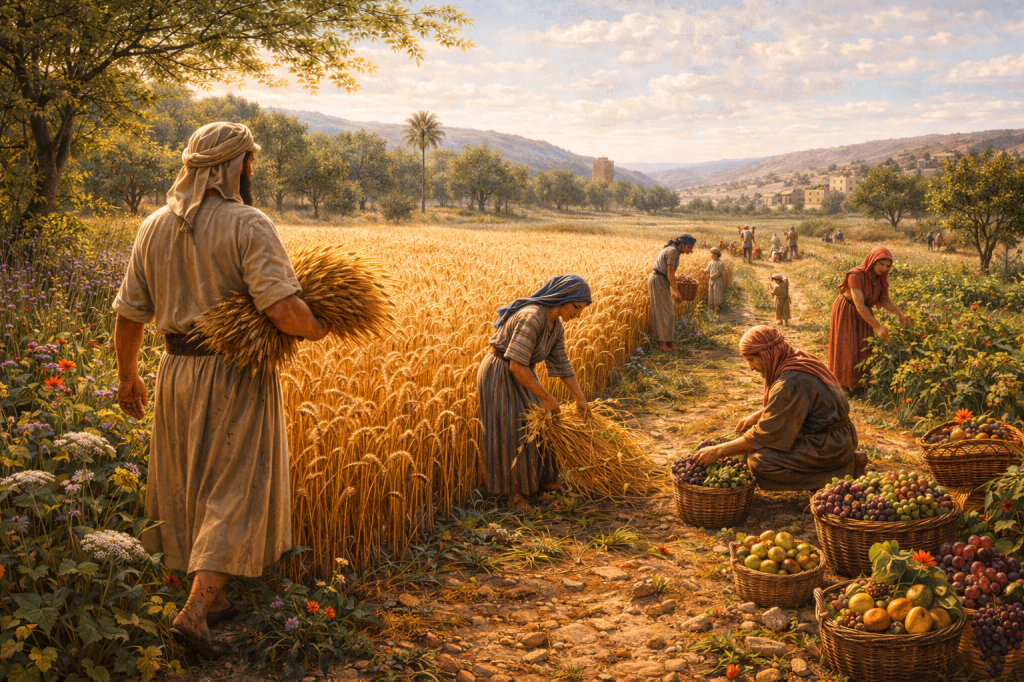
    “Now when you reap the harvest of your land, you shall not reap to the very corners of your field, nor shall you gather the gleanings of your harvest. Nor shall you glean your vineyard, nor shall you gather the fallen fruit of your vineyard; you shall leave them for the needy and for the stranger. I am the LORD your God.”

    Leviticus doesn’t just tell Israel to “be holy.” It shows what holiness looks like with skin on—what it looks like in a field, in a paycheck, in a conversation, in the way you treat someone who can’t “keep up.”

    It’s striking that one of the most-quoted Old Testament commands in the New Testament comes from this very chapter. Leviticus 19:18 is quoted or echoed repeatedly (and has a prominent place in Jesus’ “Top Two” in Mark 12:31): “You shall love your neighbor as yourself.” And right around that command, God gives everyday, practical ways to love.

    Here’s one of the simplest: leave margin. Don’t squeeze everything out of the field. Don’t live like every last stalk is yours, every last grape is owed to you, every last dollar is untouchable. God built generosity into the harvesting process itself—so that the poor could live with dignity, not with humiliation.

    And holiness isn’t only about what we give—it’s also about how we treat the vulnerable.

    Leviticus 19:14 (NASB 1995) says:

    “You shall not curse a deaf man, nor place a stumbling block before the blind, but you shall revere your God; I am the LORD.”

    In other words: God takes personally the way we treat the impaired. Reverence for God shows up in restraint, patience, honor, and protection—especially when someone’s weakness could be exploited.

    Holiness is not a halo. It’s a harvest with corners left. It’s a mouth that doesn’t mock. It’s a heart that notices who is struggling—and then acts.

    • Reflection:  Where can you “leave the corners” today—creating margin in your time, money, attention, or schedule so a needy person isn’t squeezed out?

    EVENING— Letting Grudges Go

    • Focal Passage: Leviticus 19:18

    “You shall not take vengeance, nor bear any grudge against the sons of your people, but you shall love your neighbor as yourself; I am the LORD.”

    By evening, love has usually been tested. Not by ideas or principles, but by real people—conversations that didn’t go well, words that lingered, frustrations that followed us home. This is where loving our neighbor stops being a concept and becomes a choice.

    Leviticus 19 moves from the field into the heart. It speaks to grudges held in secret, resentment nurtured slowly, and words spoken behind backs. God will not let love appear generous in public while it grows bitter in private.

    “Love your neighbor as yourself” is not sentimental. It confronts how we speak, how we judge, how we forgive—or refuse to.

    The New Testament repeatedly returns to this verse. Jesus calls it second only to loving God. Paul says it fulfills the whole law. James calls it the royal law. Why? Because it exposes what truly rules us—mercy or self-interest.

    Loving our neighbor means refusing to keep score. It means choosing not to weaponize memory. It means allowing the grace we depend on to shape how we treat others.

    This kind of love does not come naturally. It flows from a deeper reality: we are already loved. Already forgiven. Already shown mercy we did not earn.

    And once again, the command ends where it began:
    “I am the LORD.”
    Love is not optional and holiness is not negotiable.

    • Reflection:  Who tested your love today—and what would it look like to respond with the same patience and mercy God has shown you?
    • Closing Prayer:  Holy God, You have shown us that love is not abstract—it is practiced in fields, homes, conversations, and choices. Teach us to leave room for others in what You have given us, and grace in how we respond to those around us. Shape our hearts to reflect Yours, so that loving our neighbor becomes the natural fruit of walking with You.
      Amen.