
- Read Genesis 16
MORNING— The God Who Hears
- Focal Passage: Genesis 16:11
“And the angel of the Lord said to her, ‘Behold, you are with child, and you will bear a son;
And you shall call his name Ishmael, Because the Lord has given heed to your affliction’”
Ishmael’s backstory begins with a foolish proposal. Sarai, tired of waiting and convinced that time was running out, offers Abram a culturally acceptable solution. In the ancient world, this arrangement was legal and common. A servant could bear a child on behalf of a barren wife. It would be counted as Sarai’s child, not Hagar’s.
But what was culturally acceptable was covenantally unfaithful.
God tells Hagar to name her child Ishmael—a name that means “God hears.”
But this name was not only for Hagar. It was meant for Abram.
By this point, Abram had already heard from God four times about the promise of a son. God had spoken clearly and repeatedly. Yet when the moment of decision came, Abram listened—not to the voice of God—but to the voice of Sarai. He did not reject God outright; he simply allowed another voice to matter more when it really counted.
From that day forward, every time Abram called that boy in for supper, he spoke a reminder aloud.
“Ishmael.”
God hears.
The name carried grace, but it also carried weight. It reminded Abram that God had not been silent—he had been impatient.
God does not always shield us from the consequences of our choices. The conflict between the descendants of Ishmael and Isaac continues even to this day. It is a sober reminder that some struggles are not resolved quickly because they did not develop quickly. What began as a moment of compromise became a long, unfolding consequence.
Yet even here, God is not absent. He hears. He names. He stays involved—even when the story includes our missteps.
- Reflection: What voices have you allowed to outweigh God’s voice in your own decisions?
EVENING— The God Who Sees
- Focal Passage: Genesis 16:13
“Then she called the name of the Lord who spoke to her, ‘You are a God who sees’; for she said, ‘Have I even remained alive here after seeing Him?’
Hagar is not an innocent bystander in this story. She is wronged, yes—but she was also opportunistic.
When Sarai gives Hagar to Abram, Hagar recognizes the moment. This is her opening. If she bears the master’s child, her status changes overnight. She is no longer just a servant; she becomes indispensable. Scripture tells us that once she conceived, “her mistress was despised in her sight.” Hagar sees leverage—and she uses it.
It doesn’t matter how this came about, she may have thought. What matters is getting ahead. The opportunity is here. The iron is hot. So she presses her advantage. But striking while the iron is hot can still leave burn marks. Short-term gains often come with long-term wounds.
For a while, the plan appears to work. Abram is going to be a father. Sarai’s idea seems validated.
And then—BOOM.
The whole arrangement collapses.
Sarai’s jealousy ignites. Abram retreats into passivity. Hagar bears the brunt of the fallout and runs—pregnant, alone, and wounded—into the wilderness.
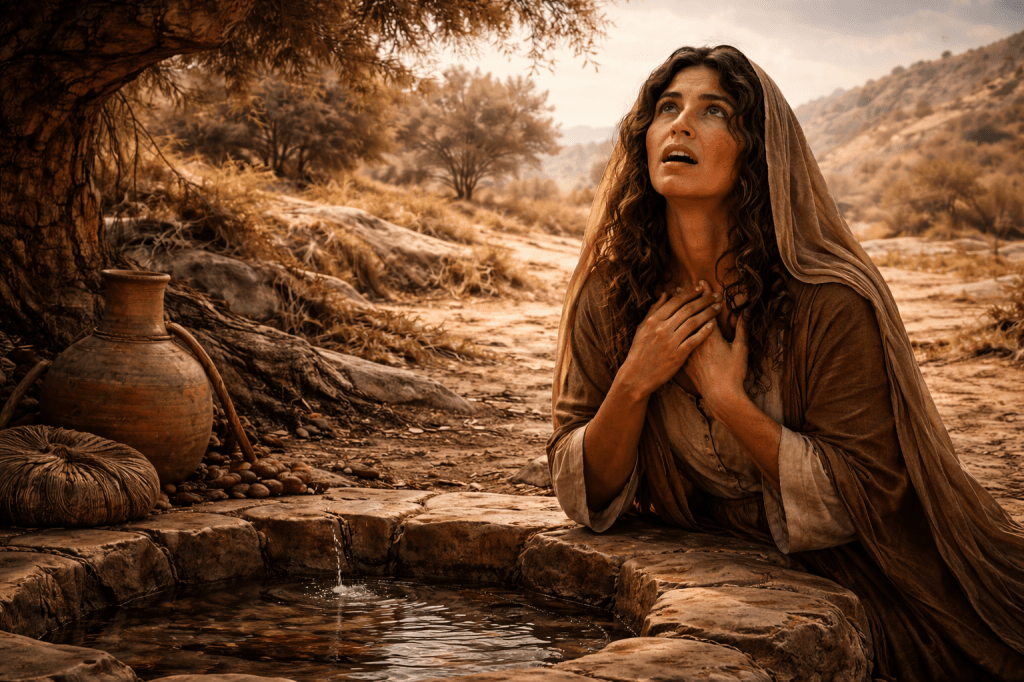
It is there, by a spring along the road, that God meets her.
God does not come only to correct; He comes to comfort. Hagar is told to return— because her pain is not unnoticed, and her life is not abandoned. In that moment, she gives God a name: “The God who sees.” She names the well “the well of the Living One who sees me.”
God sees.
God hears.
God comes.
God brings life.
Your circumstances may have brought you to a well in the middle of a wilderness. But if you meet God there, even painful circumstances can begin to work toward healing. Repentance is required. Obedience is costly. But knowing you are seen by God is enough to motivate you to take the next step.
Hagar realizes she has seen the One who sees her—and that knowledge gives her the courage to return, to obey, and to trust that God can bring life even out of a broken, ill-conceived plan.
- Reflection: Where have you tried to force an opportunity instead of trusting God’s timing?
- Closing Prayer: God who sees, meet me in my wilderness places. Forgive me for the times I have tried to get ahead instead of waiting on You. Give me humility to repent, courage to obey, and faith to believe that You can still bring life where my choices have left scars. Thank You for seeing me. Amen.


Leave a reply to Janine presnell Cancel reply