
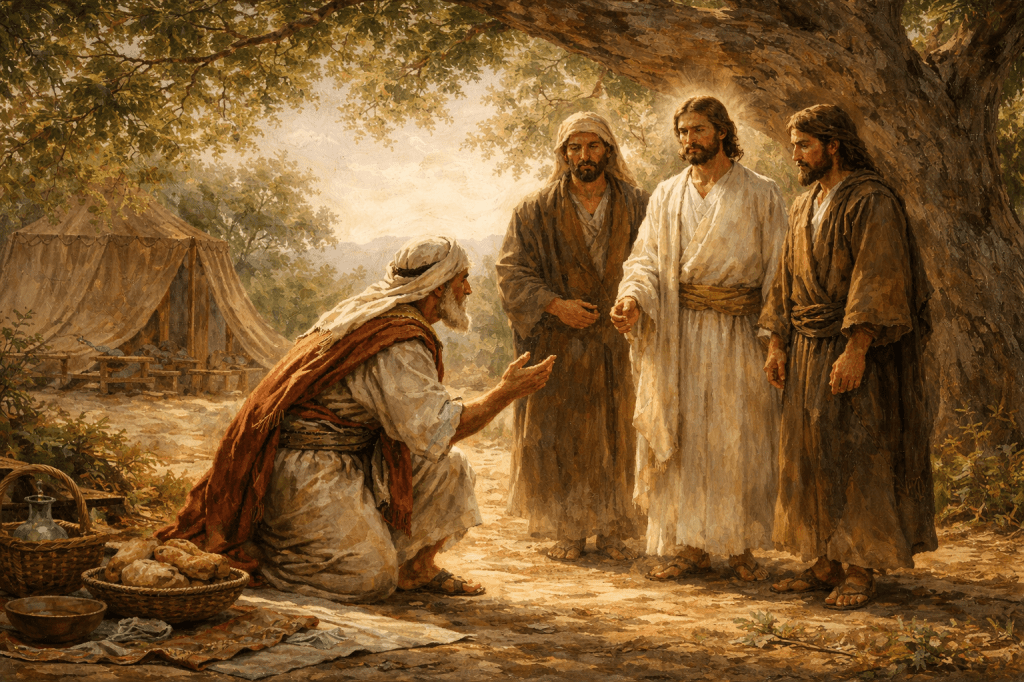
- Read Genesis 18
MORNING— Beneath the Patient Oaks🌳
- Focal Passage: Genesis 18:1
🌳“The Lord appeared to Abraham near the great trees of Mamre while he was sitting at the entrance to his tent in the heat of the day.”
Genesis 18 opens quietly. Abraham is not seeking a vision or building an altar. He is sitting at the entrance of his tent, in the heat of the day—resting, waiting, enduring the ordinary rhythms of life. And it is there, beneath the great trees of Mamre, that the Lord appears.
The setting matters. These trees had become a familiar place for Abraham—a place of dwelling, shade, and patience. Faith does not always grow in dramatic moments. Often it deepens in places where we have lingered a long time.
When Abraham notices three visitors, he responds with generous hospitality. He runs to meet them. He bows low. He offers water, rest, food, and shade under the tree. What begins as simple kindness becomes holy ground.
As the meal unfolds, the visitors reaffirm God’s promise: Sarah will have a son. Sarah laughs quietly to herself—not out of mockery, but weariness. Years of waiting have thinned her hope. Yet God’s question pierces the moment: “Is anything too hard for the Lord?”
The trees of Mamre🌳stand witness to this exchange. They have shaded Abraham through years of waiting. Now they shelter a moment when God renews hope where doubt had taken root.
Where there had been sorrow, laughter was soon to come.
- Reflection:
Where has God asked you to wait longer than you expected—and how might He be inviting you to trust Him again beneath the shade of that waiting?
EVENING— Standing in the Gap
- Focal Passage: Genesis 18:22-23
“The men turned away and went toward Sodom, but Abraham remained standing before the Lord. Then Abraham approached Him and said…”
As the visitors rise to leave, one remains. Abraham recognizes the moment. God has stayed behind—not to announce a verdict, but to invite intercession.
What follows is the first extended prayer of intercession recorded in Scripture. Abraham draws near with humility—“I am but dust and ashes”—and yet with remarkable boldness. He asks hard questions. He presses repeatedly. He appeals to God’s justice and mercy.
Abraham is not bargaining for his own comfort. He is standing in the gap for others—especially for one man he never names aloud: Lot.
Intercession is not passive. It is holy labor. As Brigid Herman once wrote, intercession means “making Christ’s interests our own… learning to think with God, to see the world through His eyes, and to share His passion to save and redeem.” That kind of prayer reshapes the heart of the one who prays.
Jesus later promised that those who ask, seek, and knock would find doors opened. Abraham’s prayer reminds us that God is not threatened by honest questions or persistent requests. He invites them.
Michael Yaconelli tells a powerful story that captures this truth. On the eve of a Billy Graham crusade in Sacramento, a choir member noticed a man slumped on the cold steps of the state capitol late at night. Concerned, he approached—only to discover it was Billy Graham himself, praying alone for the city.
Despite global fame, worldwide influence, and countless people praying for him, Graham understood where true power comes from. Quiet intercession. Kneeling prayer. Standing before the Lord on behalf of others.
Abraham did not save Sodom—but God answered his unspoken prayer by rescuing Lot. Intercession may not always change outcomes the way we expect, but it always draws us deeper into God’s heart.
- Reflection: Who has God placed on your heart to pray for—not casually, but persistently and lovingly?
- Closing Prayer: Gracious God, thank You for inviting us to draw near—to ask, to seek, and to stand in the gap for others. Teach me to pray with humility and courage. Help me trust that You are at work even when outcomes remain unseen. Tonight, I place the burdens of others—and my own—into Your merciful hands. Amen.


Leave a reply to Janine Cancel reply