
- Read Psalm 133-134
MORNING— Blessed Unity
- Focal Passage: Psalm 133:1
“Behold, how good and how pleasant it is for brothers to dwell together in unity!”
A story is told of a tiny pygmy warrior standing proudly over a dead rhinoceros. Someone asked, “Did you kill that?”
“Yeah,” he said, “I killed it.”
“How?”
“With my club.”
“How big is your club?”
“About a hundred of us.”
There are things you simply cannot do alone.
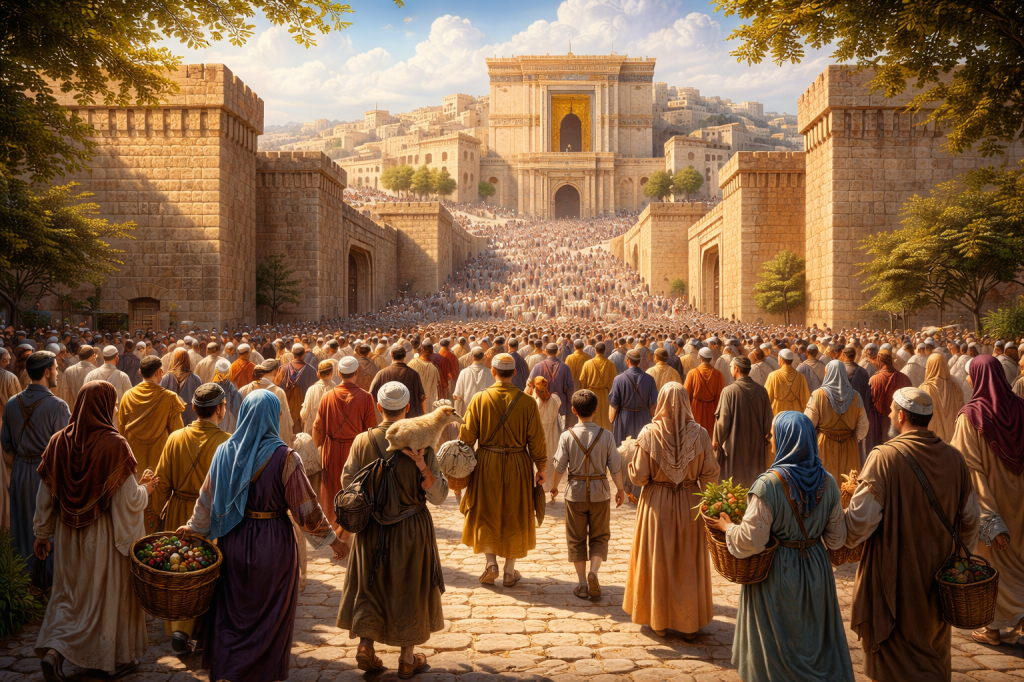
The final stretch of the Psalms of Ascent assumes that. These were pilgrim songs—sung by families and caravans as they went up to Jerusalem for the great feasts. They were meant to be heard in many voices, walking the same road.
Psalm 133 begins with a word that asks us to stop and stare: “Behold…” Look at this. Pay attention. “How good and how pleasant it is for brothers to dwell together in unity.”
Good: it is right, fitting, aligned with God’s will.
Pleasant: it is genuinely enjoyable.
We rarely find those two together. Some things are good but not pleasant (medicine). Others are pleasant but not good (double-fudge cake as a food group). True unity in God’s family is both.
That’s why it’s so striking when it’s missing.
Philip Yancey tells of speaking at a pastors’ conference in Myanmar. Nearly all the leaders there had spent time in prison for their faith. When he offered to speak on suffering, the organizer said, “No, they expect that. They’re used to it. We’d like you to speak on grace. The various groups of Christians here can’t get along with each other.” Shared persecution had not guaranteed shared love.
Jesus prayed otherwise in John 17—that His followers would be one, “so that the world may believe” the Father sent Him. Our unity is not a side theme; it is part of our witness.
David reaches for rich images to describe it:
“It is like the precious oil upon the head,
Coming down upon the beard, even Aaron’s beard,
Coming down upon the edge of his robes.”
Oil on Aaron was not a polite dab. It ran down over beard and garments. The high priest carried the names of the tribes on his vest. Unity, like that oil, starts at the head but flows over the whole people. It is messy, costly, all-encompassing.
Then:
“It is like the dew of Hermon
Coming down upon the mountains of Zion;
For there the LORD commanded the blessing—life forever.”
Mount Hermon in the far north is high and cool, covered with snow in winter and heavy dew in summer. Zion, by contrast, is smaller and often dry. David imagines Hermon’s refreshing dew falling on Zion—a picture of life where you would least expect it.
That is what God-given unity feels like: refreshment that could not have been manufactured by personality, strategy, or shared taste. It is grace coming down.
“No Christian is an only child,” Eugene Peterson wrote. The ascent to Zion ends with a family gathered under one Father, drenched in the same blessing.
- Reflection: Where is God inviting you to move from “fellow attender” to “brother/sister of”—to actively seek unity rather than merely wish for it?
EVENING— Reaching the Summit
- Focal Passage: Psalm 134:1-2
“Behold, bless the LORD, all servants of the LORD, who serve by night in the house of the LORD!
Lift up your hands to the sanctuary and bless the LORD.”
If Psalm 133 is the family arriving together, Psalm 134 is the moment at the gate.
The pilgrims have climbed the long road, sung their way through valleys and passes, and now stand within sight of the temple. This short psalm is likely a final exchange between the travelers and the priests.
First, the call goes to the servants of the LORD—those who “serve by night in the house of the LORD.” They were the ones who stayed when the crowds went home. Lights trimmed. Offerings tended. Songs sustained through the dark hours.
The pilgrims address them: “Behold, bless the LORD…” In other words, remember what a privilege you’ve been given. Don’t just manage the routine—worship.
Those who lead God’s people need that reminder. Pastors, elders, worship leaders, teachers, volunteers—anyone who “serves by night”—can grow weary. They can keep the machinery going and lose the music over time. Encouragement from God’s people helps guard their hearts and sharpen their zeal.
Then comes the gesture:
“Lift up your hands to the sanctuary
And bless the LORD.”
Hands lifted are not performance. They are posture—open, dependent, offering. The Hebrew word for “bless” (barak) carries the sense of kneeling. When we bless the LORD, we bow in worship and speak well of His name.
The psalm closes with the leaders answering back:
“May the LORD bless you from Zion,
He who made heaven and earth.”
Worship moves both directions. God’s people bless Him; He, in turn, blesses them from Zion—the place of His presence, the meeting point of heaven’s Maker with earth’s pilgrims.
This is how the Songs of Ascent end:
not in complaint, but in praise;
not with scattered voices, but with a people answering each other in blessing.
The journey continues beyond the psalm, of course. We go back to ordinary days, ordinary work, ordinary conflicts. But the pattern is set: Gather as one family under one Head. Refresh and heal one another on the way. Call your leaders to worship, and let their worship call you higher.
Come expecting a gift, not only from those who serve, but from the God who made heaven and earth.
- Reflection: As you gather for worship, do you come mainly to “get something,” or also to bless—to bless your brothers and sisters, your leaders, and above all the LORD Himself?
- Closing Prayer: Lord, thank You for calling us into a family and not a solitary faith. Pour out Your Spirit among us, refreshing weary hearts and strengthening those who serve. Teach us to bless one another and to lift our hands to You with sincerity and joy. May our life together point clearly to You, the Maker of heaven and earth. Amen.

Leave a comment