
- Read Isaiah 25 & 26
🌅MORNING— Banquet After the Final Battle
- Focal Passage: Isaiah 25:1
“O LORD, You are my God; I will exalt You, I will give thanks to Your name; For You have worked wonders, Plans formed long ago, with perfect faithfulness”
Isaiah 25 is not a song after one ordinary battle. It rises out of Isaiah 24, where the prophet has just described the shaking of the whole earth. The “city of chaos” has fallen. Proud powers are brought low. The world system that set itself against God collapses.
Isaiah had seen Assyria threaten Jerusalem. He knew what ruthless nations looked like. But here he is looking beyond one empire. He sees the great conflict behind all conflicts — the overthrow of every structure raised in defiance of God, and ultimately the defeat of death itself. World War I was once called “the war to end all wars.” History proved otherwise. Isaiah in chapter 25 speaks of the true war to end all wars — not merely between nations, but between God and all that opposes Him.
And so he sings.
“You are my God.” That is allegiance in the middle of upheaval. The word for “give thanks” suggests open acknowledgment. Isaiah is declaring public praise. He marvels not only at visible wonders but at the long strategy of God — “Plans formed long ago, with perfect faithfulness.” The Lord has not been reacting to history. He has been governing it.
The ruined “city” in verse 2 represents more than bricks and gates. It is Babel reborn in every generation — human pride organized without reference to God. Its fall makes way for something better.
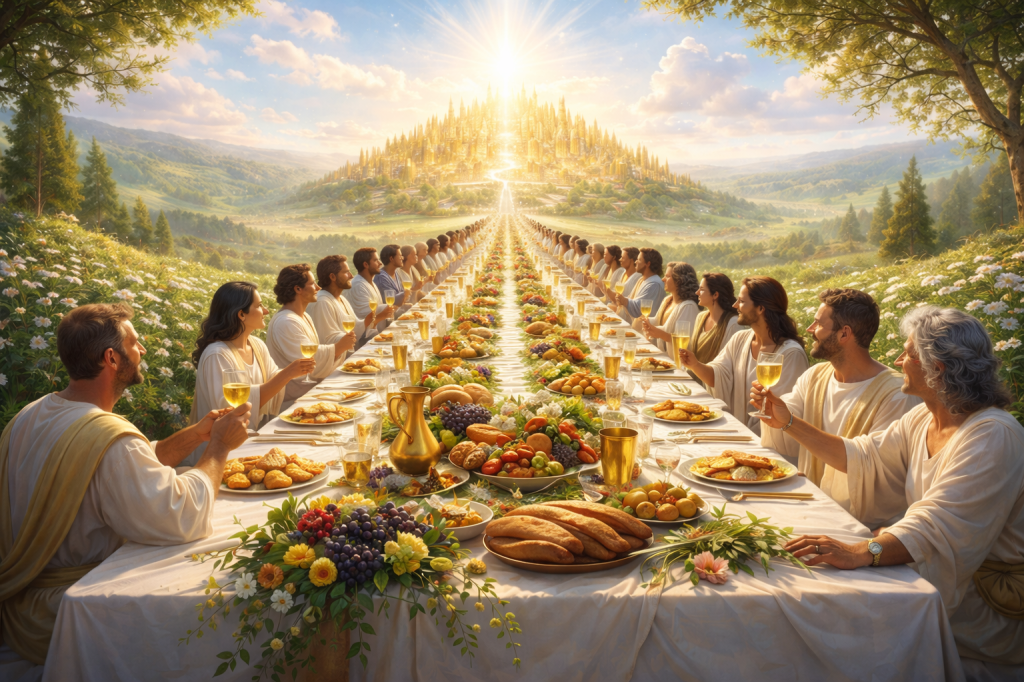
At the center of the chapter stands the mountain banquet (vv. 6–8). A covenant feast for all peoples. Rich food. Aged wine. And then the promise that moves beyond politics entirely:
“He will swallow up death for all time.”
This is the true victory Isaiah sees. Not merely a defeated army, but a defeated grave. Paul will later quote this very line in 1 Corinthians 15, tying it to the resurrection of Christ. The feast Isaiah foresaw is anchored in that empty tomb and stretches toward the day when tears are wiped away from every face.
Jesus frequently spoke of this coming banquet. He described many coming from east and west and from north and south to recline at table in the kingdom (Luke 13:29). He told the parable of the great banquet (Luke 14:15–24). Isaiah’s mountain and Jesus’ table are the same hope viewed from different sides of the covenant story.
It is fitting to sing after a battle. But this song is for the war behind all wars — and for the God whose purposes have never faltered.
- Reflection: When the world feels unstable, do you see only the shaking — or do you also see the steady hand of the One whose plans were formed long ago?
🌆EVENING— Peace, Peace Before the Victory
- Focal Passage: Isaiah 26:3-4
“The steadfast of mind You will keep in perfect peace, because he trusts in You. Trust in the LORD forever, for in GOD the LORD, we have an everlasting Rock.”
Chapter 26 continues the vision with another song. A strong city appears — not built on pride, but secured by salvation. Its gates open to those who trust.
“Perfect peace” is literally “peace, peace.” The doubling intensifies it. This is not shallow calm. It is the settled steadiness of a mind fixed on the Lord. An undeviating way of seeing life — measuring events by the character of God rather than by headlines or fear — results in rest.
The chapter contrasts two cities. The lofty one collapses into dust. The strong one stands. The difference is not architectural but relational. “Trust in the LORD forever.”
Waiting tests that trust. Later in the chapter the people are told to enter their rooms and close their doors “for a little while” (v. 20). That phrase can stretch thin. Seasons of suffering alter time. When your daughter is recovering from brain surgery, the world seems to move quickly while your own days feel suspended. “A little while” can feel immense.
After Ernest Hemingway was wounded during World War I, surgeons removed 237 pieces of shrapnel from his body. During his long convalescence he observed how waiting exposed what was already present in a person. Hard seasons did not create strength or shallowness; they revealed it. In A Farewell to Arms, he later wrote, “The world breaks everyone and afterward many are strong at the broken places.” Waiting uncovers where the mind truly rests.
Isaiah’s song says the same. The mind fixed on the Lord is kept — guarded — in peace, peace. The Rock does not erode. The strong city does not crumble. The One who swallows death at the end also sustains His people now.
- Reflection: What is shaping your thoughts tonight — the instability of the moment, or the everlasting Rock?
- Closing Prayer: Lord, You are our God. Your plans were formed long ago and have never failed. When cities fall and waiting stretches long, steady our minds on You. Keep us in peace, peace, as we trust in You. Thank You for the victory over death secured through Christ. Hold us fast until the feast is fully seen. Amen.

Leave a comment