
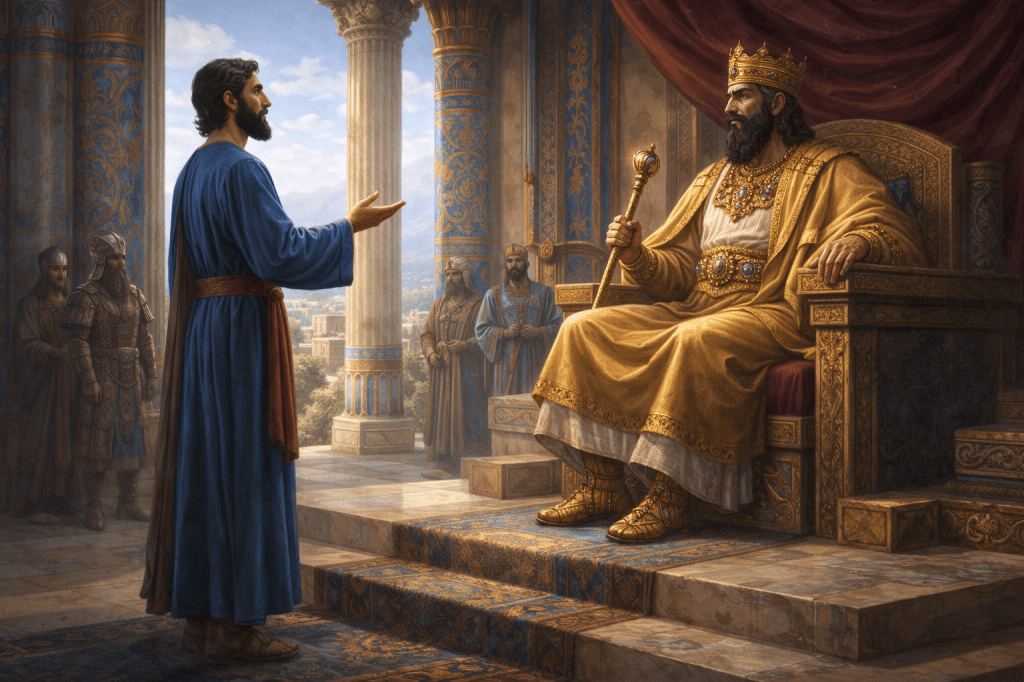
- Read Daniel 1; 2:13-28
🌅MORNING– Settled Before the Test
- Focal Passage: Daniel 1:8
“But Daniel made up his mind that he would not defile himself with the king’s choice food…”
Daniel’s decision was never really about vegetables.
It was about allegiance.
He was a young exile living inside the most powerful empire on earth. Babylon intended to reshape these Hebrew captives completely — their language, education, names, habits, and eventually their identity. The king’s table represented more than food. It symbolized acceptance into the Babylonian system and participation in its values.
To refuse that provision was risky.
Nebuchadnezzar was not known for tolerating defiance, and the pressure toward assimilation must have been immense. The food itself likely violated Levitical law and was almost certainly tied in some way to Babylonian idol worship. Eating from the king’s table meant more than satisfying hunger. It carried the expectation of conforming.
Assimilation usually works that way.
Very few people abandon conviction all at once. More often compromise enters gradually through small accommodations that seem harmless at first. Over time participation reshapes loyalty.
Daniel recognized the danger early.
The text says he “made up his mind” or literally “set it upon his heart” that he would not defile himself. The resolve existed internally before it ever appeared publicly. Long before the test arrived at the table, Daniel had already settled who ultimately owned his allegiance.
What is equally striking is the way he handled the situation. Daniel did not become combative or theatrical. He approached the chief official respectfully and requested a simple test. His courage carried conviction without arrogance.
R. G. LeTourneau, before becoming one of America’s most successful industrialists, determined that his business practices would remain subject to his commitment to Christ. As his company expanded, he became known for giving away the vast majority of his income while refusing contracts that required dishonesty or ethical compromise.
Those decisions were not made under pressure in the middle of negotiations. The boundaries had already been established long beforehand.
By the time LeTourneau was handling enormous government contracts and major financial opportunities, the deeper questions had already been answered in private.
Daniel’s test came at a royal table.
LeTourneau’s came in boardrooms and contracts.
Both men understood something many people learn too late: if convictions are postponed until temptation or pressure arrives, compromise has often already begun in the heart.
Daniel did not negotiate his belonging to God.
He settled it beforehand.
- Reflection: Where could future opportunity blur your convictions? What must be decided in your heart now — before the table is set?
🌆EVENING– The God Who Removes Kings
Focal Passage: Daniel 2:21
“It is He who changes the times and the epochs; He removes kings and establishes kings…”
Totalitarian regimes have often been uncomfortable with the book of Daniel. The reason is not difficult to see. The book of Daniel declares that kings are not ultimate.
In Daniel 2, Nebuchadnezzar issues a chilling decree. Troubled by a dream, he demands that his wise men do the impossible: recount the dream itself and then interpret it. When they protest, he orders their execution.
The Babylonian advisers admit something revealing: “There is not a man on earth who could declare the matter… except gods, whose dwelling place is not with mortal flesh” (2:10–11). Their worldview assumed distance between heaven and earth. Their gods were inaccessible.
Daniel’s worldview was different.
He asks for time. He gathers his companions. He seeks mercy from “the God of heaven.” And when the mystery is revealed, he does not congratulate himself.
He worships. “Let the name of God be blessed forever and ever, For wisdom and power belong to Him.”
Daniel begins not with Nebuchadnezzar, but with God.
History is not fixed in the hands of emperors. Seasons turn because God turns them. What looks permanent from below is temporary from above. “He removes kings and establishes kings.”
Nebuchadnezzar believed he had secured his throne through conquest. Daniel confesses that thrones are granted and withdrawn by divine authority. “He gives wisdom to wise men and knowledge to men of understanding.”
Daniel’s insight is not self-generated brilliance. It is given revelation.
Then comes the boldness.
Daniel stands before the most powerful man on earth and says, in effect: Your dream is about the rise and fall of kingdoms — including yours. The statue of gold, silver, bronze, iron, and clay represents successive empires. Nebuchadnezzar is the head of gold. But after him will arise another kingdom, and another, and another.
And finally, a stone “cut out without hands” will strike the statue and shatter it. That stone will become a kingdom that will never be destroyed.
Daniel was not merely interpreting symbols. He was telling the king that his throne had an expiration date. That kind of speech could cost a man his life.
But Daniel’s confidence did not rest in Nebuchadnezzar’s mood. It rested in the sovereignty of God. Before he entered the throne room, he had already declared: God rules time. God rules kings. God reveals mysteries.
When a person truly believes that, fear loses its grip.
The king may command execution.
But God commands history.
- Reflection: Is earthly power ultimate — or provisional? How would your courage change if you truly believed that God removes kings and establishes them?
- Closing Prayer: God of heaven, You rule over rulers. You reveal what is hidden. Strengthen us to speak truth with humility and courage. Keep our confidence anchored in Your kingdom, not in the shifting power of this world. Establish Your reign in our hearts. In Jesus’ name, Amen.

Leave a comment