
- Read Haggai 1
🌅 MORNING– Bring Wood🪵
- Focal Passage: Haggai 1
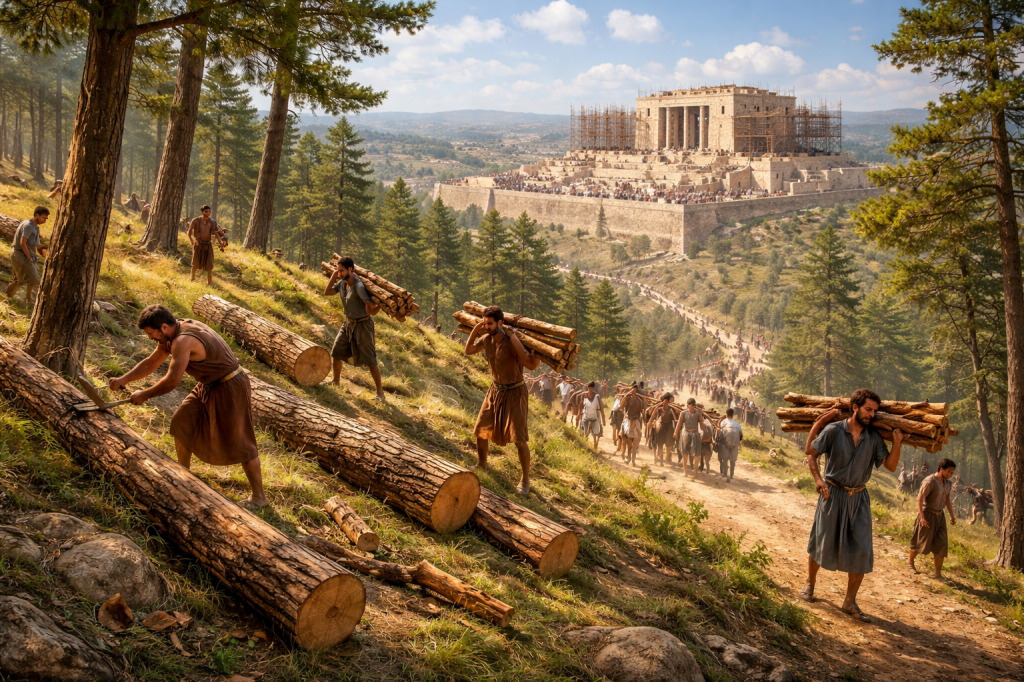
“Go up to the mountains, bring wood and rebuild the temple, that I may be pleased with it and be glorified,” says the Lord.”
Haggai speaks into a moment of spiritual drift.
The people of Judah had returned from exile nearly twenty years earlier. When they first came back to Jerusalem, they laid the foundation for the temple with great celebration (Ezra 3). But opposition arose. Discouragement set in. The work stopped.
Years passed.
Meanwhile, something else quietly advanced. The people built their own homes. They paneled their walls. They cultivated their fields. Life moved forward — just not in the direction God had commanded.
So the Lord sends the prophet Haggai with a blunt instruction repeated twice in the chapter:
“Consider your ways.”
Look closely at the path you are walking.
The people had been working hard, but the results felt strangely thin:
“You have sown much, but harvest little… you earn wages to put into a purse with holes” (Haggai 1:6).
Their lives were busy, but spiritually misaligned.
God’s solution was surprisingly simple:
“Go up to the mountains, bring wood, and rebuild the temple.”
Bring wood. 🪵
The temple represented the center of Israel’s relationship with God. By leaving it unfinished, the people had unintentionally declared that other priorities mattered more.
Haggai does not call them to endless introspection or complicated reforms. He calls them back to obedience. Go up the hills. Cut the timber. Carry it down. Start building again. Sometimes spiritual renewal begins with something just that practical.
In Scripture, wood often becomes the material through which God’s purposes unfold — from the ark that preserved Noah’s family to the cross that carried the weight of redemption. God repeatedly takes ordinary wood and turns it into something sacred.
For us today, “bringing wood” may look like returning to simple acts of faithfulness — opening the Scriptures again, setting aside time for prayer, restoring regular worship, or finishing something God once prompted us to begin. Renewal often starts not with dramatic moments, but with small acts of obedience.
The call in Haggai is not merely about construction. It is about realigning life so that God again stands at the center.
- Reflection: What step of obedience might God be asking you to take today so that your life reflects His priorities again?
🌆 EVENING– Stirred Up Spirits
Focal Passage: Haggai 1:14
“So the Lord stirred up the spirit of Zerubbabel the son of Shealtiel, governor of Judah, and the spirit of Joshua the son of Jehozadak, the high priest, and the spirit of all the remnant of the people; and they came and worked on the house of the Lord of hosts, their God.”
Haggai’s message was direct and uncomfortable: Consider your ways. The temple had been neglected while the people focused on their own houses.
But the remarkable part of the chapter is what happens next.
The people listened.
Verse 12 says they “obeyed the voice of the Lord their God.” Then something deeper occurs:
“The Lord stirred up the spirit.”
Three groups are mentioned: Zerubbabel the governor, Joshua the high priest, and the remnant of the people. Leaders and laborers alike felt the same movement within. What had lain dormant for years suddenly awakened.
The Hebrew word translated stirred up carries the sense of rousing something that has grown sluggish — like embers being stirred until flame returns.
For nearly two decades the temple project had sat silent. Tools were set aside. The foundation gathered dust. Yet when God stirred their spirits, the people returned to the work.
History shows that God often begins renewal the same way.
In August of 1806, five students from Williams College in Massachusetts gathered in a field to pray and discuss the spiritual needs of the world. A sudden thunderstorm forced them to take shelter beside a haystack. While they waited for the storm to pass, their conversation turned to the question of whether Americans could take the gospel to other nations.
One of the students, Samuel Mills, reportedly said, “We can do it if we will.”
That small gathering—now known as the Haystack Prayer Meeting—ignited the American foreign missions movement. Within a few years it led to the formation of the American Board of Commissioners for Foreign Missions (1810), the first major American missionary society. Missionaries soon went to Asia, the Middle East, and the Pacific.
Historians of missions still point back to that prayer meeting beside a haystack as the moment when God stirred a generation.
Great movements often begin that way. Not with crowds. Not with headlines. But with hearts awakened to do what had long been neglected.
The work resumed in Jerusalem because God moved first.
Human obedience matters, but the deeper movement is God awakening the heart. Duty alone cannot sustain spiritual work. The Lord breathes life into it.
And when He stirs a spirit, dormant things rise again.
- Reflection: Is there some area of your life God might be stirring again — something once begun but left unfinished?
- Closing Prayer: Lord, thank You for not leaving dormant hearts alone. Stir our spirits where we have grown tired or distracted. Give us strength to continue the work You have placed before us.
Amen.

Leave a comment