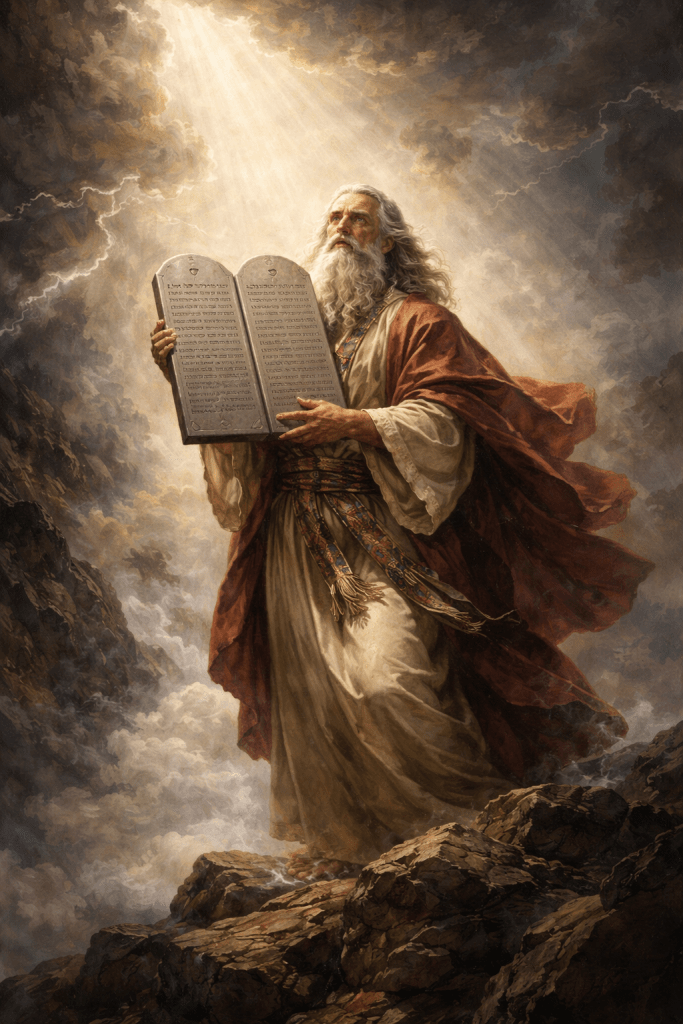
• Read Exodus 20

    MORNING— Ten Commandments at the Center

    • Focal Passage: Exodus 20:1-3

    “Then God spoke all these words, saying, ‘I am the LORD your God, who brought you out of the land of Egypt, out of the house of slavery. You shall have no other gods before Me.”

    The Ten Commandments were not given to an oppressed people trying to earn freedom. They were given to a people who had already been freed—and now needed structure.

    Freedom without form does not last. A nation released from slavery still needs order, clarity, and direction if it is to endure.

    The first portion of the Ten Commandments is directed upward. These commands establish who holds ultimate authority and how that authority is to be acknowledged.

    They address allegiance (no other gods), representation (no idols), reverence (God’s name), and rhythm (the Sabbath). Together, they orient life toward God as the center rather than the self. Old Testament scholar Christopher J. H. Wright notes that these opening commands function as the foundation for everything that follows:

    “The first four commandments establish the framework within which all human moral behavior must operate. If God is displaced, the rest of the law inevitably unravels.”
    Christopher J. H. Wright, Old Testament Ethics for the People of God

    When reverence for God erodes, something else quickly assumes the highest place—power, ideology, wealth, or self.

    These early commands anchor life to what does not shift.

    The law begins not with human conduct, but with divine priority. Only when that order is established can anything else remain stable.

    • Reflection:  What currently sets the rhythm of your life—worship and reverence, or competing demands that slowly displace them?

    MORNING— Ten Commandments: Rules that Guard Life

    • Focal Passage: Exodus 20:12-17

    “Honor your father and your mother…
    You shall not murder.
    You shall not commit adultery.
    You shall not steal.
    You shall not bear false witness against your neighbor.
    You shall not covet…”

    These six commandments do more than restrain evil; they preserve love in shared life. They protect trust between parents and children, neighbors and strangers, husbands and wives, the strong and the vulnerable. Where they are honored, communities hold. Where they are ignored, they fracture.

    A powerful example came in the aftermath of the September 11, 2001 attacks. In New York City, thousands of ordinary citizens acted instinctively in ways that mirrored these commands. Strangers carried the injured down stairwells. Office workers stayed behind to help coworkers escape. Wallets, jewelry, and cash were later returned untouched. Families opened their homes to people they had never met. Blood donation centers overflowed.

    Sociologists and journalists who studied those days noted something striking: despite fear and loss, there was an unusual absence of looting, deception, or exploitation. In a moment when order could have collapsed, people chose restraint, truth, protection of life, and sacrificial care for others.

    Those actions did not happen because new laws were written that day. They happened because deeply held moral restraints—honoring life, respecting what belongs to others, telling the truth, placing people above self—rose to the surface when they were most needed.

    That is what these commandments do. They hold society together not by force, but by love expressed through restraint.

    • Reflection:  How did your choices today contribute—however quietly—to trust, safety, and care for the people around you?
    • Closing Prayer:  Lord God, order our lives rightly before You—our worship, our words, and our time. From that order, govern how we live with others, guarding our actions, our speech, and our desires. Teach us to walk within Your wise commands, for through them You preserve what is good and hold life together.  Amen.
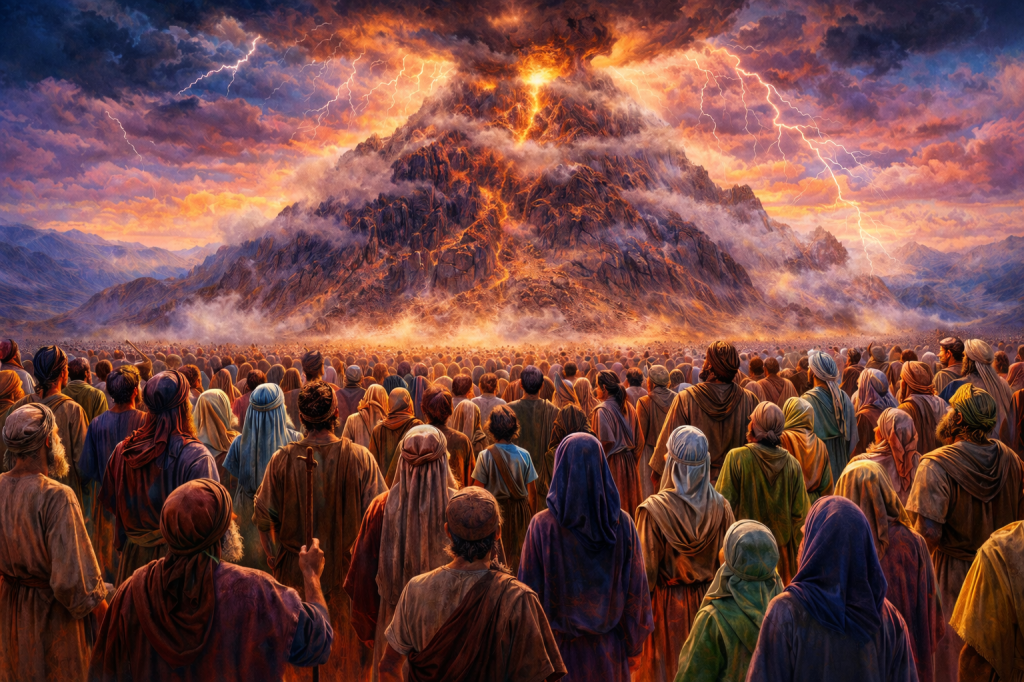
    • Read Exodus 19

    MORNING— A DTR Moment at Mount Sinai

    • Focal Passage: Exodus 19:4-6

    “You yourselves have seen what I did to the Egyptians, and how I bore you on eagles’ wings, and brought you to Myself. Now then, if you will indeed obey My voice and keep My covenant, then you shall be My own possession among all the peoples, for all the earth is Mine; and you shall be to Me a kingdom of priests and a holy nation.”

    There comes a moment in every meaningful relationship when assumptions are no longer enough.
    It’s the moment when things must be said out loud. Defined. Owned.

    We often call it a DTRDefine the Relationship.

    By Exodus 19, Israel has been rescued, fed, guided, protected, and carried. The Red Sea is behind them. Manna appears each morning. Water has flowed from the rock. God’s presence has been unmistakable. But one crucial thing is still missing: the relationship has not yet been clearly defined.

    So God brings them to Sinai.

    This mountain is not random. Years earlier, when Moses stood before the burning bush, God told him, “When you have brought the people out of Egypt, you will worship God at this mountain.” What began as a private encounter now becomes a public declaration. One man’s calling becomes a nation’s identity.

    Before God gives commands, He tells a story.

    “You have seen what I did.”
    “I carried you.”
    “I brought you to Myself.”

    God reminds them of their shared history. This is not the language of a taskmaster. It is the language of relationship. He does not say, “Here is what you owe Me.” He says, “Here is what I have already done for you.”

    Only then does He say the defining words:
    “You shall be My own possession.”

    Not a workforce. Not a social experiment. Not a temporary alliance.

    His.

    This moment matters because people are prone to forget who they are when circumstances change. Victory fades. Gratitude thins. Expectations creep in. Without clarity, even rescued people begin to drift.

    There is something deeply personal here for us.

    Many people live with God in a vague, undefined way. He has helped them. Provided for them. Protected them. But they’ve never settled the deeper question: Am I His—or am I just receiving benefits?

    I’ve known people who attended church faithfully for years yet live with constant anxiety about God’s approval. They served, give, and try hard—because they are never sure where they stand. One man once told me, “I know God saved me… I just don’t know if He actually wants me.” That’s a DTR problem.

    Hear God’s word thunder from Sinai. God does not invite Israel into covenant because they are strong, faithful, or impressive. He invites them because He has already chosen them.

    At Sinai, God is saying, “Before you do anything for Me, understand this: you belong to Me.”

    • Reflection:  Where in your life might God be inviting you to stop relating to Him out of uncertainty or fear and begin resting in the truth that you belong to Him?

    EVENING— Here Comes My Friend

    • Focal Passage: Exodus 19:5

    “…then you shall be My own possession among all the peoples, for all the earth is Mine.”

    Identity changes everything.

    Frederick Douglass once approached the White House, hoping to attend Abraham Lincoln’s second inaugural reception. As he reached the door, officers stopped him. When he tried to enter, they seized him, mocking and threatening him, preparing to drag him back outside.

    Douglass cried out, “Just tell President Lincoln that Frederick Douglass is at the door.”

    Confusion followed. Orders were shouted. Suddenly the officers released him and escorted him inside. The room fell silent as Abraham Lincoln crossed the floor, extended his hand, and announced clearly for all to hear:

    “Here comes my friend Frederick Douglass.”

    In that moment, everything changed.
    If the President called him friend, who dared treat him otherwise?

    This is the power of Exodus 19.

    God does not merely tolerate Israel. He does not call them useful. He calls them His own possession. And when God defines the relationship, the status of the people is forever altered.

    Later Scripture tells us that Jesus would define the relationship again—this time not at a trembling mountain, but at an intimate supper with His 12 in an upper room. He would say to them, “I no longer call you servants… I have called you friends.” (John 15:15)

    If the Son of God calls you friend,
    if the Lord of the covenant calls you His own,
    who gets to redefine you?

    Sin does not.
    Fear does not.
    Your past does not.

    To belong to God is to live with both humility and security—to stand in awe without shrinking back, to obey without striving for approval.

    At Sinai, the people learn who God is.
    At the cross, we learn how far He will go to claim us.

    And once that relationship is defined, everything else—obedience, worship, mission—simply flows.

    • Reflection:  Where in your life might God be inviting you to stop relating to Him out of uncertainty or fear and begin resting in the truth that you belong to Him?
    • Closing Prayer:  Father, thank You Friend, for carrying me and bringing me to Yourself.  Help me to follow You in holy obedience based on the identity I’ve found in you.  Let me rest this evening in the knowledge that I am Yours.  Amen.
    • Read Exodus 16

    MORNING— Manna in the Morning

    • Focal Passage: Exodus 16:4

    “Then the Lord said to Moses, ‘Behold, I will rain bread from heaven for you; and the people shall go out and gather a day’s portion every day, that I may test them, whether or not they will walk in My instruction.’”

    Israel leaves Elim rested, watered, and hopeful. But before long, the wilderness of Sin stretches out before them, and the joy of palm trees fades into the ache of hunger. It doesn’t take long for old memories to resurface—selective memories. Egypt begins to look better in hindsight. Slavery is remembered as comfort. Bondage is recast as abundance. “We sat by the pots of meat,” they say, forgetting the whips that stood nearby.

    Grumbling always edits history.

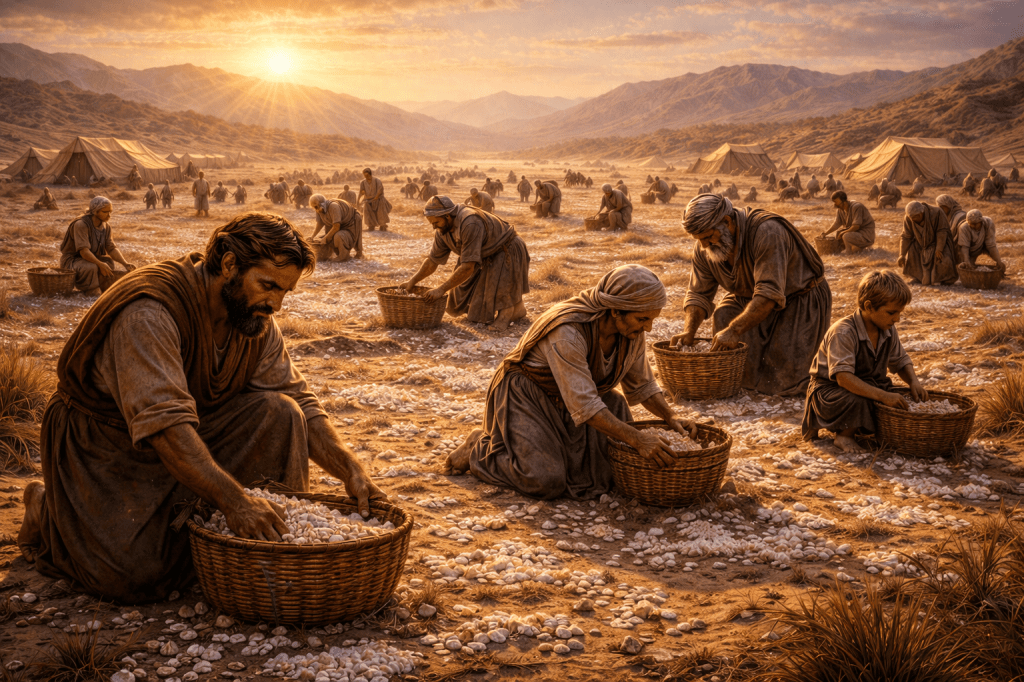
    God hears their complaints—not because they are noble, but because they are needy. And instead of rebuke, He responds with provision. “I will rain bread from heaven for you.” Not storehouses. Not surplus. Bread. Enough for today.

    When the manna appears, it confuses them. “What is it?” they ask. The word manna simply means “What is it?

    God calls it bread from heaven. The people can only describe it by approximation: white like coriander seed, tasting like wafers with honey. It is nourishment, not indulgence. Provision, not excess.

    Manna teaches a rhythm of trust. It arrives daily. It cannot be hoarded. Yesterday’s manna will not sustain today’s hunger. God gives what is needed, when it is needed, so that His people learn dependence rather than control.

    Years later, Moses would command that a portion of manna be kept—not to be eaten, but remembered. The miracle was not just the food itself, but the faith it required. Manna was never meant to replace trust in God. It was meant to train it.

    We often pray for “more” when God is offering “enough.” We ask for certainty when God offers daily grace. Like Israel, we sometimes stand over God’s provision and ask, “What is this?” when we should be saying, “Thank You.”

    Manna reminds us that God knows what we need before we ask—and that His care arrives right on time, even if it doesn’t arrive in the form we imagined.

    • Reflection:  How am I responding to God’s daily provision—trusting Him for today, or worrying about tomorrow?

    MORNING— Bread that Sustains

    • Focal Passage: Exodus 16:18

    “When they measured it with an omer, he who had gathered much had no excess, and he who had gathered little had no lack.”

    Manna was not only daily—it was communal. Some gathered more. Some gathered less. But no one lacked. God’s provision was never meant to terminate on the individual. What one received became a gift for another.

    Paul would later point back to this moment and call it a picture of God’s economy: abundance meeting need, not excess feeding greed. The miracle was not just bread on the ground—it was equality in the camp.

    Someone on Facebook gave shout out to his new friend, Hayden.  He had stopped at a McDonald’s on the way home and his card wouldn’t work. Before he could say a word, the young man behind the counter—Hayden—pulled out his own debit card and paid for his meal. No hesitation. No speech. Just generosity. When the gentleman tried to refuse, Hayden smiled and said, “I got you.” Inside the bag, he slipped back the cash the customer tried to give him, along with a receipt that read, “Have a blessed day.”

    That is manna lived out.  Give of your surplus.

    But manna also came with limits. Even provision could be mishandled. Gather too much and it spoiled. Ignore God’s rhythm of Sabbath and the gift turned sour. God was not being restrictive—He was being protective. He knew that blessings hoarded would crowd out rest, trust, and worship. The Sabbath itself was part of the gift.

    Jesus later stood before a hungry crowd and said something astonishing: “Your fathers ate the manna in the wilderness, and they died… I am the bread of life. Manna sustained bodies for a day. Christ sustains souls forever.

    The wilderness teaches us that God’s greatest gift is not what He places in our hands, but Who He places at the center of our lives. Morning by morning, His mercies still appear—quietly, faithfully, sufficiently.

    Tomorrow morning, you will wake up to a choice. You can grumble at what is missing, or give thanks for what has been provided. You can worry about tomorrow’s bread, or trust the God who has never missed a morning yet.

    Manna still falls. God is still faithful.

    • Reflection:  Where might God be inviting me to receive His provision with gratitude—and to share it freely with others?
    • Closing Prayer:  Father, thank You for daily bread—often simple, always sufficient. Teach me to trust You one day at a time. Guard my heart from grumbling, and shape it toward gratitude. Help me receive Your gifts wisely and share them generously, remembering that You are my true provision. Amen.
    • Read Exodus 15

    MORNING— The Tree at Marah🌳

    • Focal Passage: Exodus 15:25

    “Then he cried out to the Lord, and the Lord showed him a tree; and he threw it into the waters, and the waters became sweet.”

    Exodus 15 opens with joy that spills over into song. The sea has closed behind Israel, the threat is gone, and freedom is no longer theoretical. It is real. Tangible. Miriam lifts her tambourine. The women dance. The people sing words they will remember for generations: “Sing to the Lord, for He is highly exalted; the horse and his rider He has hurled into the sea.”

    This is what it feels like when deliverance is fresh. The danger is past. God has come through. Faith feels effortless. Praise comes easily. These are the moments we wish we could freeze—when obedience seems rewarded without delay and trust feels natural rather than costly.

    But Exodus moves quickly from celebration to silence.

    Three days into the wilderness, the singing stops. The landscape is unforgiving. Throats are dry. Children are thirsty. When water finally appears at Marah, hope surges—only to collapse. The water is bitter. Undrinkable. And with that discovery, something else turns bitter as well.

    The people grumble. Not against Pharaoh. Not against the desert. But against Moses. Disappointment looks for someone to blame. It always does.

    Moses responds differently. He does not argue. He does not defend himself. He cries out to the Lord. And the Lord shows him a tree. 🌳 Not a sermon. Not an explanation. A tree.🌳 Moses throws it into the water, and what was bitter becomes sweet.

    God does not remove the desert. He transforms the experience within it.

    At Marah, the Lord reveals a new name for Himself: “I am the Lord, your healer.” Not just the God who rescues dramatically, but the God who heals quietly. Not only the One who defeats enemies, but the One who tends wounded hearts.

    Corrie ten Boom once met a German lawyer whose legs had been taken by the war. He sat in a wheelchair, consumed by bitterness toward God and humanity. When Corrie told him that bitterness must be surrendered, he snapped back, “What do you know about bitterness? You still have your legs.”

    So she told him about betrayal. About prison. About watching family members die because of one man’s treachery. About hatred so deep she wanted her betrayer dead.

    “I know what it is to hate,” she said. “And I know what it is to be healed.”

    Bitterness does not disappear because circumstances improve. It is healed when it is surrendered to God.

    That tree at Marah stands as a witness: God can sweeten what disappointment has poisoned.

    • Reflection:  Has bitterness begun to take hold in your spirit, tempting you to forget the victories God has granted in the past?

    EVENING— The Trees at Elim 🌳

    • Focal Passage: Exodus 15:27

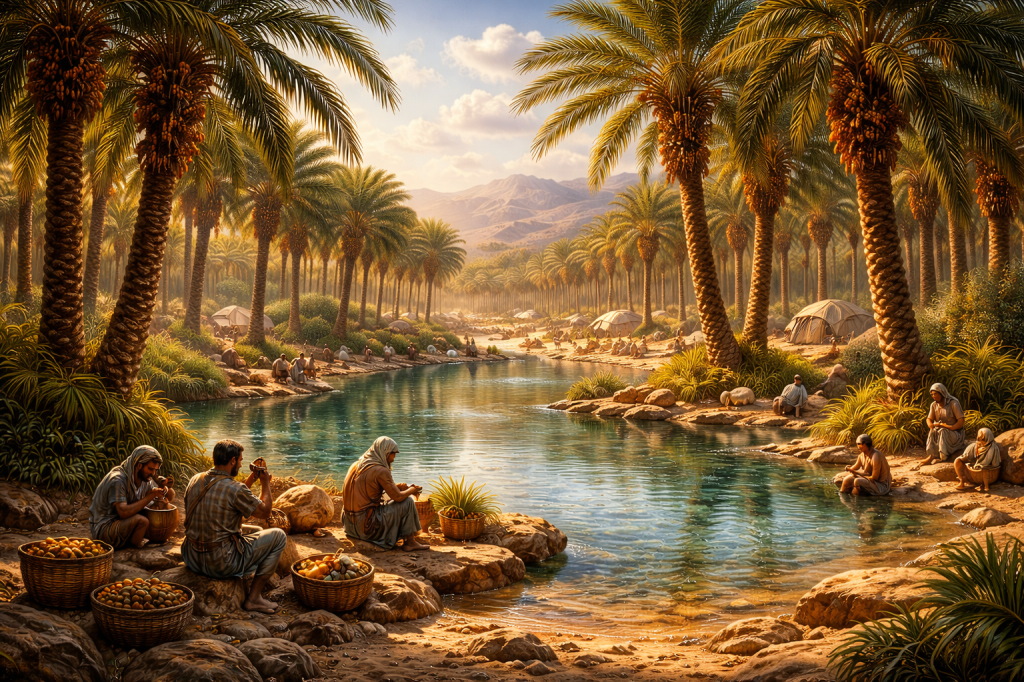
    “Then they came to Elim where there were twelve springs of water and seventy date palms 🌳, and they camped there beside the waters.”

    God does not leave His people at Marah.

    Soon after, Israel arrives at Elim—a place marked not by scarcity, but abundance. Twelve springs of water. Seventy palm trees. 🌳 Shade. Rest. Provision that feels almost extravagant after the dryness of the desert.

    Elim is not the destination. But it is a gift.

    God knows when His people need rest. He knows when they need to stop moving, to drink deeply, to let healing settle in. Elim is a reminder that the journey with God is not unbroken hardship. There are oases along the way—places where strength is restored and perspective is renewed.

    Corrie ten Boom would return to Darmstadt a year after her conversation with the bitter lawyer. This time, he met her at the station, driving a specially equipped car. He laughed and told her that he had surrendered his bitterness to God. The man who once isolated himself in bitterness was now out and about serving others. The sourness that hollowed him out had been replaced with love.

    Elim does not erase Marah. It follows it.

    Life moves this way more often than we expect. Celebration gives way to disappointment. Disappointment can create bitterness. But God heals. Rest is given. And then the journey continues.  Just remember when you arrive at an oasis to fill your canteen.  You are going to need it.  Your journey is not yet complete.

    Wherever you find yourself this night—singing, thirsty, bitter, or resting—the Lord has not changed. He still heals. He still provides. And He is still leading His people home.

    • Reflection:  If you are experiencing a season of blessing in your life, how are you seeking to “fill your canteen” for the road ahead?
    • Closing Prayer:  Father, I surrender any bitterness I might be harboring in my heart due to my current circumstances.  Teach me that YOU are my healer.  Help me to rest under your gracious touch.  In moments that you supply in abundance, let me share it with others and use the experience to cultivate thanksgiving in my heart.  Amen.
    • Read Exodus 14:10-31

    MORNING— Stand Still and Witness His Power

    • Focal Passage: Exodus 14:10-12

    “As Pharaoh drew near, the sons of Israel looked, and behold, the Egyptians were marching after them, and they became very frightened; so the sons of Israel cried out to the Lord…”

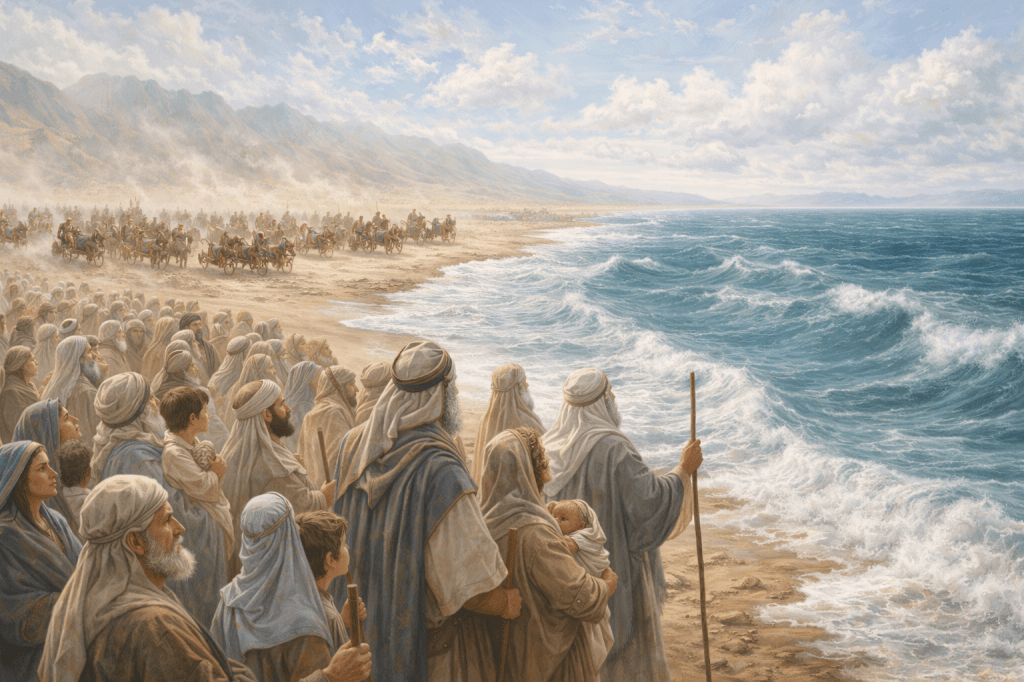
    The story is familiar, but it never loses its power. Israel stands at the edge of the sea with nowhere to go. Mountains hem them in. Behind them comes Pharaoh—angry, armed, and determined to reclaim what he believes is his.

    They are trapped.

    What makes this moment so unsettling is that it wasn’t a navigational error. God Himself directed Israel into this dead end. Earlier in the chapter, the Lord tells Moses to lead the people to this very spot, knowing Pharaoh would conclude, “The wilderness has shut them in.” This was not an accident. It was a setup—not for Israel’s destruction, but for God’s glory.

    The people cry out to the Lord—and then almost immediately turn on Moses. Panic rewrites their memory. Slavery suddenly sounds safer than freedom. Egypt feels preferable to uncertainty. Fear has a way of doing that. It distorts both the past and the present.

    We recognize this pattern because we’ve lived it. A financial crisis tightens. A relationship fractures. A diagnosis comes back grim. A calling that once felt clear now feels like a trap. And we begin to wonder whether obedience has led us into something we can’t escape.

    Moses’ response cuts through the chaos with startling calm: “Do not fear! Stand by and see the salvation of the Lord.” Moses does not deny the danger. He does not minimize the fear; he simply refuses to let fear have the final word.

    Standing still here is not passivity. It is restraint. It is choosing not to let panic determine the next move. Faith, in moments like this, begins by staying put long enough to see what God will do.

    • Reflection:  Where has fear begun to reshape the way you remember God’s guidance?

    EVENING— Move Forward at His Command

    • Focal Passage: Exodus 14:15

    “Then the Lord said to Moses, ‘Why are you crying out to Me? Tell the sons of Israel to go forward.”

    There is a time to stand still.  But there is also a time for action. 

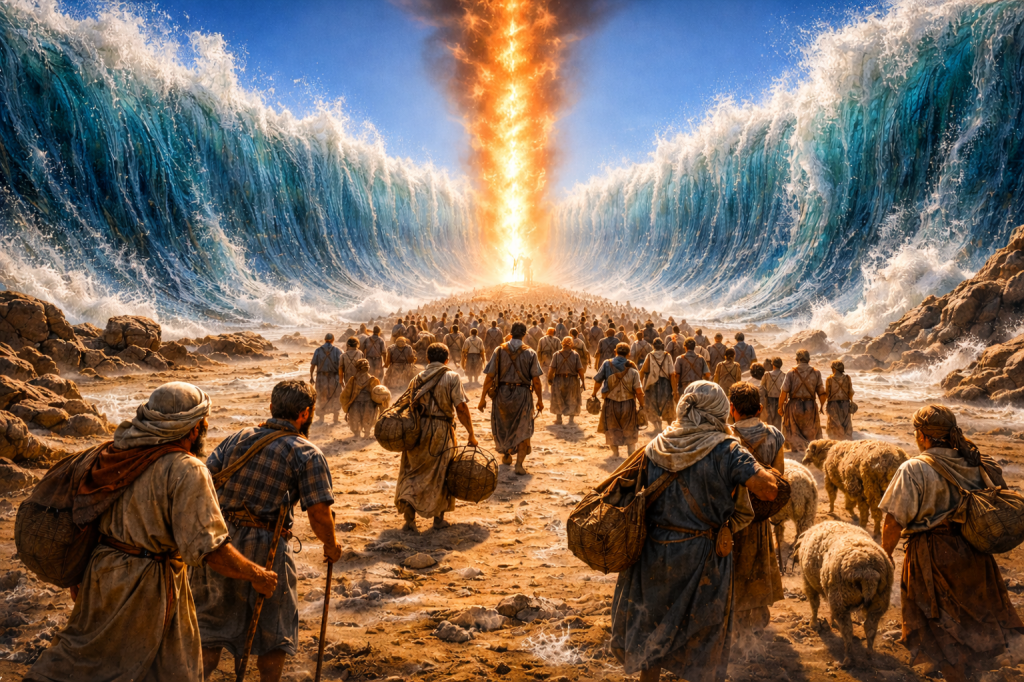
    God’s words to Moses in verse 15 are almost abrupt. “Why are you crying out to Me?” Not because prayer is wrong but because the time for waiting has passed. The people are still boxed in. The sea is still ahead. Pharaoh is still behind. Yet God says, “Break camp. Go forward.”

    This is one of the hardest transitions in the spiritual life: knowing when to stop waiting and start moving.

    Notice what God does not say. He does not explain how the sea will open. He does not reveal the timing. He does not calm the people by describing the miracle in advance. He simply commands movement in the direction that still looks impossible.

    Faith does not always wait for clarity. Sometimes clarity comes after obedience.

    Breaking camp meant rolling up tents, gathering children, loading animals, and stepping toward water that had not yet parted. Every instinct would have said, “Wait until it’s safe.” God says, “Move while it’s not.”

    I was once in a place like that, far removed from Egypt and chariots, but just as confining. Years ago in Frederick, Maryland, I found myself worn down and cornered. I was working full time in accounting while also pouring myself into a church start. The work was heavy, the hours were long, and the situation was unraveling because of a lack of integrity from someone I trusted. I wasn’t seeing my family enough. I was tired in body, mind, and spirit.

    One night I came home after a draining commute to find the house empty. Janine and the kids had gone out to eat. I had forgotten my key. So I sat down on the steps, stared up at the stars, and prayed — not eloquently, just honestly.

    “God, You led me here. I know You did. But just as sure as I know that, I know it’s time to move on. And I don’t see how.”

    There was no thunder. No instant answer. Just quiet.

    Not long after, a small church in California heard a sermon tape. A door opened I hadn’t been looking for.

    There was a season of stillness. But there came a moment when God began to nudge me forward. Not with a detailed plan, but with a door opening just enough to step through.

    Verse 15 reminds us that faith is not frozen reverence. It is responsive obedience. We stand still long enough to trust God — and then we move when He says move.

    God does not part seas for spectators. He parts them for people who are willing to break camp.

    • Reflection:  Where might God be asking you to move forward — even though the way is not yet clear?
    • Closing Prayer:  Father, I trust you to tell me when I should be still and when I am to move forward.  You see what appears to me to be a trap and You desire to display Your glory when I am at last delivered.  Teach me to wait without fear and to move without hesitation.  I place myself in your hands this night.  Amen.
    • Read Exodus 12:29-14:9

    MORNING— Judgement at Midnight

    • Focal Passage: Exodus 12:29-31

    “Now it came about at midnight that the Lord struck all the firstborn in the land of Egypt… Pharaoh arose in the night… and he called for Moses and Aaron at night and said, ‘Rise up, get out from among my people…’”

    Midnight arrives with vengeance. 

    Pharaoh had resisted God through warning after warning, sign after sign. He had negotiated, delayed, hardened, relented, and hardened again. But at midnight, the struggle ended.

    Every house in Egypt experienced loss. Scripture is unflinching: “There was no home where there was not someone dead” (Exodus 12:30). Rank, wealth, power, and lineage offered no protection. The gods of Egypt were silent. The throne of Pharaoh was powerless.

    And yet—on that same night—Israel walked free.

    What changed?  It wasn’t Israel’s strength or Moses’ eloquence.  Certainly not the sudden compassion of Pharaoh.

    What changed was God’s timing.

    Earlier God had declared: “Against all the gods of Egypt I will execute judgments—I am the Lord” (Exodus 12:12). This night was not merely about release; it was about revelation. Egypt would know Who truly ruled. Israel would learn Who truly saves.

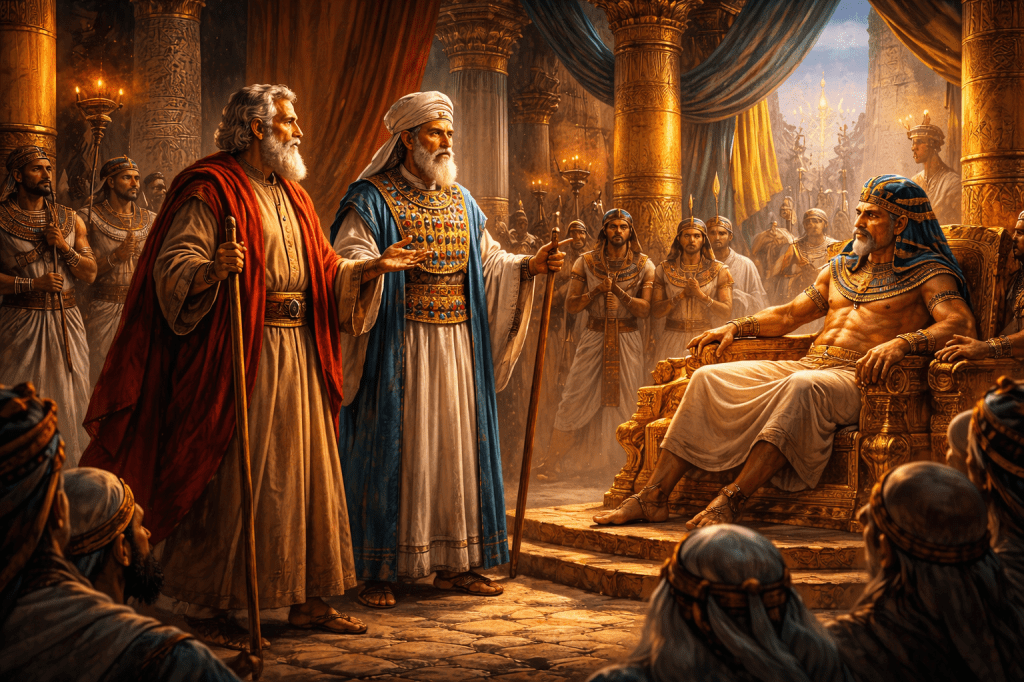
    Notice the reversal: Pharaoh does not negotiate at midnight. He does not threaten. He summons Moses and Aaron and commands, “Go.” The man who once scoffed, “Who is the Lord that I should obey His voice?” now urges God’s people to leave—immediately.

    Deliverance often feels delayed…
    but when it comes, it comes decisively.

    There are seasons when God allows the night to deepen—not because He has forgotten, but because only the night can finally expose false power and stubborn hearts.

    • Reflection:  Is there a “midnight” you are seeking to avoid, when it may be the very moment He intends to set you free?

    EVENING— Freedom Won, Freedom Pursued

    • Focal Passage: Exodus 14:5-9

    “Now it was told the king of Egypt that the people had fled… Pharaoh made ready his chariot and took his people with him… and overtook the sons of Israel as they were camping by the sea.”

    Freedom is rarely uncontested.

    Israel left Egypt loaded with silver and gold, guided by the pillar of cloud and fire, marching as a redeemed people. The promises were being fulfilled. God was leading. The night was over.

    And then Pharaoh changed his mind.

    Scripture says his heart turned—not because God failed, but because power never relinquishes control quietly. The same Pharaoh who begged Israel to leave now mobilizes chariots. He pursues what he had just released.

    This is a sobering truth:
    Deliverance does not mean the enemy stops chasing—it means the enemy no longer has authority.

    Pharaoh’s army was terrifying: six hundred elite chariots, officers, horses, and soldiers—an overwhelming force against a newly freed people with families, livestock, and no weapons. From a human perspective, Israel looked foolish to have left.

    But Scripture has already told us something Pharaoh did not understand:

    “The Lord will fight for you while you keep silent.” (Exodus 14:14)

    There is a difference between being pursued and being owned.

    A person who has broken free from addiction may still feel cravings.
    A forgiven believer may still hear the voice of accusation.
    A redeemed people may still see chariots in the distance.

    But pursuit does not equal defeat.

    “Therefore there is now no condemnation for those who are in Christ Jesus.”
    Romans 8:1 (NASB 1995)

    Pharaoh could pursue Israel, but he no longer owned them.
    He could threaten, but he could not judge.
    The sound of chariots did not mean the verdict had changed.

    God had already spoken.

    He speaks the same to you.

    • Reflection:  What still feels like it is chasing you, even after God has declared you free—and how does Romans 8:1 change the way you interpret that pursuit?
    • Closing Prayer:  Father, I thank you that, through Christ, you have defeated the enemy of my soul.  I have been set free.  Help me daily remember that when the enemy tries to reassert control over my life.  I embrace your statement:  He whom the Son sets free will be free indeed.  Amen.
    • Read Exodus 11-12:14

    MORNING— When I See the Blood

    • Focal Passage: Exodus 12:13

    “The blood shall be a sign for you on the houses where you live; and when I see the blood I will pass over you, and no plague will befall you to destroy you when I strike the land of Egypt.”

    The final plague was different from all the others.  The darkness came and lifted.
    The swept up the dead frogs.  The Hail fell and stopped.
    But this plague—death—would not simply disrupt life. It would end it.

    At midnight, judgment would pass through every neighborhood in Egypt. Not just Pharaoh’s palace. Not just the homes of idol worshipers. Death would knock on every door, from the firstborn of Pharaoh to the firstborn of the servant girl behind the millstones.

    Scripture reminds us that this plague is not ancient or foreign. It is universal.

    “It is appointed for men to die once, and after this comes judgment.” (Hebrews 9:27)

    Death does not discriminate. It comes to the religious and irreligious, the wealthy and the poor, the moral and immoral. The difference—then and now—is not whether death comes, but whether a substitute has already died in your place.

    That night, there was a death in every house in Egypt.

    The only question was who would die.

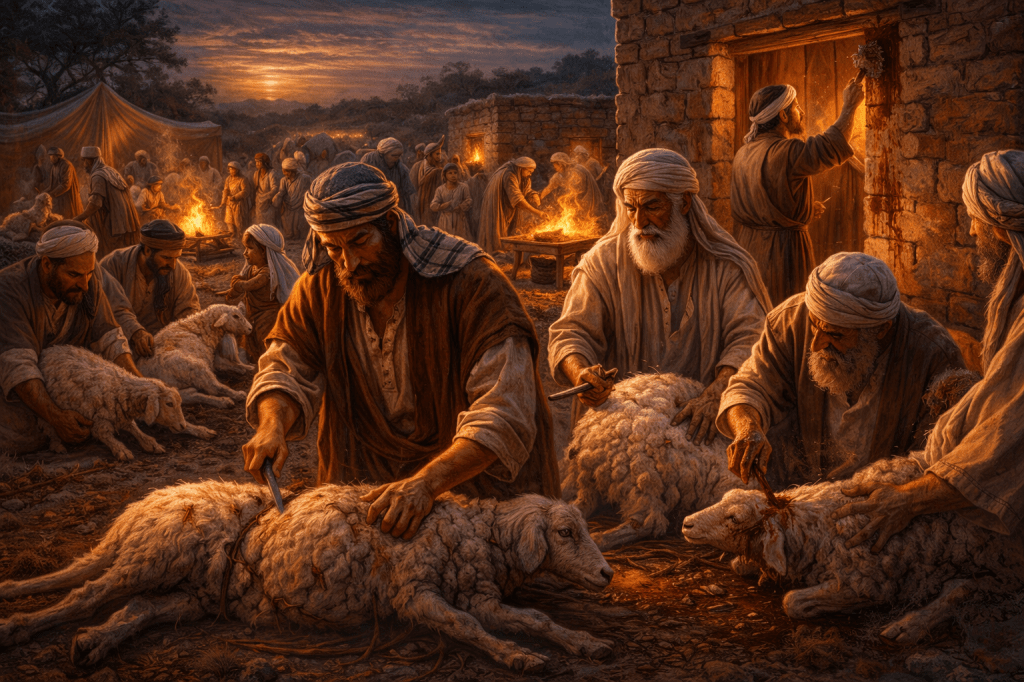
    For the Israelites, God provided a way of escape—not through merit, status, or lineage, but through blood applied in faith. The lamb had to be chosen. The lamb had to be killed. And the blood had to be applied to the doorposts and lintel.

    God did not say, “When I see your sincerity.” He did not say, “When I see your fear.”
    He did not say, “When I see your good intentions.”

    He said:  “When I see the blood… I will pass over you.”

    The Israelites were not saved because they were braver than the Egyptians. Some were undoubtedly terrified. They weren’t saved because of bravery, but through trust in God’s provision.

    As D. A. Carson once illustrated, two Israelites could have approached that night very differently—one fearful and anxious, the other calm and trusting. Yet if both applied the blood, both found their first born alive the next morning. The difference was not the outcome, but the experience. One slept in peace. The other in dread.

    • Reflection:  Are you resting tonight in what Christ has done—or anxiously hoping you’ve done enough?

    EVENING— The Lamb Who Was Enough

    • Focal Passage: Exodus 12:26

    “When your children ask you, ‘What does this ritual mean to you?’ you are to reply, ‘It is the Passover sacrifice to the Lord, for He passed over the houses of the Israelites in Egypt when He struck the Egyptians and spared our homes.”

    The Passover was never meant to end in Egypt. It was a shadow, not the substance.

    Scripture traces a remarkable progression:

    • In Genesis, it was a lamb for one man (Abel).
    • In Exodus, it became a lamb for each family.
    • In Leviticus, it was a lamb for the nation, offered year after year.

    But the blood of animals could only delay judgment—not remove guilt.  That is why the New Testament speaks so clearly:

    “For it is impossible for the blood of bulls and goats to take away sins.” (Hebrews 10:4)

    All those lambs were pointing forward—to one final Lamb.  When John the Baptist saw Jesus, he did not introduce Him as a teacher or reformer. He announced Him as fulfillment:

    “Behold, the Lamb of God who takes away the sin of the world!” (John 1:29)

    Jesus was perfectly chosen—without blemish.
    Perfectly examined—even His enemies found no fault.
    Perfectly sacrificed—once, for all time.

    Paul leaves no ambiguity:

    “Christ our Passover also has been sacrificed.” (1 Corinthians 5:7)

    But here is the crucial truth Exodus teaches us with sobering clarity:
    A lamb slain does not save unless the blood is applied.

    Salvation has always been personal.

    Exodus 12 quietly records a progression:

    • A lamb (v. 3)
    • The lamb (v. 4)
    • Your lamb (v. 5)

    Many are willing to say Jesus is a Savior.
    Some will admit He is the Savior.
    But salvation comes when you can say, “He is my Savior.”

    • Reflection:  Have you personally applied the blood of Christ—or are you standing near the door, hoping proximity will be enough?
    • Closing Prayer:  Father, thank You for the Lamb You provided—when we could not save ourselves.  Teach us to remember your sacrifice with grateful hearts and confident faith.  May we be reminded to live each day under the covering of Christ, passed over by judgment and claimed by grace.
      Amen.
    • Read Exodus 7

    MORNING— So That They May Know

    • Focal Passage: Exodus 7:5

    “The Egyptians shall know that I am the Lord, when I stretch out My hand on Egypt and bring out the sons of Israel from their midst.”

    The confrontation between Moses and Pharaoh is not primarily about winning an argument or forcing a decision. God tells us plainly why this encounter is unfolding:

    So that they may know.

    Egypt had many gods. Pharaoh himself was regarded as divine. Power was measured by spectacle, control, and fear. Israel, meanwhile, had lived so long under oppression that they were unsure whether their God still acted at all.

    Into that confusion, God steps forward—not to negotiate, but to reveal Himself.

    The signs Moses performs are not parlor tricks. They are disclosures. Each word spoken, each act performed, is meant to answer a single question: Who is the Lord?

    God’s purpose reaches beyond Pharaoh’s throne room. Israel must know. Egypt must know. And history must know. The Lord is not one god among many. He is the Lord.

    • Reflection:  Where might God be working in your life—not merely to change circumstances, but to make Himself known more clearly?

    EVENING— Who Really Holds the Power?

    • Focal Passage: Exodus 7:12

    “But Aaron’s staff swallowed up their staffs.”

    Pharaoh’s magicians are able to imitate the first sign. Their staffs become serpents too. For a moment, it appears as though power is evenly matched.

    But then Aaron’s staff swallows theirs.

    It is a quiet but decisive moment. God demonstrates the limits of manmade religion. What Egypt claims as strength is absorbed. What Pharaoh trusts is exposed as fragile.

    This moment previews what is coming next.

    The plagues that follow are not random acts of judgment. Each one confronts an Egyptian god directly:

    • The Nile turned to blood challenged Hapi, god of the river.
    • Frogs filled the land, mocking Heqet, goddess of fertility.
    • Darkness fell, humiliating Ra, the sun god.
    • Even Pharaoh’s authority collapsed when his firstborn died.

    Again and again, God answers the same question: Who really holds the power?

    By the time Israel walks out of Egypt, it is no longer in doubt. The Lord alone rules over nature, nations, life, and death.

    • Reflection: Where are you tempted to fear competing powers—when God has already shown that He alone prevails?
    • Closing Prayer:  Lord, Open our eyes to see who You truly are. When false powers appear strong, remind us that You alone endure. Teach us to trust not what impresses the world, but what reveals Your glory. So that we may know—and live accordingly.
      Amen.
    • Read Exodus 4

    MORNING— Here I Am… But

    • Focal Passage: Exodus 4:1

    “Then Moses said, ‘What if they will not believe me or listen to what I say?”

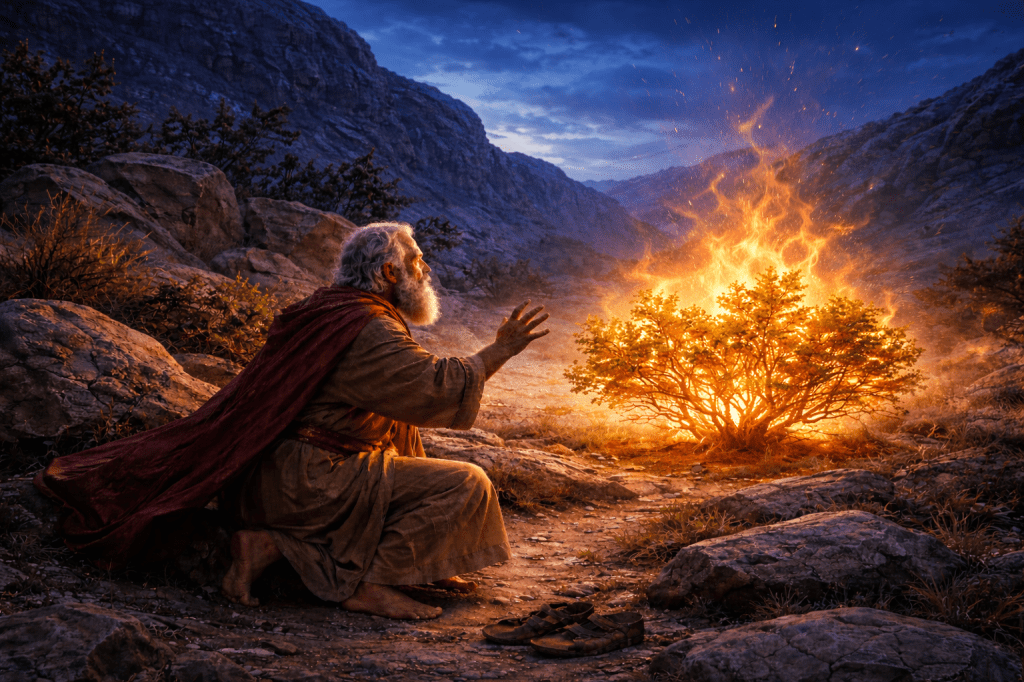
    Moses stands before God at the burning bush—sandals off, heart exposed, listening to a call he once longed to receive-to help rescue his own people from bondage. And yet, instead of stepping forward, he pauses.

    What follows is not rebellion so much as hesitation layered with concern. Moses does not deny God’s voice. He simply begins to ask what if.

    Zig Ziglar once told a story about a man who went next door to borrow his neighbor’s lawnmower. The neighbor explained that he couldn’t lend it because all the flights from New York to Los Angeles had been canceled.

    Puzzled, the borrower asked what airline cancellations had to do with borrowing a lawnmower.

    The neighbor replied, “It doesn’t have anything to do with it—but if I don’t want to let you use my lawnmower, one excuse is as good as another.”

    Moses’ responses begin to sound familiar. What if they don’t believe me? What if I say the wrong thing? What if I’m not the right person? What if someone else would do this better?

    And if we’re honest, those questions echo in our own hearts as well.

    God does not dismiss Moses for asking. But neither does He allow the excuses to stand. Instead, He patiently redirects Moses’ attention—from his inadequacy to God’s sufficiency, from his fear to God’s presence, from what Moses lacks to what God will provide.

    The call of God often comes with tension—not because God is unclear, but because obedience requires trust before certainty.

    • Reflection:  Which “what if” question has been quietly delaying your obedience to God?

    EVENING— What’s in Your Hand?

    • Focal Passage: Exodus 4:2

    “The Lord said to him, ‘What is that in your hand?’ And he said, ‘A staff.”

    In April 1970, the crew of Apollo 13 suffered an explosion that crippled their spacecraft. Power was failing. Oxygen was running out. The mission to the moon was over—but survival was now in doubt.

    One of the most serious problems was carbon dioxide buildup. The scrubbers designed to remove it were incompatible between the command module and the lunar module. The astronauts could suffocate if a solution wasn’t found quickly.

    NASA engineers were given a blunt assignment: “You must solve this problem using only what the astronauts already have on board.” No new tools. No ideal equipment.

    Using duct tape, plastic bags, cardboard, and a sock—items already in the spacecraft—the engineers improvised a working solution. The astronauts assembled it exactly as instructed, and the crisis passed. The crew returned safely to Earth.

    NASA didn’t save Apollo 13 by giving the astronauts something new. They saved them by showing them how to use what was already in their hands.

    God does not answer Moses’ doubts with a lecture.
    He asks a question.

    What is that in your hand?

    A staff—ordinary, familiar, unimpressive. The tool of Moses’ daily work. God does not ask Moses for something new or dramatic. He asks him to surrender what he already carries.

    In verse 20, Scripture quietly notes a change: “Moses also took the staff of God in his hand.” What was once his own now belonged to God. The staff did not remove fear, shorten the journey, or guarantee ease—but it became the place where obedience and God’s power met.

    God often begins His work not with what we wish we had, but with what has already been placed into our hands.

    • Reflection: What might God be able to do—not if you had more—but if you offered what you already have?
    • Closing Prayer:  Faithful God, You know our fears, our doubts, and the excuses we carry. Teach us to trust You not with what we wish we had, but with what You have already given us. Give us courage to lay it down in obedience, believing that You are more than enough. Take what is ours and make it Yours—for Your glory.
      Amen.
    • Read Exodus 2:11-25; 3

    MORNING— FIRE!

    • Focal Passage: Exodus 3:2

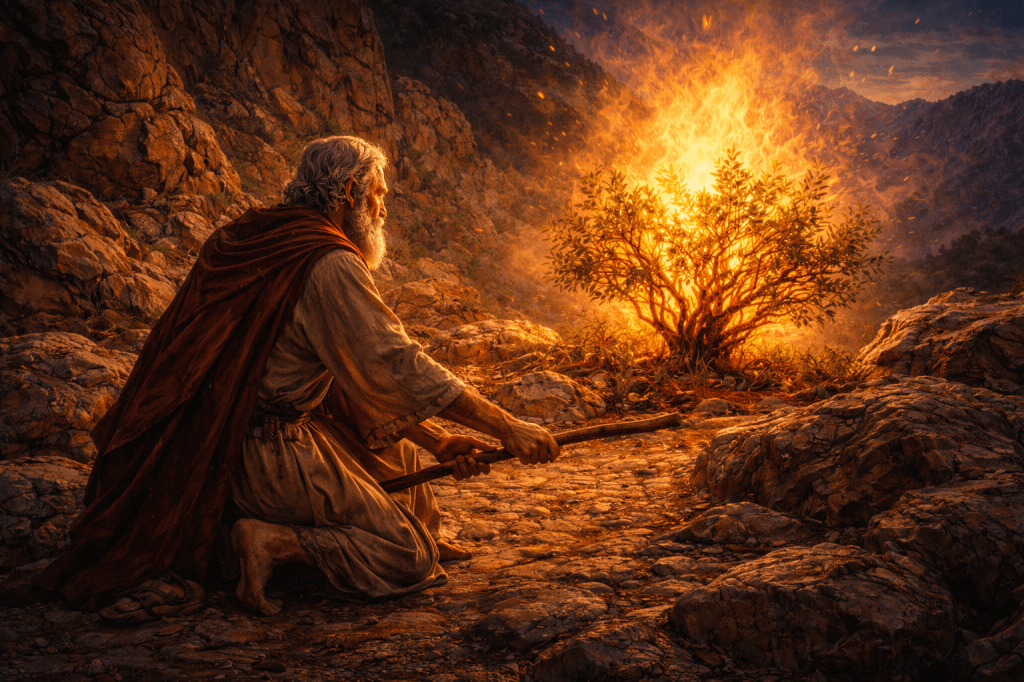
    “The angel of the Lord appeared to him in a blazing fire from the midst of a bush… yet the bush was not consumed.”

    After a disastrous attempt to deliver his people from bondage (Exodus 2:11–15), Moses found himself on the backside of the desert.

    Once a prince in Pharaoh’s household, Moses now walked behind sheep. The man who believed he was ready to lead discovered he was not ready at all. His passion had outrun God’s timing, and the result was exile—forty years of anonymity, routine, and waiting. The deliverer became a shepherd, and the dream faded into the background of ordinary days.

    God did not speak to Moses at the height of his confidence, but at the end of his self-reliance.

    Then fire appeared—not in a palace, not in a temple, but in a bush along a desert path. Burning bushes were not unusual in the wilderness, but this one refused to burn out. Moses stopped. He turned aside. And when he did, God called his name.

    Centuries later, the same thing happened to Blaise Pascal. A mathematical prodigy, inventor, and scientific genius, Pascal spent decades running from God. Then one night in November of 1654, after a terrifying brush with death, he encountered the living God. His life was forever changed. After his death, a note was found sewn into his coat—his private testimony. At the top of it was one word:

    FIRE!

    Not theory. Not intellect.
    A word symbolizing:  Encounter.

    The living God still interrupts ordinary routines—often after failure, often in obscurity. The question is not whether God is present, but whether we will turn aside to look.

    • Reflection:  Where might God be inviting you to pause, turn aside, and notice His presence—especially in the wake of disappointment?

    EVENING— God’s Humble Choice

    • Focal Passage: Exodus 3:5

    “Do not come near here; remove your sandals from your feet, for the place on which you are standing is holy ground.”

    The fire drew Moses closer—but holiness stopped him short.

    Before God explained His plan, He established His holiness. Shoes came off. Awe replaced familiarity. Any real encounter with God reshapes how we approach Him.

    And notice where God chose to appear.

    Not in a palace.
    Not in a temple.
    Not even in a towering tree.

    Exodus says it was a bush—a low, ordinary desert shrub. The Hebrew word (seneh) emphasizes humility. God did not choose a cedar.

    It is intentionally not a tree—which actually heightens the humility and surprise of God’s appearance.

    Then God revealed His heart:
    “I have surely seen… I have heard… I am aware… I have come down to deliver.”

    A holy God sends a humble servant on a holy mission.

    Moses thought he had missed his calling decades earlier. God revealed that the desert years were not wasted—they were preparation. The God who speaks from humble places sends ordinary people into holy work.

    God does not need an impressive servant. He only needs a willing one.

    • Reflection: What might God want to do through you—not because of your strength, but because of your availability?
    • Closing Prayer:  Living God, open our eyes to Your presence in the ordinary. Teach us to pause, to listen, and to approach You with reverence. Where our lives feel small or overlooked, remind us that You delight in using humble places for holy purposes. Call us, shape us, and send us—according to Your will.
      Amen.