• Read: Genesis 37

    MORNING— Joseph’s Dreams

    • Focal Passage: Genesis 37:5

    “Then Joseph had a dream, and when he told it to his brothers, they hated him even more.”

    Genesis 37 opens quietly. Jacob is settled in the land of Canaan, and though his story will continue, the focus subtly shifts with a single name:

    Joseph.

    At seventeen, Joseph lives in a complicated household. He is favored by his father, marked by a richly ornamented tunic, and resented by his brothers. Long before God speaks, the family system is already strained by favoritism, rivalry, and unhealed wounds.

    And yet God does speak.

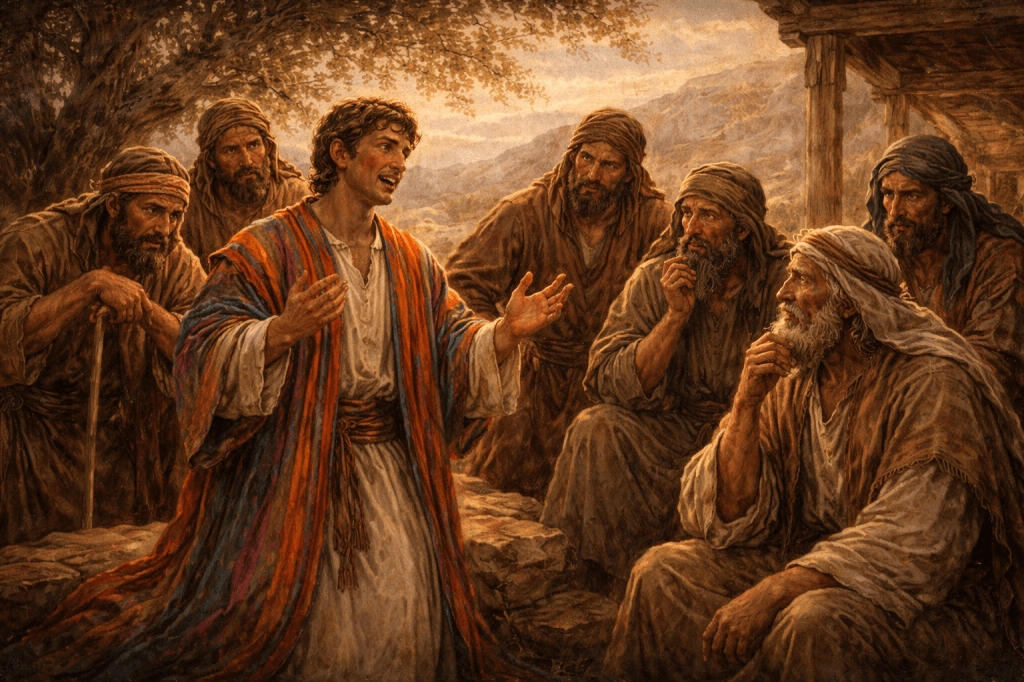
    Joseph receives dreams—clear, symbolic, unmistakable. In them, his life matters. Authority is promised. Honor is foreshadowed. Even his own family will one day bow. Scripture presents these dreams not as ambition, but as revelation. Joseph does not chase greatness; it is announced to him.

    But revelation often arrives before readiness.

    Joseph shares his dreams openly, perhaps too openly. Instead of encouragement, he meets resistance. His brothers grow angrier. Even Jacob rebukes him, though he quietly stores the matter away in his heart.

    God-given dreams rarely come with immediate clarity.

    John Kavanaugh once traveled to Calcutta to work among the dying, hoping to gain direction for the rest of his life. On his first day, he asked Mother Teresa to pray that God would give him clarity. She refused. When he asked why, she replied, “Clarity is the last thing you are clinging to and must let go of. I have never had clarity—only trust.”

    Joseph receives no clarity—only a dream.

    He does not know how it will happen, when it will unfold, or what it will cost. He knows only that God has spoken. And for now, that will have to be enough.

    God often gives dreams without explanations, promises without timelines, and calling without instructions. What He looks for first is not understanding, but trust.

    • Reflection:  Is there something God once placed in your heart that you quietly stopped believing was from Him?

    EVENING— Between Promise and Fulfillment: A Pit

    • Focal Passage: Genesis 37:28

    “So they pulled him up and lifted Joseph out of the pit, and sold him to the Ishmaelites for twenty shekels of silver.”

    Genesis 37 turns sharply from dreams to violence.

    Joseph is no longer dreaming in safety. He is stripped of his tunic, lowered into a pit, and eventually sold to strangers. Joseph does not choose this path. He does not consent to it. His life is redirected without his permission.

    There is a popular philosophy that says, “If it is to be, it is up to me.” It sounds empowering—until the moment life slips from our grip. When control is taken away, that philosophy collapses. If everything depends on us, then losing control means the dream is over.

    Joseph’s story tells us otherwise.

    Nothing about this moment suggests progress. Joseph is not moving closer to the dream—he is being carried farther from it. He is no longer directing his life; he is being forced along by decisions made by others.

    And yet, God is not absent.

    The God who gave the dream is greater than every outside force now steering Joseph’s life. He reigns above betrayal, above injustice, above systems that buy and sell people. What feels like chaos to Joseph is not outside God’s providence.

    Joseph’s brothers believe they are ending the dream. The traders believe they are controlling his future. In reality, none of them are in charge.

    God is.

    The pit is not the end of the dream.
    It is the place where Joseph learns who truly controls his life.

    • Reflection:  When control was taken from you, did you assume God had lost His grip—or were you being asked to trust Him more deeply?
    • Closing Prayer:  Father, when my life feels steered by forces I cannot control, help me trust that You still reign.  I release what I cannot manage, and rest in the truth that You govern even this. Keep my heart faithful while You work beyond my sight. Amen.
    • Read Genesis 35

    MORNING— Back to Bethel

    • Focal Passage: Genesis 35:1

    “Then God said to Jacob, ‘Arise, go up to Bethel and live there, and make an altar there to God, who appeared to you when you fled from your brother Esau.”

    There are seasons when the fire grows dim.

    Charles Finney once admitted that even in the midst of fruitful ministry, he sometimes sensed a coldness settling over his own heart. He didn’t excuse it or ignore it. He withdrew. He fasted. He prayed. And as Finney described it, he “plowed up until I struck fire and met God.”

    Jacob knew something about that fire.

    Genesis 34 records one of the darkest chapters in his life. Violence. Deception. Moral collapse. And perhaps most telling of all—God is not mentioned once. His name simply disappears from the narrative. That’s often how drift begins. Not with outright rebellion, but with quiet absence.

    Then, in Genesis 35, God speaks again.

    “Arise, go up to Bethel and live there.”

    Bethel was not a new place. It was an old one. Years earlier, Jacob had encountered God there while fleeing from his brother. He had made a vow—“If God will be with me… then the LORD will be my God.” Now God calls him back, not to repeat the past, but to remember it.

    Revival often begins the same way—not with something new, but with a return.

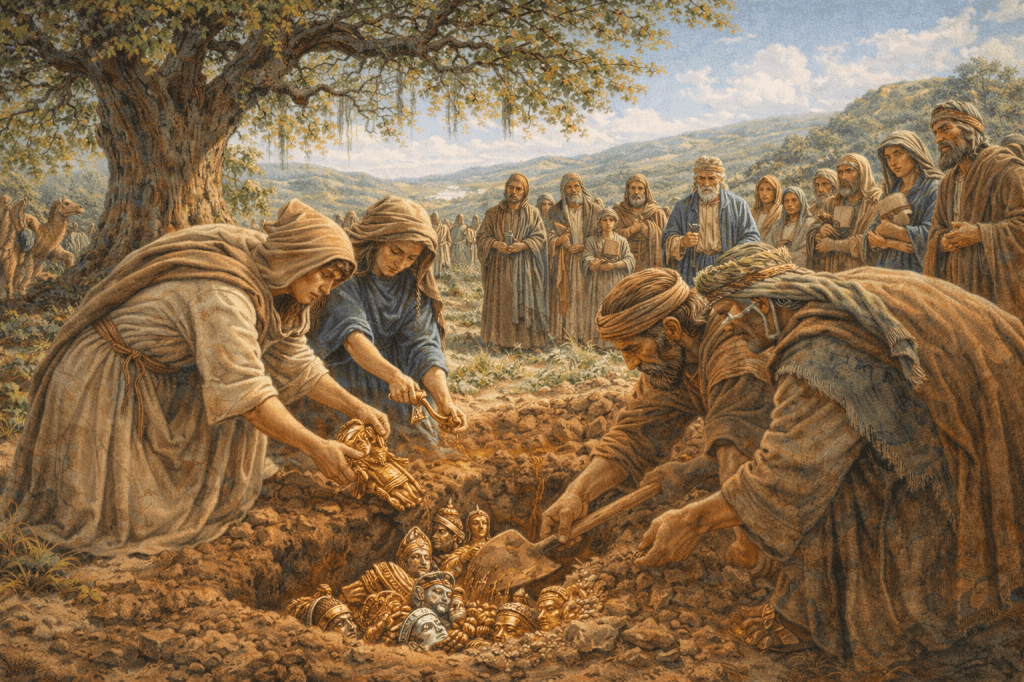
    Jacob obeys, and before the journey begins, he calls his household together:

    “Put away the foreign gods… purify yourselves… change your garments.” They buried their idols “underneath the oak 🌳which was near Shechum.” (v. 4)

    Coming back to Bethel required a decision. Allegiances had to be clarified. Things carried too long had to be laid down. What once felt harmless now had to go.

    We may not carry carved idols, but Scripture still warns us plainly:

    “Little children, guard yourselves from idols.”
    1 John 5:21 (NASB 1995)

    Anything we rely on for security, meaning, or hope in place of God can quietly take His seat in our hearts.

    When Jacob arrived at Bethel, he built an altar. He remembered who God had been to him—“the God who answered me in the day of my distress.” And God met him there again.

    Sometimes the way forward begins by going back—to the place where you first met Him.

    • Reflection:  This morning, consider this:  Where was your Bethel?  What promises did you make there?  And could God be gently calling you back?

    EVENING— The Oak of Weeping

    • Focal Passage: Genesis 35:8

    🌳 “Now Deborah, Rebekah’s nurse, died, and she was buried below Bethel under the oak; it was named Allon-bacuth.”

    Jacob came back to Bethel expecting renewal—and he received it. But revival did not spare him from sorrow.

    Just after God reaffirmed His promises, the narrative pauses on a quiet, easily overlooked verse. Deborah, the nurse who had likely been part of Jacob’s life since childhood, dies and is buried beneath an oak 🌳. The place is named Allon-bacuththe Oak of Weeping.

    It is a tender detail. A reminder that even in seasons of spiritual clarity, grief still finds us. Bethel was a place of worship—but nearby stood an oak named for tears.

    Soon after, Rachel—the love of Jacob’s life—dies in childbirth. Jacob sets up another stone, this one not of celebration, but of loss. Revival did not remove the ache; it steadied him within it.

    Life is often like that.
    One stone marks where God met us.
    Another marks where someone we loved was laid to rest.

    And yet, God was still at work.

    Rachel named her son Ben-oni—“son of my sorrow.” Jacob renamed him Benjamin—“son of my right hand.” What began in grief was redefined by hope.

    Even the geography whispers grace. Rachel died near Ephrath—later known as Bethlehem. And just beyond, near Migdal-eder—the watchtower of the flock—shepherds would one day hear angels announce the birth of the Savior. God was weaving redemption into places marked by pain.

    God met Jacob at Bethel.
    And God stayed with him at the oak 🌳.

    • Reflection:  Can you name a place in your life where worship and weeping now stand side by side—and are you willing to trust that God is present in both?
    • Closing Prayer:  Father, You are the God who calls us back—and the God who stays with us when we weep. If my heart has drifted, draw me back to Bethel. And if sorrow lingers tonight, meet me beneath the oak. Thank You that renewal does not cancel grief, and grief does not cancel Your promises. Be my God again tomorrow, as You were the day I first met You. Amen.
    • Read: Genesis 32

    MORNING— At the Watershed

    Focal Passage: Genesis 32:11–12

    11 Deliver me, I pray, from the hand of my brother, from the hand of Esau; for I fear him, that he will come and attack me and the mothers with the children. 12 For You said, ‘I will surely prosper you and make your descendants as the sand of the sea, which is too great to be numbered.’”

    There are moments in life that divide everything into before and after. Scripture calls today’s passage one of those moments for Jacob.

    The word watershed originally described a ridge of land where rain fell in two different directions, feeding two different river systems. Over time, it came to mean a decisive turning point—an event that forces a person to move one way or another. Genesis 32 is Jacob’s spiritual watershed.

    Jacob is finally heading home. Behind him is a life marked by cleverness, manipulation, and escape. Ahead of him is Esau—the brother he deceived, the relationship he never made right. Jacob could have avoided this confrontation. Instead, he moves forward in obedience, even though fear walks beside him.

    Along the way, God gives Jacob a glimpse of unseen reality. Angels meet him on the road—God’s camp surrounding him. Jacob names the place Mahanaim, “two camps,” a reminder that he is not as alone as he feels. God has already gone ahead of him.

    Still, Jacob does what comes naturally. He sends messengers. He gathers information. He divides his camp. He prays—but even his prayer is laced with contingency, as if faith must be backed up by strategy. Fear has a way of doing that to us.

    Yet hidden inside Jacob’s prayer is a fragile but powerful thread: “But You promised.” That single phrase reveals the beginning of change. Jacob may not fully trust yet—but he remembers God’s word.

    Watershed moments often begin this way. We come to the end of our plans, our rehearsed speeches, our carefully constructed strategies. And we realize that if we are going to move forward, God will have to carry us.

    • Reflection:
      What fear is God asking you to face—not with better planning, but with deeper trust in His promise?

    EVENING— Face to Face

    • Focal Passage: Genesis 32:30

    “So Jacob name the place Peniel, for he said, I have seen God face to face, yet my life has been preserved.”

    That night, everything changes.

    Jacob sends his family, servants, and possessions across the Jabbok River. For the first time in years, he is truly alone. No audience. No leverage. No escape route. And it is there—at the empty center of his life—that God meets him.

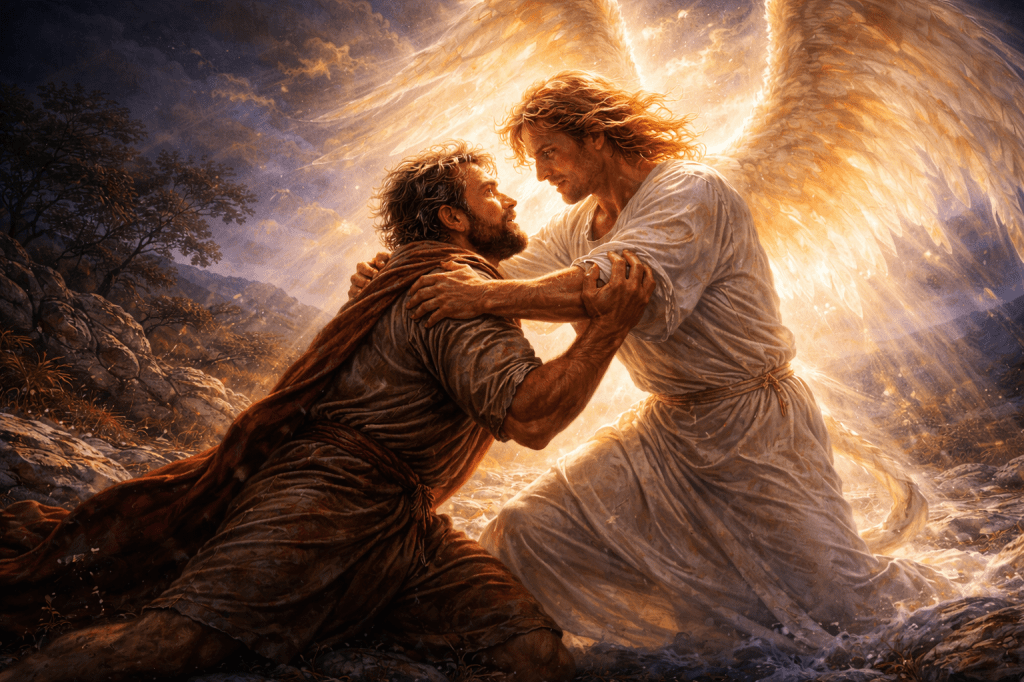
    The struggle that follows is strange and unsettling. A man wrestles with Jacob until daybreak. There is a triple word play going on here in the Hebrew.  The Hebrew for wrestled (ye’abeq) is similar in sound to Jacob (ya’aquob) and Jabbock (yabboq) – the place this wrestling match takes place.  The triple word play is there to mark the importance of this pivotal moment in Jacob’s life. Scripture wants us to feel its intensity. This is not a casual encounter. This is Jacob wrestling with the God he has talked about for years but never truly surrendered to.

    Jacob does not win the fight. With a single touch, his opponent dislocates his hip. Yet Jacob refuses to let go. For the first time, he is not grasping for advantage—he is clinging for grace.

    “I will not let You go unless You bless me.”

    God responds with a question that cuts to the heart: “What is your name?” Jacob answers honestly. Jacob. Heel-grabber. Deceiver. The name he has spent his life trying to outrun.

    God gives him a new name instead: Israel—one who strives with God, or one for whom God fights. The blessing Jacob receives is not wealth, safety, or immediate resolution. It is assurance. Grace. A transformed identity.

    Jacob limps away at sunrise, marked forever by the encounter. The limp will slow him down. It will remind him that blessing comes not through strength or schemes, but through surrender. He names the place Peniel—“the face of God”—because he realizes something astonishing: he met God in the struggle, and lived.

    Some encounters with God leave us comforted. Others leave us changed. The deepest ones do both.

    • Reflection:
      Where might God be inviting you to stop striving—and begin clinging?
    • Closing Prayer: Gracious God, meet me in the places where my strength runs out. Teach me to release control and hold fast to You instead. Give me the courage to face You honestly, and the grace to walk forward changed. Amen.

    • Read Genesis 28

    MORNING— Surely the Lord is in This Place

    • Focal Passage: Genesis 28:16

    “Surely the Lord is in this place, and I did not know it.”

    Jacob did not leave home under noble circumstances. He was not heading out on a great adventure fueled by courage or faith. He was running. Running from the consequences of his own deception. Running from a brother who wanted him dead. Escaping with just the clothes on his back and his staff in his hand.

    Probably not how he pictured leaving home.

    When Jacob finally stops for the night, there is no indication that he believes in the God of Abraham and Isaac in any personal way. He knows the language. He knows the stories. But faith, at this point, still belongs to his parents. Jacob is living off borrowed belief.

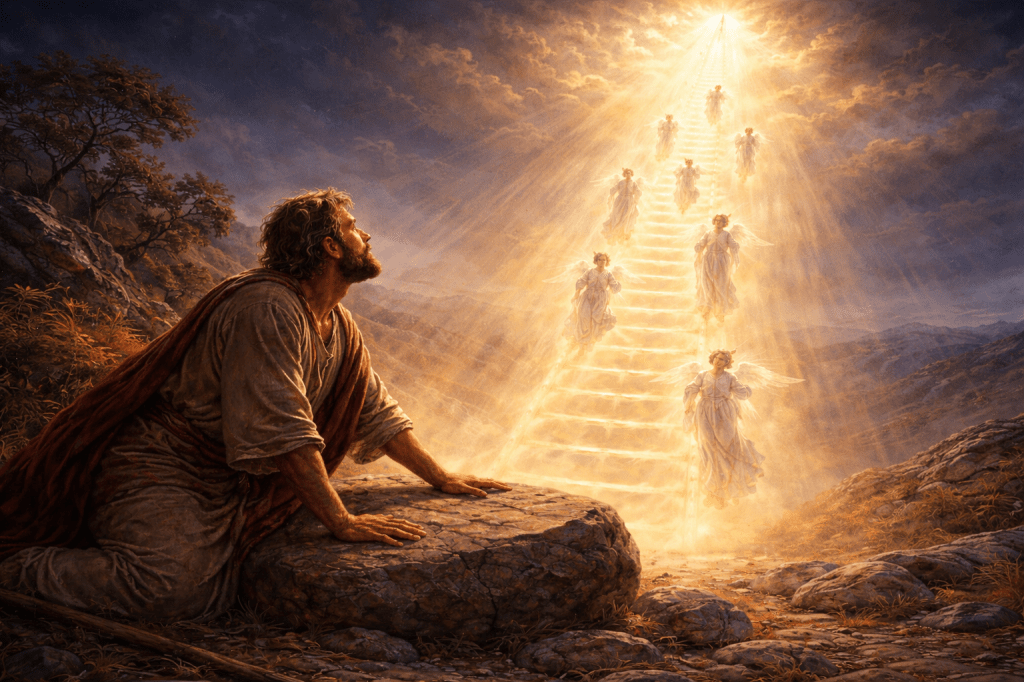
    He lays his head on a stone, falls asleep in the open country, and it is there—at his lowest, loneliest moment—that God shows up.

    Jacob dreams of a ladder set on the earth, its top reaching to heaven. Angels ascend and descend. And above it all stands the Lord, who speaks promises Jacob has done nothing to earn. Land. Descendants. Blessing. Presence. The same promises given to Abraham and Isaac are now spoken directly to Jacob.

    Jacob’s reaction when he wakes?

    “Surely the Lord is in this place, and I did not know it.”

    Jacob doesn’t say, “I finally found God.”
    He says, “God was already here.”

    In our wanderings, when we feel so far away from our Maker, wherever it is we lay our head, in a 5 star hotel or in an alleyway–God is already present.

    Like Jacob’s experience, God meets us first—before awareness, before belief, before response.

    This is often how God works.

    We assume God shows up when we are spiritually alert, morally strong, or faithfully consistent. But Scripture repeatedly shows us a God who meets people when they are exhausted, confused, running, or unaware.

    Jacob slept on a stone that night, but he awoke on holy ground.

    • Reflection:
      Where might God already be present in your life—even if you haven’t fully recognized it yet?

    EVENING— Grace Before Growth

    • Focal Passage: Genesis 28: 15

    “Behold, I am with you and will keep you wherever you go… for I will not leave you until I have done what I have promised you.”

    Jacob’s awakening is sincere—but his response is immature.

    He sets up the stone as a pillar, pours oil on it, names the place Bethel (“house of God”), and then promptly begins negotiating with God.

    “If God will be with me…
    If He will keep me…
    If He will give me food and clothing…
    If I return safely…”

    Then—then—the Lord will be his God.

    It’s hard not to wince at that.

    God has just made unconditional promises, and Jacob responds with conditions. He tries to turn grace into a contract. He treats God the same way he treated Esau—bargaining, calculating, protecting his own interests.

    Yet here is the astonishing part of the story:

    God does not withdraw.

    He does not revise the promise.
    He does not correct Jacob mid-vow.
    He does not say, “Come back when your faith matures.”

    God simply lets Jacob move forward—still under promise.

    This is grace.

    Jacob’s faith is real, but it is small. It is mixed with pride, fear, and self-interest. And yet God remains faithful—not because Jacob understands Him correctly, but because God is faithful to His own word.

    Years later, Jesus would speak to Nathanael and deliberately echo this moment:

    “You will see heaven opened, and the angels of God ascending and descending on the Son of Man.” (John 1:51)

    Jacob was in no shape to climb this ladder (contrary to the children’s song “Climbing Jacob’s Ladder” neither or we.) Jesus doesn’t even say He will climb this ladder.
    He declares that He is the ladder.

    The connection between heaven and earth is not a structure, a ritual, or a moral achievement. It is a Person. Grace does not come because we ascend—it comes because God gives Himself.

    Jacob received grace before his faith grew strong.
    We receive grace the same way.

    The good news of Scripture is not that God waits for us to get it right—but that He stays with us because Christ has made us right with the Father.

    • Reflection:
      Where might God be inviting you to stop bargaining and start trusting His promise?
    • Closing Prayer

    Faithful God, Thank You for meeting us before we know You well
    and staying with us while our faith grows.  Teach us to trust Your presence,
    rest in Your grace, and walk forward—not by bargaining, but by believing.
    Amen.

    • Read Genesis 25:19-34

    MORNING— Welcome to the Family

    • Focal Passage: Genesis 25:21

    “Isaac prayed to the Lord on behalf of his wife, because she was barren; and the Lord answered him.”

    Every family has an origin story. Some are told with laughter, others with longing. Jacob’s story begins with prayer—and with waiting.

    Isaac and Rebekah wanted children, but years passed in silence. Twenty years, in fact. Isaac was forty when he married Rebekah and sixty when the twins were born. Two decades of unanswered questions. Two decades of learning that God’s promises often unfold on a slower timetable than our hopes.

    What finally breaks the silence is prayer. (v. 21)

    Isaac did not try to manipulate circumstances as his parents once had. He did not scheme. He did not panic. He prayed. And God answered.

    That answer, however, came with complexity. Rebekah’s pregnancy was not peaceful. The children struggled within her, so much so that she cried out, “If it is so, why then am I this way?” God’s response was startling: there were two nations, two peoples, two futures—already battling with each other before either child took a breath.

    And then the unexpected word: “The older shall serve the younger.”

    God’s purposes often run counter to our assumptions. Jacob was not the obvious choice. He would not come to look like the heir of promise. Yet God chose him—not because of merit, but because of mercy.

    That truth is both humbling and hopeful. God does not choose us because we are impressive. He chooses because He is gracious. And His plans for us are formed long before we are aware of them.

    • Reflection:
      What blessing are you waiting patiently for—and how might prayer, rather than pressure, be the place to begin again?

    EVENING— Names, Stew, and the Weight of a Birthright

    • Focal Passage: Genesis 25:34

    “Thus Esau despised his birthright.”

    Jacob and Esau grew into the tension that marked their beginning.

    Esau looked the part—strong, outdoorsy, admired. Jacob lived among the tents, quieter, more reflective. And yet, Scripture tells us something sobering: appearance does not determine spiritual hunger.

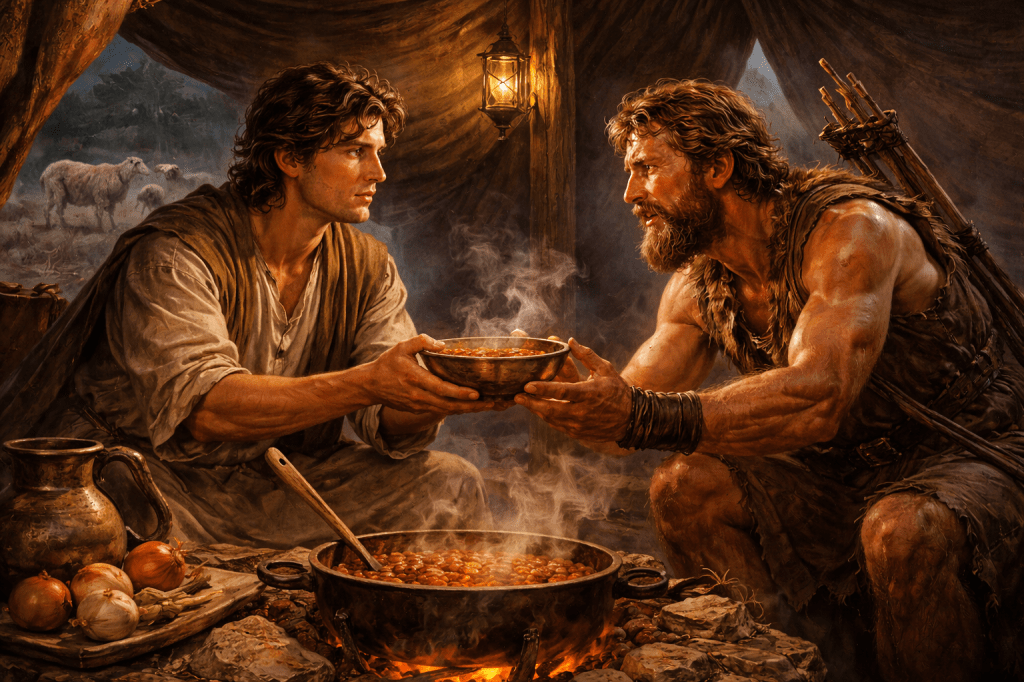
    The famous exchange over lentil stew is not merely about hunger. It is about value. Esau returns exhausted and asks for food, saying, “Let me eat some of that red stuff.” The Hebrew verb used here is לָעַט (lāʿaṭ)—a word often used to describe animals feeding greedily. The language is intentional. Esau is not simply hungry; he is consuming without thought for consequence.

    Jacob, true to his name (Yaʿaqōb—“heel-grabber,” “supplanter”), sees opportunity and schemes to get ahead. Neither brother shines in this moment. But the weight of the text falls on Esau.

    Verse 34 tells us plainly: “Thus Esau despised his birthright.”
    The Hebrew word בָּזָה (bāzāh) means to treat with contempt, to regard as worthless. Esau did not misunderstand the birthright—he dismissed it. He traded what carried covenant meaning for what satisfied immediate appetite.

    The writer of Hebrews later warns the church not to follow this pattern, urging believers to avoid becoming “immoral or godless like Esau, who sold his own birthright for a single meal” (Hebrews 12:16).

    This is not simply a warning against impulse. It is a warning against living without reference to God’s long-term purpose.

    Jacob’s story will take decades to unfold. He will reap the consequences of his scheming. He will limp. He will wrestle. He will weep. And yet, Scripture repeatedly calls the Lord “the God of Jacob.” Not because Jacob was noble—but because God was faithful.

    That is the quiet hope of this passage. God does not abandon people who begin poorly. He reshapes them over time.

    In Christ, we are not defined by a single moment of weakness, nor by the worst trade we have ever made. We are invited to grow into the inheritance God intends—learning, slowly and sometimes painfully, to value what truly lasts.

    • Reflection:  What might you be tempted to treat lightly right now that God calls weighty and sacred?
    • Closing Prayer:  God of Abraham, Isaac, and Jacob,
      Thank You that You work patiently with complicated people. Teach us to wait rather than scheme, to pray rather than grasp, and to value the calling You have placed on our lives. When we are tempted to live for the moment, remind us of the promise. And when we struggle with who we are, help us rest in Whose we are.
      Amen.

    • Read Genesis 22

    MORNING— Trust at the Breaking Point

    • Focal Passage: Genesis 22:2

    “Take now your son, your only son, whom you love… and offer him there as a burnt offering.”

    Have you ever had to take a test you weren’t prepared for?  Maybe you got your calendar marked wrong and you walked into a college exam with no clue it was exam day.

    Imagine Abram’s shock on his examination day.  Genesis 22 opens with:  “After these things, God tested Abraham.”

    This was not a pop quiz. This was not a test of intellect. It was the ultimate examination of trust.  God called Abraham by name, and Abraham responded with three words that define faith: “Here I am.”  Then came the command—layered like a blade pressing deeper with every phrase:

    • Take your son.
    • Your only son.
    • Whom you love.
    • Isaac

    This is the first time the word “love” appears in Scripture, and it is a love for a father for a son.  Isaac was not just Abraham’s child. He was the fulfillment of decades of waiting. He was laughter after barrenness. He was the future God Himself had promised. And now God asked Abraham to place that promise back into His hands.

    The journey to Moriah took three days. Three long days to walk, think, pray, and wrestle. Three days where Abraham had nothing to lean on except what he knew of God’s character.

    When Isaac finally asked the question that must have torn at Abraham’s heart—
    “Where is the lamb?”
    Abraham answered with remarkable restraint:

    “God will provide.”

    Abraham did not know how God would act.
    He did not know when God would intervene.
    But he knew who God was.

    Hebrews reflects on this moment and tells us what anchored Abraham’s faith:

    “He considered that God is able to raise people even from the dead…” (Hebrews 11:19)

    Abraham trusted the character of God more than the clarity of his circumstances. He believed that whatever God asked, God would still be faithful to His promises—even if the path forward seemed impossible.

    That is the heart of the test.

    Not whether Abraham loved his son.
    But whether Abraham trusted his God.

    • Reflection:
      Where is God asking you to trust His character when you cannot yet see His plan?

    EVENING— The Lord Will Provide

    • Focal Passage: Genesis 22:14

    🪵 “So Abraham called the name of that place, The Lord Will Provide; as it is said to this day, ‘In the mount of the Lord it will be provided”

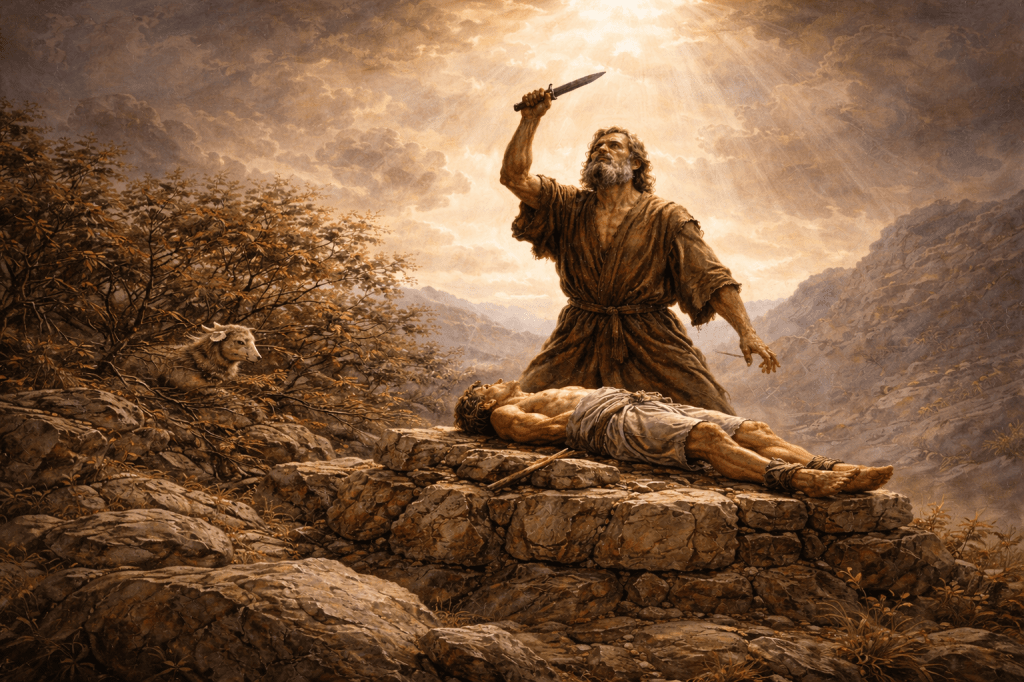
    The scene on Mount Moriah is one of the most arresting moments in all of Scripture.  Abraham built the altar. He arranged the wood. He bound his son.

    There is no recorded protest from Isaac. Whether he was a young boy or a grown man—as some Jewish tradition suggests—he allowed himself to be placed on the altar. Father and son walked together in obedience, both trusting God in ways that defy easy explanation.

    When Abraham lifted the knife, God stopped him.  “Do not stretch out your hand against the lad.”

    And then—almost as if it had been waiting there all along—Abraham lifted his eyes and saw a ram caught in a thicket by its horns.

    The sacrifice God required was not Isaac.
    The sacrifice God required was provided.

    Abraham named the place Yahweh-Yireh—“The Lord Will Provide.” Not the Lord did provide, but the Lord will provide. Abraham understood that this moment was bigger than himself, bigger than Isaac, bigger than even this mountain.

    The ram died in the place of the son.

    Scripture later tells us that Abraham “received Isaac back as a type”—a living picture, a shadow of something yet to come (Hebrews 11:19). What Abraham experienced figuratively, God would one day accomplish literally.

    On another hill, centuries later, a Father would also offer His Son.  That Son would carry the wood of His own sacrifice. 🪵There would be no last-minute reprieve.
    No substitute found in the thicket.

    John the Baptist would look at Jesus and say, “Behold, the Lamb of God, who takes away the sin of the world.”

    The gospel is not that God demands our sacrifice. The gospel is that God provides His own.

    Isaac was spared by a ram. We are spared by a Savior.

    The wood of the altar on Moriah points forward to the wood of the cross, where mercy and justice met without compromise. And like Abraham, we name the place where God meets us in our greatest fear and deepest surrender:

    The Lord Will Provide.

    • Reflection:  What are you still trying to place on the altar that God has already provided a substitute for? Contemplate John 3:16.
    • Closing Prayer:  Lord God, Thank You for being the God who provides what we cannot.  When obedience feels costly and trust feels dangerous, remind us that You have already given Your Son for us.  Teach us to rest—not in our sacrifice—but in Yours.  Tonight, we worship the Lamb who was provided in our place.
      Amen.

    • Read Genesis 21

    MORNING— Promise Fulfilled

    • Focal Passage: Genesis 21:1-2

    “Then the Lord took note of Sarah as He had said, and the Lord did for Sarah as He had promised… at the appointed time of which God had spoken.”

    Genesis 21 opens with quiet precision: as He had said… as He had promised… at the appointed time.
    God’s promises are not vague hopes or spiritual metaphors. They are fulfilled exactly as spoken—and precisely when God determines.

    Some promises of God are conditional, calling for obedience and response. Others are unconditional, rooted not in what we do but in who God is. Isaac belongs to that second category. Abraham and Sarah did not produce this child by effort or ingenuity. They received him by promise.

    Isaac’s very name means laughter. Once Sarah laughed in disbelief. Now she laughs in joy. The same mouth that once questioned God now praises Him. Delay did not diminish the promise—it deepened the delight.

    Yet notice what follows fulfillment: obedience. Abraham names his son as God instructed. He circumcises Isaac as commanded. Faith does not relax after blessing arrives. True faith continues walking with God once the storm has passed.

    It is easy to make promises to God in moments of desperation—what some call foxhole faith. Harder is keeping those promises once calm waters return. Abraham teaches us that obedience after blessing matters just as much as obedience before it.

    And then—celebration. Abraham throws a feast. Joy is not postponed. Gratitude is expressed openly. God is honored not only by our obedience, but by our delight in His faithfulness.

    • Reflection:
      Where have you seen God keep His word—and how are you responding now that the promise has been fulfilled?

    EVENING— Planting for the Long Haul

    • Focal Passage: Genesis 21:33

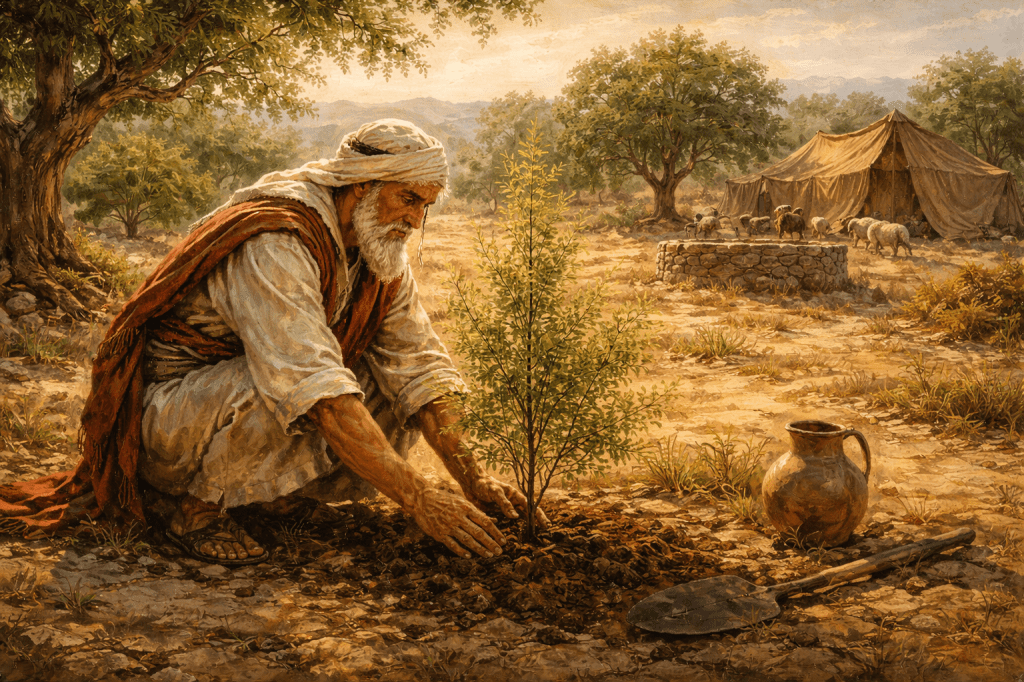
    🌳 “Abraham planted a tamarisk tree at Beersheba, and there he called on the name of the Lord, the Everlasting God.”

    After celebration comes something quieter—but just as meaningful. Abraham plants a tree.

    The tamarisk was not chosen for beauty. It was chosen for endurance. Deep-rooted and slow-growing, it provided shade in arid land and stabilized soil over time. Planting one was an investment not just for the present, but for future generations.

    Abraham plants this tree at Beersheba, a place of covenant and provision. And beneath its branches, he worships. He calls on the name of the Everlasting God. The tree becomes a living testimony: God’s faithfulness is not seasonal. It is lasting.

    This is faith that thinks long-term. Not faith that rushes from miracle to miracle—but faith that plants, waits, and trusts. We often want immediate fruit. God often invites us to plant shade we may never sit under. The tamarisk reminds us that worship is not only spoken—it is lived, planted, and patiently nurtured.

    • Reflection:  What are you planting right now that reflects trust in God’s long-term faithfulness?
    • Closing Prayer:  Everlasting God, thank You for keeping every promise You have spoken. Teach me to obey You not only in waiting, but in fulfillment. Help me celebrate Your goodness, and give me faith to plant wisely for the future—trusting that You are faithful across generations. Amen.
    • Read Genesis 18

    MORNING— Beneath the Patient Oaks🌳

    • Focal Passage: Genesis 18:1

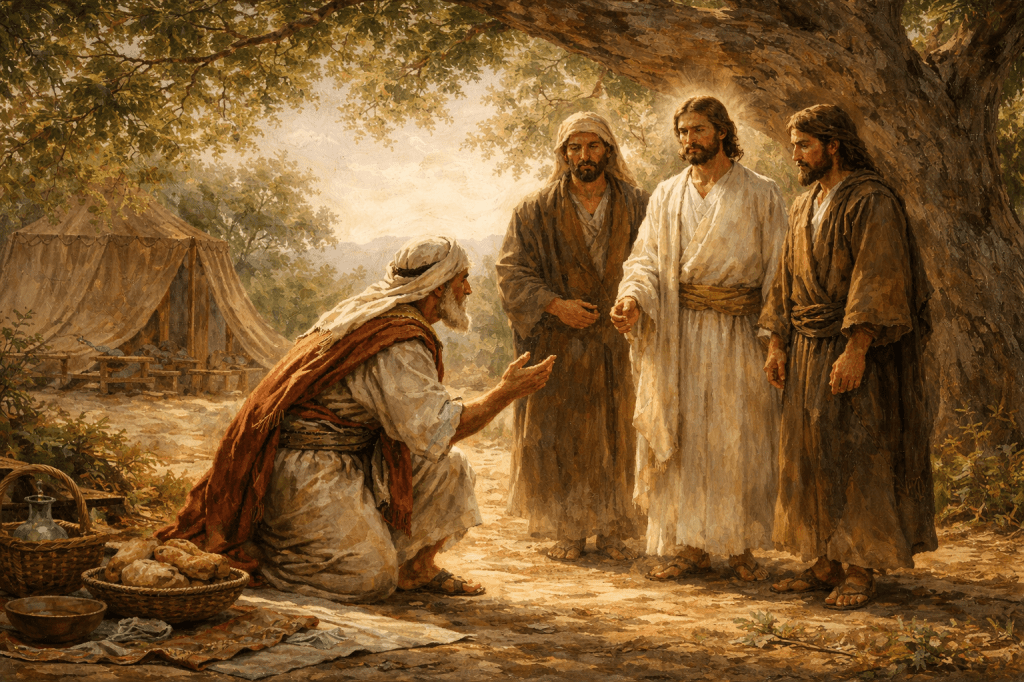
    🌳“The Lord appeared to Abraham near the great trees of Mamre while he was sitting at the entrance to his tent in the heat of the day.”

    Genesis 18 opens quietly. Abraham is not seeking a vision or building an altar. He is sitting at the entrance of his tent, in the heat of the day—resting, waiting, enduring the ordinary rhythms of life. And it is there, beneath the great trees of Mamre, that the Lord appears.

    The setting matters. These trees had become a familiar place for Abraham—a place of dwelling, shade, and patience. Faith does not always grow in dramatic moments. Often it deepens in places where we have lingered a long time.

    When Abraham notices three visitors, he responds with generous hospitality. He runs to meet them. He bows low. He offers water, rest, food, and shade under the tree. What begins as simple kindness becomes holy ground.

    As the meal unfolds, the visitors reaffirm God’s promise: Sarah will have a son. Sarah laughs quietly to herself—not out of mockery, but weariness. Years of waiting have thinned her hope. Yet God’s question pierces the moment: “Is anything too hard for the Lord?”

    The trees of Mamre🌳stand witness to this exchange. They have shaded Abraham through years of waiting. Now they shelter a moment when God renews hope where doubt had taken root.

    Where there had been sorrow, laughter was soon to come.

    • Reflection:
      Where has God asked you to wait longer than you expected—and how might He be inviting you to trust Him again beneath the shade of that waiting?

    EVENING— Standing in the Gap

    • Focal Passage: Genesis 18:22-23

    “The men turned away and went toward Sodom, but Abraham remained standing before the Lord. Then Abraham approached Him and said…”

    As the visitors rise to leave, one remains. Abraham recognizes the moment. God has stayed behind—not to announce a verdict, but to invite intercession.

    What follows is the first extended prayer of intercession recorded in Scripture. Abraham draws near with humility—“I am but dust and ashes”—and yet with remarkable boldness. He asks hard questions. He presses repeatedly. He appeals to God’s justice and mercy.

    Abraham is not bargaining for his own comfort. He is standing in the gap for others—especially for one man he never names aloud: Lot.

    Intercession is not passive. It is holy labor. As Brigid Herman once wrote, intercession means “making Christ’s interests our own… learning to think with God, to see the world through His eyes, and to share His passion to save and redeem.” That kind of prayer reshapes the heart of the one who prays.

    Jesus later promised that those who ask, seek, and knock would find doors opened. Abraham’s prayer reminds us that God is not threatened by honest questions or persistent requests. He invites them.

    Michael Yaconelli tells a powerful story that captures this truth. On the eve of a Billy Graham crusade in Sacramento, a choir member noticed a man slumped on the cold steps of the state capitol late at night. Concerned, he approached—only to discover it was Billy Graham himself, praying alone for the city.

    Despite global fame, worldwide influence, and countless people praying for him, Graham understood where true power comes from. Quiet intercession. Kneeling prayer. Standing before the Lord on behalf of others.

    Abraham did not save Sodom—but God answered his unspoken prayer by rescuing Lot. Intercession may not always change outcomes the way we expect, but it always draws us deeper into God’s heart.

    • Reflection:  Who has God placed on your heart to pray for—not casually, but persistently and lovingly?
    • Closing Prayer:  Gracious God, thank You for inviting us to draw near—to ask, to seek, and to stand in the gap for others. Teach me to pray with humility and courage. Help me trust that You are at work even when outcomes remain unseen. Tonight, I place the burdens of others—and my own—into Your merciful hands. Amen.
    • Read Genesis 16

    MORNING— The God Who Hears

    • Focal Passage: Genesis 16:11

    “And the angel of the Lord said to her, ‘Behold, you are with child, and you will bear a son;
    And you shall call his name Ishmael, Because the Lord has given heed to your affliction’”

    Ishmael’s backstory begins with a foolish proposal. Sarai, tired of waiting and convinced that time was running out, offers Abram a culturally acceptable solution. In the ancient world, this arrangement was legal and common. A servant could bear a child on behalf of a barren wife. It would be counted as Sarai’s child, not Hagar’s.

    But what was culturally acceptable was covenantally unfaithful.

    God tells Hagar to name her child Ishmael—a name that means “God hears.”
    But this name was not only for Hagar. It was meant for Abram.

    By this point, Abram had already heard from God four times about the promise of a son. God had spoken clearly and repeatedly. Yet when the moment of decision came, Abram listened—not to the voice of God—but to the voice of Sarai. He did not reject God outright; he simply allowed another voice to matter more when it really counted.

    From that day forward, every time Abram called that boy in for supper, he spoke a reminder aloud.
    “Ishmael.”
    God hears.

    The name carried grace, but it also carried weight. It reminded Abram that God had not been silent—he had been impatient.

    God does not always shield us from the consequences of our choices. The conflict between the descendants of Ishmael and Isaac continues even to this day. It is a sober reminder that some struggles are not resolved quickly because they did not develop quickly. What began as a moment of compromise became a long, unfolding consequence.

    Yet even here, God is not absent. He hears. He names. He stays involved—even when the story includes our missteps.

    • Reflection:  What voices have you allowed to outweigh God’s voice in your own decisions?

    EVENING— The God Who Sees

    • Focal Passage: Genesis 16:13

    “Then she called the name of the Lord who spoke to her, ‘You are a God who sees’; for she said, ‘Have I even remained alive here after seeing Him?’ 

    Hagar is not an innocent bystander in this story. She is wronged, yes—but she was also opportunistic.

    When Sarai gives Hagar to Abram, Hagar recognizes the moment. This is her opening. If she bears the master’s child, her status changes overnight. She is no longer just a servant; she becomes indispensable. Scripture tells us that once she conceived, “her mistress was despised in her sight.” Hagar sees leverage—and she uses it.

    It doesn’t matter how this came about, she may have thought. What matters is getting ahead. The opportunity is here. The iron is hot. So she presses her advantage. But striking while the iron is hot can still leave burn marks. Short-term gains often come with long-term wounds.

    For a while, the plan appears to work. Abram is going to be a father. Sarai’s idea seems validated.

    And then—BOOM.
    The whole arrangement collapses.

    Sarai’s jealousy ignites. Abram retreats into passivity. Hagar bears the brunt of the fallout and runs—pregnant, alone, and wounded—into the wilderness.

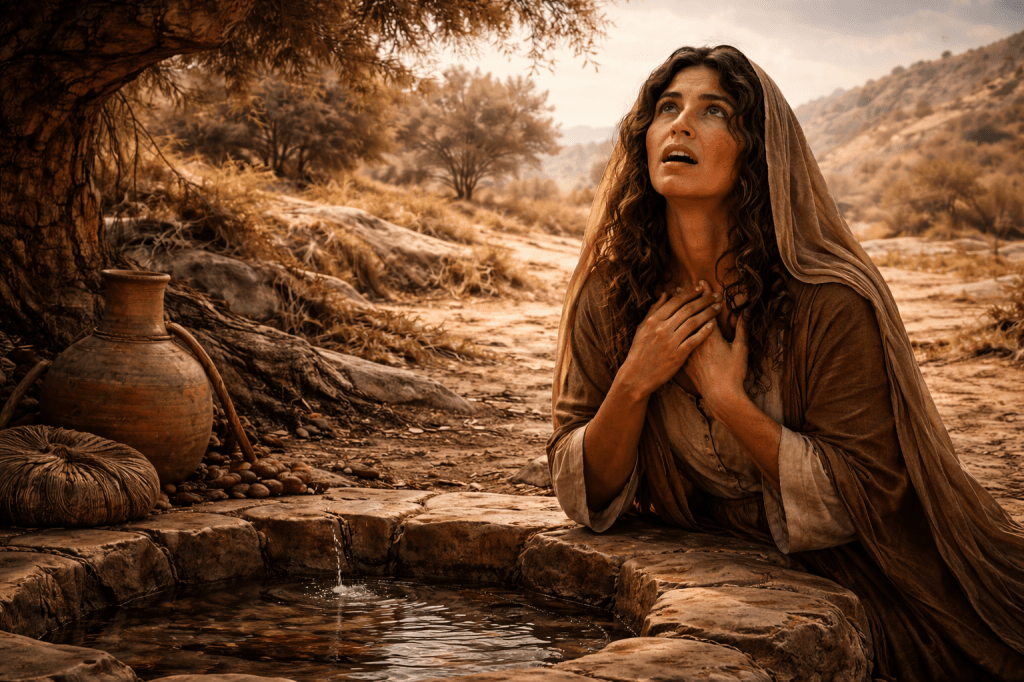
    It is there, by a spring along the road, that God meets her.

    God does not come only to correct; He comes to comfort. Hagar is told to return— because her pain is not unnoticed, and her life is not abandoned. In that moment, she gives God a name: “The God who sees.” She names the well “the well of the Living One who sees me.”

    God sees.
    God hears.
    God comes.
    God brings life.

    Your circumstances may have brought you to a well in the middle of a wilderness. But if you meet God there, even painful circumstances can begin to work toward healing. Repentance is required. Obedience is costly. But knowing you are seen by God is enough to motivate you to take the next step.

    Hagar realizes she has seen the One who sees her—and that knowledge gives her the courage to return, to obey, and to trust that God can bring life even out of a broken, ill-conceived plan.

    • Reflection:  Where have you tried to force an opportunity instead of trusting God’s timing?
    • Closing Prayer:  God who sees, meet me in my wilderness places. Forgive me for the times I have tried to get ahead instead of waiting on You. Give me humility to repent, courage to obey, and faith to believe that You can still bring life where my choices have left scars. Thank You for seeing me. Amen.
    • Read Genesis 15

    MORNING— Faith at Low Tide

    • Focal Passage: Genesis 15:1

    “After these things the word of the Lord came to Abram in a vision, saying, ‘Do not fear, Abram, I am a shield to you; Your reward shall be very great.’”

    Low tide is predictable along the coast, but it’s rarely pleasant. When the water pulls back, what was once hidden is exposed—seaweed tangled around dock posts, driftwood stranded on the shore, scars beneath the surface that high tide kept out of sight. What once felt easy to navigate can suddenly become treacherous.

    Life has low tides too.

    Genesis 15 opens after these things—after Abram’s victory in battle (chapter 14), after rescuing Lot, after refusing the spoils of Sodom. By all appearances, this should have been a spiritual high point. Instead, God speaks directly to Abram’s fear. That alone tells us something important: even after great victories, faith can ebb.

    Abram’s low tide came in the form of unanswered promises. God had promised a nation—but Abram was still childless. Time had passed. The waves of hope had receded, leaving questions exposed. “What are You really doing, God?” he asks.

    God doesn’t rebuke Abram for his honesty. Instead, He reassures him: “I am your shield.” Before addressing the promise, God addresses the fear. Abram’s security was never meant to rest in circumstances, success, or even fulfilled promises—but in God Himself.

    Low tide reveals what we’re standing on. And in Genesis 15, Abram learns that faith isn’t only for mountaintops. It’s for the exposed places, the waiting places, the places where the promise feels distant and the night sky feels very large.

    Reflection:  What does it look like for you to walk faithfully with God in the midst of a culture that often pulls you in a different direction?


    EVENING— Count the Stars

    • Focal Passage: Genesis 15:5-6

    “And He took him outside and said, ‘Now look toward the heavens, and count the stars, if you are able to count them.’ And He said to him, ‘So shall your descendants be.’ Then he believed in the Lord; and He credited it to him as righteousness.”

    When Abram voices his discouragement, God does something simple but profound—He takes him outside.

    Away from the tent.
    Away from the questions.
    Away from the closed space of anxious thinking.

    God invites Abram to lift his eyes. The same God who named every star now asks Abram to count them. It’s not a math exercise—it’s a reminder. If God can hang galaxies in place, a single promised son is not beyond His reach.

    Verse 6 stands as one of the most important statements in all of Scripture: “Abram believed the Lord, and He credited it to him as righteousness.” Abram doesn’t fix the problem. He doesn’t see the fulfillment. He simply trusts God in the gap between promise and reality.

    Later in the chapter, God seals His covenant in a striking way—passing alone between the pieces of the sacrifice. Abram does not walk through. God does. The message is clear: this promise rests on God’s faithfulness, not Abram’s strength.

    At low tide, we are tempted to strive, explain, or panic. Genesis 15 reminds us that faith is sometimes nothing more—and nothing less—than trusting God when we cannot yet see the shore.

    The same God who walked between the pieces for Abram would one day walk the hill of Calvary for us. When our strength gives out, His covenant does not.

    • Reflection:  What promise of God are you struggling to believe tonight—and what would it look like to lift your eyes instead of rehearsing your doubts?
    • Closing Prayer:  Faithful God, when my hope feels exposed and my strength runs low, remind me that You are my shield. Help me trust You in the space between promise and fulfillment. Teach me to believe You—not only when the tide is high, but when the shore is bare. Tonight, I rest in Your covenant faithfulness. Amen.