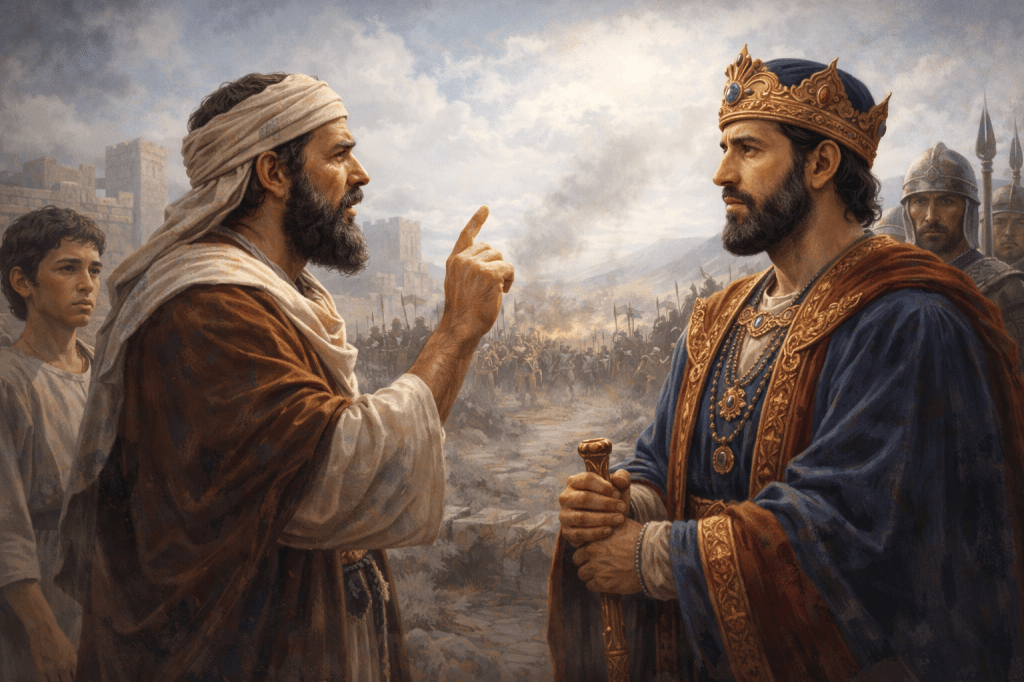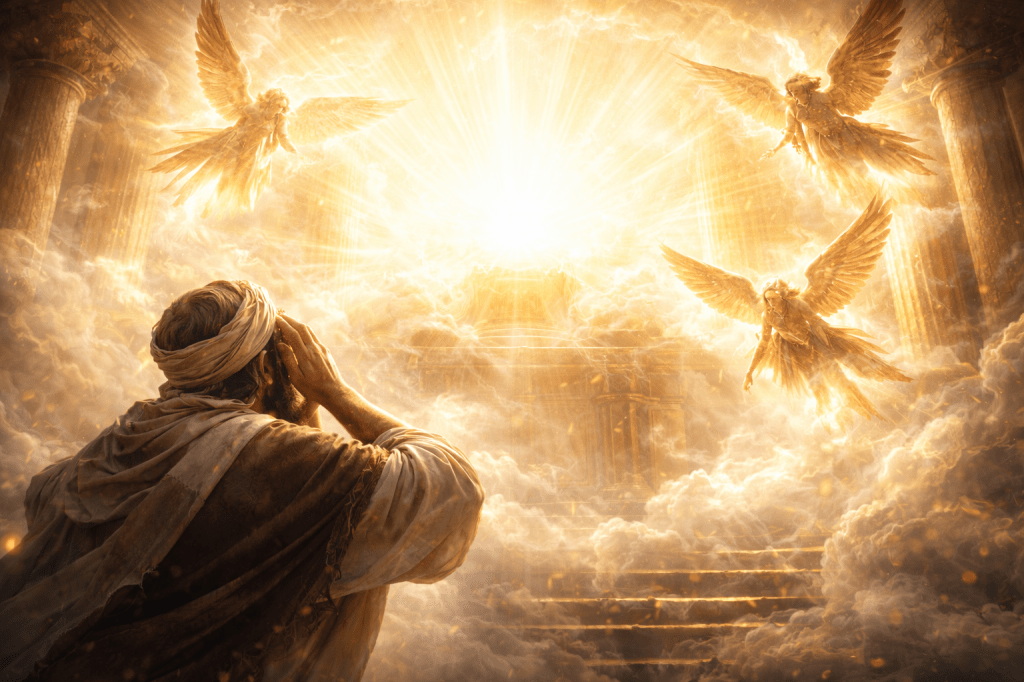
• Read Isaiah 40

    🌅MORNING— Speak Kindly to Her

    • Focal Passage: Isaiah 40:1-2

    “Comfort, O comfort My people,” says your God. “Speak kindly to Jerusalem; and call out to her, that her warfare has ended, that her iniquity has been removed, that she has received of the LORD’S hand double for all her sins.”

    Joseph Parker once said, “Preach to the suffering and you will never lack a congregation. There is a broken heart in every pew.” That is not preacher’s exaggeration. It is pastoral reality. There is always someone in the room who is barely holding it together.

    Isaiah 40 begins there.

    We step from chapter 39 into chapter 40 and the tone changes completely. The prophet who thundered judgment now speaks like a shepherd kneeling beside the wounded. Exile is coming. Loss is coming. Hard years are ahead. And yet the first word is not accusation.

    “Comfort, O comfort My people.”

    Notice that phrase — My people. Even under discipline, they still belong to Him. Their warfare will end. Their sin will be removed. God is not done with them.

    There was a season in my own life in Cincinnati when I felt misplaced and sidelined. I was not preaching. I was not teaching. I was stuck in work that felt far removed from calling. It was easy in that stretch to wonder if my way was hidden from the Lord — if I had somehow drifted beyond His notice.

    Israel’s exile was not innocent. It followed generations of rebellion and defiance. Yet even there, after discipline had done its work, God speaks comfort. That is the soil Isaiah 40 grows in — not denial of sin, but mercy after truth.

    “Speak to her heart.”

    That is what God tells Isaiah to do. Not lecture. Not scold. Speak to the heart.

    C.S. Lewis once wrote:

    “The Christian religion… does not begin in comfort; it begins in dismay… In religion, as in war and everything else, comfort is the one thing you cannot get by looking for it. If you look for truth, you may find comfort in the end: if you look for comfort you will not get either comfort or truth—only soft soap and wishful thinking to begin with and, in the end, despair.”

    Isaiah has already dealt in truth. He has named the sin. He has warned of exile. Now he can speak comfort that is solid — not soft soap, but something that holds.

    Isaiah’s comfort is not abstract. The very next verses speak of a voice crying in the wilderness, “Clear the way for the LORD” (40:3). All four Gospels identify that voice as John the Baptist (cf. Mark 1:1–4). The comfort of Isaiah 40 moves forward into history. God does not merely soothe His people; He comes to them. The Shepherd promised in verse 11 walks into the wilderness and then to a cross.

    And how can comfort be this deep? Because forgiveness is real. “Her iniquity has been removed.” Isaiah hints here at atonement — a removal that chapter 53 will later unfold fully. The comfort of Isaiah 40 rests on the coming work of Christ.

    If you are in a season that feels stalled, sidelined, or heavy, hear this chapter as it was first spoken:

    Comfort.
    You are still His.

    • Reflection:  Where do you most need to hear that you still belong to Him, even in this season?

    🌆EVENING— Wings As Eagles

    • Focal Passage: Isaiah 40:30-31

    “Though youths grow weary and tired, and vigorous young men stumble badly, yet those who wait for the LORD will gain new strength; They will mount up with wings like eagles, they will run and not get tired, they will walk and not become weary.”

    Isaiah now turns to people who feel forgotten.

    “My way is hidden from the Lord,” they say (v. 27). Exile has twisted their view of God. Some question His care. Others question His power. Perhaps He wants to help but cannot overcome stronger forces. That explanation still circulates today. But Isaiah will not allow it.

    He asks question after question — fourteen in this chapter — not to shame them, but to stretch their view of God. Who measured the waters in the hollow of His hand? Who directed the Spirit of the Lord? Who calls the stars by name? The nations are a drop from a bucket. Rulers rise and fall at His breath. The idols people construct cannot even stand upright without being propped in place.

    This is not a small God trying His best. This is the Everlasting Creator.

    Steven Lawson tells the story of Donald Barnhouse preaching before the brilliant Old Testament scholar Robert Dick Wilson. Midway through the sermon, Wilson stood and left. Barnhouse was crushed. Afterward he went to the professor’s office and asked where he had failed. Wilson replied, “Oh, you didn’t fail. I always come to hear my former students preach once. I want to know if they are a big-Godder or a small-Godder. You preach a big God. I didn’t need to hear any more.”

    Isaiah 40 is big-God theology for tired saints.

    And then comes the promise: “Those who wait for the LORD will gain new strength.” Waiting here does not mean idle resignation. It means hopeful dependence — lifting your eyes, rehearsing His character, trusting His word when the horizon is unclear.

    If you are exhausted tonight — not theatrically tired, but bone-tired — notice what the text does not say. It does not say, “Try harder.” It does not say, “Be stronger.” It says, “He gives strength to the weary.” The initiative is His.

    An airport once struggled with complaints about long waits at baggage claim. Executives reduced the average wait to eight minutes, yet complaints continued. They eventually realized passengers walked only one minute to reach the carousel and then stood idle for seven. So they moved the arrival gates farther away. The walk was longer, but the waiting felt shorter because it was occupied.

    Waiting feels hardest when it seems empty. But waiting on the Lord is never empty. Even when you cannot see movement, He is at work — steadying, sustaining, shaping endurance into your soul.

    The promise unfolds in stages. You may soar like an eagle in rare moments. More often, you will run for a season. And most days, you will simply walk. The miracle is not always flight. Sometimes it is that you keep walking.

    The Everlasting God does not grow tired. And He is not impatient with your weakness. He gathers lambs in His arm. He carries them close. If tonight you can only take one more step, take it leaning on Him.

    • Reflection:  Where do you most need His strength tonight—in soaring, in running, or simply in walking one more step?
    • Closing Prayer:  Everlasting God, speak comfort to our hearts this night.  When we feel forgotten let us feel in our spirit Your everlasting arms.  When we grow weary strengthen us.  Amen.
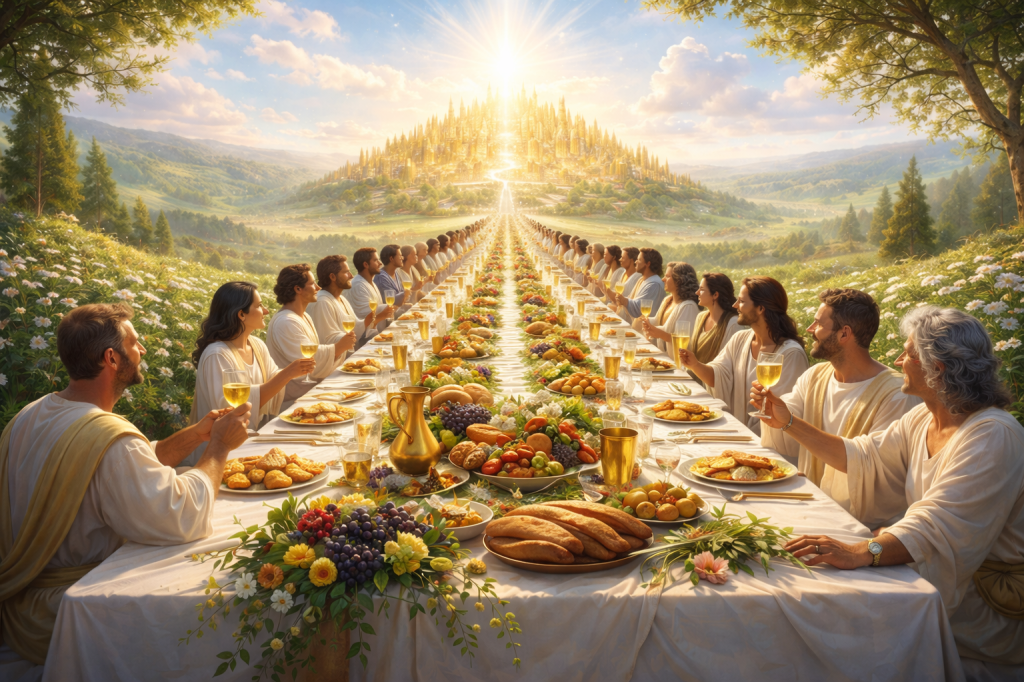
    • Read Isaiah 25 & 26

    🌅MORNING— Banquet After the Final Battle

    • Focal Passage: Isaiah 25:1

    “O LORD, You are my God; I will exalt You, I will give thanks to Your name; For You have worked wonders, Plans formed long ago, with perfect faithfulness”

    Isaiah 25 is not a song after one ordinary battle. It rises out of Isaiah 24, where the prophet has just described the shaking of the whole earth. The “city of chaos” has fallen. Proud powers are brought low. The world system that set itself against God collapses.

    Isaiah had seen Assyria threaten Jerusalem. He knew what ruthless nations looked like. But here he is looking beyond one empire. He sees the great conflict behind all conflicts — the overthrow of every structure raised in defiance of God, and ultimately the defeat of death itself. World War I was once called “the war to end all wars.” History proved otherwise. Isaiah in chapter 25 speaks of the true war to end all wars — not merely between nations, but between God and all that opposes Him.

    And so he sings.

    “You are my God.” That is allegiance in the middle of upheaval. The word for “give thanks” suggests open acknowledgment. Isaiah is declaring public praise. He marvels not only at visible wonders but at the long strategy of God — “Plans formed long ago, with perfect faithfulness.” The Lord has not been reacting to history. He has been governing it.

    The ruined “city” in verse 2 represents more than bricks and gates. It is Babel reborn in every generation — human pride organized without reference to God. Its fall makes way for something better.

    At the center of the chapter stands the mountain banquet (vv. 6–8). A covenant feast for all peoples. Rich food. Aged wine. And then the promise that moves beyond politics entirely:

    “He will swallow up death for all time.”

    This is the true victory Isaiah sees. Not merely a defeated army, but a defeated grave. Paul will later quote this very line in 1 Corinthians 15, tying it to the resurrection of Christ. The feast Isaiah foresaw is anchored in that empty tomb and stretches toward the day when tears are wiped away from every face.

    Jesus frequently spoke of this coming banquet. He described many coming from east and west and from north and south to recline at table in the kingdom (Luke 13:29). He told the parable of the great banquet (Luke 14:15–24). Isaiah’s mountain and Jesus’ table are the same hope viewed from different sides of the covenant story.

    It is fitting to sing after a battle. But this song is for the war behind all wars — and for the God whose purposes have never faltered.

    • Reflection:  When the world feels unstable, do you see only the shaking — or do you also see the steady hand of the One whose plans were formed long ago?

    🌆EVENING— Peace, Peace Before the Victory

    • Focal Passage: Isaiah 26:3-4

    “The steadfast of mind You will keep in perfect peace, because he trusts in You. Trust in the LORD forever, for in GOD the LORD, we have an everlasting Rock.”

    Chapter 26 continues the vision with another song. A strong city appears — not built on pride, but secured by salvation. Its gates open to those who trust.

    “Perfect peace” is literally “peace, peace.” The doubling intensifies it. This is not shallow calm. It is the settled steadiness of a mind fixed on the Lord. An undeviating way of seeing life — measuring events by the character of God rather than by headlines or fear — results in rest.

    The chapter contrasts two cities. The lofty one collapses into dust. The strong one stands. The difference is not architectural but relational. “Trust in the LORD forever.”

    Waiting tests that trust. Later in the chapter the people are told to enter their rooms and close their doors “for a little while” (v. 20). That phrase can stretch thin. Seasons of suffering alter time. When your daughter is recovering from brain surgery, the world seems to move quickly while your own days feel suspended. “A little while” can feel immense.

    After Ernest Hemingway was wounded during World War I, surgeons removed 237 pieces of shrapnel from his body. During his long convalescence he observed how waiting exposed what was already present in a person. Hard seasons did not create strength or shallowness; they revealed it. In A Farewell to Arms, he later wrote, “The world breaks everyone and afterward many are strong at the broken places.” Waiting uncovers where the mind truly rests.

    Isaiah’s song says the same. The mind fixed on the Lord is kept — guarded — in peace, peace. The Rock does not erode. The strong city does not crumble. The One who swallows death at the end also sustains His people now.

    • Reflection:  What is shaping your thoughts tonight — the instability of the moment, or the everlasting Rock?
    • Closing Prayer:  Lord, You are our God. Your plans were formed long ago and have never failed. When cities fall and waiting stretches long, steady our minds on You. Keep us in peace, peace, as we trust in You. Thank You for the victory over death secured through Christ. Hold us fast until the feast is fully seen. Amen.
    • Read Isaiah 11-12

    🌅MORNING— A Fruit Bearing Branch🌿

    • Focal Passage: Isaiah 11:1

    “Then a shoot🌱 will spring from the stem of Jesse, and a branch🌿 from his roots will bear fruit.”

    Isaiah 10 ends with trees🌳 falling. The proud forests🌳 of Assyria are chopped down. The image is one of devastation—axes swinging, trunks crashing, empires collapsing. What comes next is a powerful, scene changing, word: “Then…”

    After judgment. After loss. After the forest is cleared.

    Then a shoot will spring from the stem of Jesse.” 🌱

    This is prophecy.

    Isaiah is not speaking of just another king in David’s long line. He does not say “a son of David.” He says “from the stem of Jesse.” Jesse was David’s father. Isaiah reaches back before the palace, before the throne, before the glory years of Israel’s greatest king.

    When all seems lost, remember how it started. God chose a shepherd from a pasture and made him king. The line of David began in a field, not a palace. The God who raised royalty from obscurity can do it again.
    And in Isaiah 11, He promises that He will.

    This “shoot”🌱 and this “branch”🌿 are messianic titles. They speak of life coming out of what looks dead. The royal line will appear cut down to a stump—but it is not dead. Beneath the soil, the roots remain.

    And the New Testament leaves no doubt who this is.

    Jesus is called:

    • The Son of David (Matthew 1:1).
    • The Root and the descendant of David (Revelation 22:16).
    • The Root of Jesse to whom the nations will come (Romans 15:12, quoting Isaiah 11:10).

    Verse 1 is not about a political revival. It is about a Person.

    “And a branch🌿 from his roots will bear fruit.”

    This King will not merely hold office. He will bear fruit. His reign will produce righteousness. Verse 2 continues: “The Spirit of the Lord will rest on Him…” (Isaiah 11:2)

    At Jesus’ baptism, the Spirit descended and remained upon Him (John 1:32–33). The wisdom, counsel, strength, knowledge, and fear of the Lord described here were not theoretical. They were visible in His life.

    He judged not by appearances. He saw through motives. He lifted the poor. He silenced demons.
    He spoke with authority.

    And one day: “He will strike the earth with the rod of His mouth, and with the breath of His lips He will slay the wicked.” (Isaiah 11:4)

    Paul applies this verse directly to Jesus in 2 Thessalonians 2:8.

    Messiah is no fragile sapling. 🌱
    He is a righteous King.

    And His reign changes everything: “The wolf will dwell with the lamb…” (Isaiah 11:6)

    Creation itself will be healed. The curse will be reversed. The brutality of nature—like the brutality of human hearts—will give way to the prince of peace.

    • Reflection:  Where in your life does everything look cut down? Ask the Lord to help you see the shoot He is already growing.

    🌆EVENING— The Springs of Salvation

    • Focal Passage: Isaiah 12:2-3

    “Behold, God is my salvation, I will trust and not be afraid; For the Lord God is my strength and song, and He has become my salvation. Therefore you will joyously draw water from the springs of salvation.”

    Isaiah 11 widens the lens.

    “Then in that day the nations will resort to the root of Jesse…” (Isaiah 11:10)

    The shoot from the stump 🌳🌱 is not just for Israel.

    Paul quotes this verse in Romans 15:12 to explain the inclusion of the Gentiles. The Messiah is not tribal. He is not regional. He is not the property of one ethnicity. He is the hope of all the nations. The Messiah who rises from Israel’s stump 🌳becomes the Savior of all peoples.

    The “signal” or banner raised high (Isaiah 11:10) becomes, in the New Testament, Christ lifted up. People from every tribe and tongue gather to Him. Isaiah saw it. Paul preached it. Revelation celebrates it.

    Isaiah 12 begins with heartbreak:

    “Although You were angry with me, Your anger is turned away, and You comfort me.” (Isaiah 12:1)

    How is God’s anger turned away?

    Through the very Shoot of Jesse. 🌱
    Through Jesus.

    On the cross, the wrath of God against sin was satisfied. The One described in Isaiah 11 as righteous Judge became, in Isaiah 53, the suffering Servant.

    Because of Him: “God is my salvation.” (Isaiah 12:2)

    “Salvation” in Hebrew is Yeshuah.
    Its very name is Jesus.

    Notice how personal the language becomes in verse 2:

    • My salvation
    • My strength
    • My song

    And then watch as it turns outward:

    “Make known His deeds among the peoples; make them remember that His name is exalted.” (Isaiah 12:4)

    Individual praise becomes community proclamation.

    The theme Isaiah began—Messiah for the nations—is picked up by the New Testament authors again and again. Paul sees in Isaiah 11 the foundation for global mission (Romans 15). John sees the nations around the throne (Revelation 7). What Isaiah sang, the apostles preached.

    And it all ends with this:

    “Cry aloud and shout for joy, O inhabitant of Zion, for great in your midst is the Holy One of Israel.” (Isaiah 12:6)

    Not merely great in heaven.
    Not merely great in history.

    Great in your midst.

    The stump is not the end. 🌳
    The shoot has come. 🌱
    The King reigns.
    And the song has already begun.

    • Reflection:  Draw water tonight from the springs of salvation. Speak His name aloud. Let gratitude, not fear, close your day.
    • Closing Prayer:  Holy One of Israel, when life feels cut down to a stump, remind us of Your promise. Thank You for the Shoot from Jesse — our righteous King and Savior. Fill us with the knowledge of You. Let our lives become songs of praise until the day the whole earth is filled with Your glory.
      Amen.
    • Read Isaiah 7:1-14; 9:1-7

    🌅MORNING— When the Forest is Shaking 🌳🪵

    • Focal Passage: Isaiah 7:14

    “Therefore the Lord Himself will give you a sign: Behold, a virgin will be with child and bear a son, and she will call His name Immanuel.”

    War was on the horizon.

    In the days of Ahaz, king of Judah, two enemies—Rezin of Aram and Pekah of Israel—marched against Jerusalem (Isaiah 7:1). Their goal was not just conquest. They intended to remove the king and install a puppet ruler (7:6). The text says the hearts of Ahaz and his people “shook as the trees 🌳 of the forest shake with the wind”  (7:2).

    The threat was real. But beneath the political implications lay something deeper. Isaiah calls Judah “the house of David” (7:2, 13). God had promised David an enduring throne (2 Samuel 7:12–16). If the house of David falls, what would become of that promise? Would there be a coming Messiah?

    Fear pressed in. Faith was tested.

    God sent Isaiah with a message: “Take care and be calm, have no fear” (7:4). And He described the enemy as “two stubs of smoldering firebrands” 🪵🔥—burned-down pieces that look dangerous, but are almost spent (7:4).

    Then came a stunning invitation: “Ask a sign for yourself from the Lord your God; make it deep as Sheol or high as heaven.” (7:11)

    Ahaz refused. His refusal sounded spiritual—“I will not ask, nor will I test the Lord!” (7:12)—but it masked unbelief. He had already decided to trust Assyria instead of God. So the Lord gave a sign anyway.

    A virgin would bear a son. His name would be Immanuel—God with us.

    In Isaiah’s immediate context, a child would be born whose early years would mark the downfall of the two threatening kings (7:15–16). But the sign pointed beyond that moment. Matthew makes the connection explicit:

    “Now all this took place to fulfill what was spoken by the Lord through the prophet… ‘Behold, the virgin shall be with child and shall bear a Son, and they shall call His name Immanuel.’” (Matthew 1:22–23, NASB 1995)

    Jesus is Immanuel.

    Ahaz reached for human strength and found judgment.
    Mary yielded to God’s promise—and through her obedience, the Son was given.

    This is how faith stands when the forest is shaking 🌳: not by denying danger, but by trusting the Presence of God in it.

    Immanuel. God with us.

    • Reflection:  When fear shakes the forest of your heart 🌳, where do you instinctively turn—visible strength or divine promise?

    🌆EVENING— A Child is Born 🪵🔥

    • Focal Passage: Isaiah 9:6

    “For a child will be born to us, a son will be given to us; and the government will rest on His shoulders; and His name will be called Wonderful Counselor, Mighty God, Eternal Father, Prince of Peace. ”

    Isaiah moves from gloom to glory.

    Galilee—once humbled, once overrun—would see a great light (9:1–2). Matthew tells us this was fulfilled when Jesus began His ministry in that very region (Matthew 4:13–16). God chose an area that had suffered most to launch salvation for the world.

    Then comes the promise that lifts the curtain fully:

    “A child will be born to us, a son will be given to us.”

    This is the answer to the trembling house of David. The throne will not fail. The promise will not collapse. The King is coming. And His names tell us who He is—fulfilled in Jesus.

    Wonderful Counselor — In Him “are hidden all the treasures of wisdom and knowledge” (Colossians 2:3). He guides with truth, not guesswork.

    Mighty God — not a symbolic ruler, but God Himself. This Child is divine.

    Eternal Father — describing His fatherly care toward His people: steady, protective, faithful without end.

    Prince of Peace — the One who brings peace with God (Romans 5:1) and will one day end war itself.

    And “the government will rest on His shoulders.” He carries rule, justice, and righteousness with strength.

    Isaiah even pictures the end of war in a vivid, earthy way:

    “For every boot of the booted warrior in the battle tumult, and cloak rolled in blood, will be for burning, fuel for the fire.” 🪵🔥 (Isaiah 9:5)

    The prophecy stretches beyond Bethlehem: “There will be no end to the increase of His government or of peace.” This Child rules now in hearts that submit, and will one day reign openly over all creation.

    And it is all driven by this final line:

    “The zeal of the Lord of hosts will accomplish this.”

    Jesus is Immanuel.
    Jesus is the Light.
    Jesus is the King.

    • Reflection:  Which of His names meets your need tonight—Counselor, Mighty God, Eternal Father, or Prince of Peace?
    • Closing Prayer:  Lord Jesus, rule in my heart as King. Be my Counselor when I am confused, my Strength when I am weak, my Father in every season, and my Peace in every storm. Establish Your righteousness in me, and keep me under Your gracious reign. Amen.
    • Read Isaiah 6

    🌅MORNING— I Saw the Lord

    • Focal Passage: Isaiah 6:1

    “In the year of King Uzziah’s death I saw the Lord sitting on a throne, lofty and exalted, with the train of His robe filling the temple.”

    Isaiah dates his vision by a death.

    Not “in the fifty-second year of King Uzziah.”
    But “in the year of King Uzziah’s death.”

    It was a year of grief and great change.

    Uzziah’s long reign had brought prosperity—a golden age for Judah. Yet the king himself had entered the temple unlawfully and was struck with leprosy (2 Kings 15:7; 2 Chronicles 26). For years he lived isolated, diseased, under the judgment of a holy God. He died uncleansed. His condition became a living picture of the nation’s spiritual sickness.

    Meanwhile, Assyria was rising under Tiglath-Pileser. The political winds were shifting. Stability felt fragile.

    Into that moment Isaiah cries:

    “I saw the Lord.”

    Seated.
    Lofty.
    Exalted.

    Not pacing heaven. Not reacting nervously to Assyria. Calmly enthroned. The Lord is transcendent. He does not change when kingdoms do. Isaiah saw that God.

    And then he heard:

    “Holy, Holy, Holy, is the Lord of hosts,
    The whole earth is full of His glory.” (Isaiah 6:3, NASB 1995)

    Holy to the third power—total holiness. The seraphim covered their faces and feet—hearing His voice, doing His will, uninterested in presumption. The foundations trembled. Smoke filled the temple.

    True worship unsettles us before it steadies us.

    Isaiah cried:

    “Woe is me, for I am ruined!
    Because I am a man of unclean lips,
    And I live among a people of unclean lips;
    For my eyes have seen the King, the Lord of hosts.” (Isaiah 6:5)

    Before he announced judgment on anyone else, he confessed his own sin.

    Called begins with seeing.
    Cleansed begins with confessing.

    • Reflection:  Do we desire a greater vision of the Holy God we serve? Would we fear how we would see our lives in the light of His holiness?

    🌆EVENING— Here Am I. Send Me.

    • Focal Passage: Isaiah 6:8

    “Then I heard the voice of the Lord, saying, ‘Whom shall I send, and who will go for Us?’ Then I said, ‘Here am I. Send me!:

    After confession came cleansing.

    “Behold, this has touched your lips; and your iniquity is taken away and your sin is forgiven.” (Isaiah 6:7)

    Only then did the call come: “Whom shall I send?”

    Isaiah did not hesitate: “Here am I. Send me!”

    The mission would not be glamorous.

    “Go, and tell this people: ‘Keep on listening, but do not perceive; Keep on looking, but do not understand.’” (Isaiah 6:9) Faithfulness—not visible results—would define his ministry. Some hearts would harden. Cities would fall. Exile would come.

    Isaiah wonders: “How long, Lord?”

    God responds: “Until cities are devastated and without inhabitant… …Yet there will be a tenth portion in it… The holy seed is its stump.” (Isaiah 6:11–13, NASB 1995)

    Judgment would sweep through the land. But not total annihilation. A stump would remain. From that stump—life.

    In 1948, Korczak Ziolkowski was commissioned to carve a mountain into the likeness of Crazy Horse. He accepted a task so vast he knew he would never see it completed. The sculpture would be eight feet taller than the Washington Monument and far larger than the faces at Mount Rushmore. For more than three decades he hammered at stone—through harsh winters, limited funding, and physical exhaustion.

    When asked how he could devote his entire life to one unfinished project, he answered simply: “When your life is over, the world will ask you only one question: ‘Did you do what you were supposed to do?’”

    He died in 1982. The work continues.

    Isaiah’s ministry would not be finished in his lifetime either. What was critical was that he was:

    Called. Cleansed. Commissioned.

    The measure of his ministry’ success was not applause.
    It was faithfulness.

    • Reflection:  If the Lord asked you tonight, “Whom shall I send?” would there be hesitation—or readiness? And are you measuring success by results, or by faithfulness to what He has assigned?
    • Closing Prayer:  Lord of hosts, You are holy beyond measure and steady beyond circumstance. Expose our sin. Cleanse our lips. Give us courage to answer when You call. Make us faithful, even when the task is long and the results unseen. Here we are. Send us.
      Amen.
    • Read Isaiah 1

    🌅MORNING— Prophet for a Prosperous Populace

    • Focal Passage: Isaiah 1:1

    “The vision of Isaiah the son of Amoz concerning Judah and Jerusalem, which he saw during the reigns of Uzziah, Jotham, Ahaz and Hezekiah, kings of Judah.”

    The book takes its name from the prophet: Isaiah“Yahweh is salvation.”
    Before we read a single accusation or promise, we are told what this book is about. Salvation belongs to the Lord.

    Isaiah’s ministry stretched across the reigns of four kings — Uzziah, Jotham, Ahaz, and Hezekiah — more than fifty turbulent years. It was a time of prosperity, political maneuvering, rising international threats, and spiritual erosion. The danger was not merely outside Judah. It was within.

    Uzziah began well and ended proudly.
    Jotham ordered his ways before the Lord.
    Ahaz made alliances and trusted foreign power over God.
    Hezekiah learned faith through crisis.

    Isaiah preached through it all.

    Some modern critics divide the book into multiple authors because of its sweeping prophetic scope. But the unity of vocabulary, theme, and theological vision — along with the testimony of Jesus and Paul quoting “the prophet Isaiah” from every section — supports the historic understanding: one prophet, one grand message.

    And what is that message?

    Faith.

    Isaiah uses the language of trust (bāṭaḥ) more than any Old Testament book outside Psalms. Isaiah is not merely predicting events. He is calling a nation to rely on God instead of gold, alliances, armies, and idols.

    Chapter 1 opens not with comfort but with confrontation. Before hope is announced, diagnosis must be made. A prosperous people had grown religious but not repentant. Active in worship, negligent in obedience. Familiar with temple rituals, unfamiliar with humility.

    Prosperity can dull the ear.
    Success can weaken dependence.
    Religion can disguise rebellion.

    Isaiah stands in the middle of a thriving society and declares that something is deeply wrong. And yet even here, in the opening chapter of warning, salvation is already whispering.

    The prophet’s very name reminds us: Yahweh is salvation.

    • Reflection:  If Isaiah were sent to our generation, would his opening chapter sound uncomfortably familiar? Where has prosperity softened dependence on the Lord?

    🌆EVENING— Come Now, Let Us Reason Together

    • Focal Passage: Isaiah 1:18

    “’Come now, and let us reason together,” says the Lord, ‘Though your sins are as scarlet, they will be as white as snow; though they be red like crimson, they will be as wool.’”

    Isaiah 1 opens with indictment:

    “Sons I have reared and brought up, But they have revolted against Me.” (Isaiah 1:2, NASB 1995)

    Rebellion. Corruption. Hollow worship. Injustice.

    God catalogs their sacrifices, their assemblies, their festivals — and says He takes no pleasure in them because their hands are stained with wrongdoing (1:11–15). Worship detached from obedience had become noise.

    And then—this:

    “Come now.”

    It is urgent. A summons, not a suggestion.

    “Let us reason together,” says the Lord.

    The Hebrew verb (יָכַח, yākhaḥ) carries the sense of a legal settlement — to decide a case, to argue it to its conclusion. The Judge invites the guilty forward — not to negotiate new standards, but to face reality and receive mercy.

    “Though your sins are as scarlet,
    They will be as white as snow;
    Though they are red like crimson,
    They will be like wool.” (Isaiah 1:18, NASB 1995)

    Scarlet and crimson were deep dyes. Once woven into fabric, they did not easily fade. The image is deliberate: Judah’s sin is embedded, visible, undeniable.

    Yet the promise is stronger than the stain. He will not lighten the punishment.  He will not manage our sin, nor conceal it. It will be cleansed.

    J. Alec Motyer writes, “The Lord’s reasoning does not diminish sin; it magnifies grace.” The charge is serious. The mercy is greater still.

    And that is where the weight of Isaiah 1 settles. After exposure. After warning. After the call to repentance — God extends an invitation: Come.

    What can wash away our sin?

    In Isaiah, we will come to an answer to that question.

    • Reflection:  Have I come honestly before the Lord — not to defend myself, but to receive the cleansing He offers?
    • Closing Prayer:  Holy One of Israel, You see what is stained and hidden in me. Thank You for not turning me away, but instead calling me to be reconciled to You.  Thank you for Your Son Who made that possible. Amen.
    • Read Ecclesiastes 12

    🌅MORNING— When the House Begins to Lean

    • Focal Passage: Ecclesiastes 12:1

    “Remember also your Creator in the days of your youth, before the evil days come and the years draw near when you will say, “I have no delight in them”

    Scholar Derek Kidner compared the three wisdom books to houses:

    • Proverbs — a seven-pillared house of wisdom.
    • Job — a wrecked house struck by the wind.
    • Ecclesiastes — a great house in the grip of decay.

    Ecclesiastes 12 is that decaying house.

    “The keepers of the house tremble” — arms and legs weaken.
    “The strong men stoop” — knees buckle, though the belt may not.
    “The grinders cease” — teeth grow few.
    “Those who look through the windows grow dim” — eyesight fades.
    “The doors are shut” — hearing diminishes.
    “The almond tree blossoms” — hair turns white.
    “The grasshopper drags himself along” — energy fades.
    “Desire is no longer stirred” — appetites decline.

    It is poetic. It is honest. It is sobering.

    Then come the images of death:
    The silver cord severed.
    The golden bowl broken.
    The pitcher shattered.
    The wheel broken at the well.
    Dust returning to dust.
    Spirit returning to God.

    The house eventually collapses.

    So what do we do when our house begins to lean?

    Solomon says twice: Remember Him.
    Remember Him in youth.
    Remember Him before death.

    Evelyn Brand was called to India in 1909. She and her husband labored for years without a convert. After thirteen fruitful years, her husband died. At fifty, most expected her to return home. She refused.

    She stayed.
    At seventy, the mission board declined to renew her term. She built her own shack and bought a pony.
    At seventy-five she broke her hip. She refused to quit.
    At ninety-three she could no longer ride, so villagers carried her on a stretcher from village to village so she could continue telling people about Jesus.

    She never retired. She graduated.

    Her son Paul Brand once said, “This is how to grow old. Allow everything else to fall away until those around you see only love.”

    That is Ecclesiastes 12 lived well.

    • Reflection:  If the outer house is aging, what is happening to the inner life? Are you remembering your Creator today?

    🌆EVENING— Course Correction Before the Curtain Falls

    • Focal Passage: Ecclesiastes 12:13

    “The conclusion, when all has been heard, is: fear God and keep His commandments, because this applies to every person.”

    After describing the fading house of old age and echoing “Meaningless! Meaningless!” Solomon gives his final word.

    Life under the sun — by itself — is vapor.

    Marlon Brando once said near the end of his life, “I’ve tried everything… sleeping around, drinking, working. None of them mean anything.”

    He was like the prospector who once wrote: “I lost my gun. I lost my horse. I am out of food. The Indians are after me. But I’ve got all the gold I can carry!”

    We can lose everything that matters while clutching what doesn’t.

    So Solomon gives three final corrections:

    1️ Fear God

    Scripture speaks of fearing God hundreds of times. More than loving. More than trusting. Fear is not cowering terror for the believer. It is awe. It is humility. It is remembering that the One who sees all will evaluate all.

    2️ Keep His Commandments

    Jesus said, “If you love Me, you will keep My commandments.”
    The whole duty of man? Love God. Love people. Walk obediently.

    3️ Remember Judgment Is Coming

    God will bring every deed into judgment — even the hidden ones.
    That truth steadies the believer. It reminds us that life matters, choices matter, faithfulness matters.

    Ecclesiastes 12 is God saying, Remember who you are.
    Adjust your course while there is still light.

    The world does not need Christians who look identical to everyone else. It needs men and women who fear God, love deeply, and finish well.

    • Reflection:  If your life were evaluated tonight, what would need adjusting? What one step would bring your course back toward faithfulness?
    • Closing Prayer:  Lord, You are above the sun and beyond the grave. Teach us to number our days. Keep us faithful in youth and steady in age. Give us hearts that fear You, hands that obey You, and lives that honor You. And when our earthly house falls, carry us home. Amen.
    • Read Ecclesiastes 4

    🌅MORNING— The Trap That Drains a Working Soul

    • Focal Passage: Ecclesiastes 4:4

    “I have seen that every labor and every skill which is done is the result of rivalry between a man and his neighbor. This too is vanity and striving after wind.”

    Dorothy Sayers once wrote:

    “In nothing has the Church so lost her hold on reality as in her failure to understand and respect the secular vocation. She has allowed work and religion to become separate departments, and is astonished to find that, as a result, the secular work of the world is turned to purely selfish and destructive ends, and that the greater part of the world’s intelligent workers have become irreligious, or at least uninterested in religion. But is it astonishing? How can anyone remain interested in a religion which seems to have no concern with nine-tenths of his life?”

    She’s right. Ecclesiastes 4 refuses to treat work as spiritually neutral. God cares about the way you labor, the way you lead, and the way you treat those under your authority.

    Solomon exposes what drains a working soul.

    First ditch: laziness.
    “The fool folds his hands and consumes his own flesh.” (Ecclesiastes 4:5, NASB 1995)
    To fold your hands in refusal—to dodge responsibility, to coast, to cut corners—is not freedom. It is slow self-destruction.

    Second ditch: working till you drop.
    “One hand full of rest is better than two fists full of labor and striving after wind.” (Ecclesiastes 4:6, NASB 1995)
    Two clenched fists—no margin, no Sabbath, no breath. Always on. Always proving. Always chasing. It looks strong. It feels necessary. But it is still “striving after wind.”

    Then comes a word to the boss.
    Ecclesiastes begins the chapter by noticing oppression—the tears of those with no comforter. Power in the workplace is real. Scripture speaks directly to it. James warns employers that withheld wages cry out to the Lord (James 5:4). John the Baptist told soldiers and tax collectors to act justly and be content (Luke 3:12–14).

    If you lead, remember: you also answer to a Leader. Authority is stewardship, not entitlement. The first shall be last. The greatest must serve.

    And if you’re the worker, remember this: your job title is not your identity, your output is not your worth, and your hustle is not your salvation. The Lord sees. The Lord knows. The Lord is not impressed by frantic striving—but He is pleased by faithful labor done under His control.

    • Reflection:  Where are you most vulnerable right now—folded hands or clenched fists? What would one obedient adjustment look like this week?

    🌆EVENING— Better Together

    • Focal Passage: Ecclesiastes 4:8

    “There was a certain man without a dependent, having neither a son nor a brother, yet there was no end to all his labor. Indeed, his eyes were not satisfied with riches and he never asked, ‘And for whom am I laboring and depriving myself of pleasure?’ This too is vanity and it is a grievous task.”

    Solomon paints in verse 8, a portrait of isolation. A man alone. No end to his toil.

    In this scenario this man is working himself to death, and as he doesn’t have a son or a brother to share his spoils with, he is living with a lot of dissatisfaction. “For whom am I laboring?” he declares.

    I once saw a T-shirt that read:
    “My dog is the reason I get up every morning. VERY early in the morning. Every. Single. Day.”

    That’s funny. But you could substitute the word “WORK” in there as well. For some, work is the main reason he or she rises early in the morning and goes to bed too late at night.   But “for what are you laboring?”  Merely to make a living?

    “Making a living” rarely sustains the soul in and of itself.

    People do. Relationships do. Shared purpose does.

    People give us a more substantial reason to rise up in the morning. People put delight into our labor. We can even be willing to deprive ourselves of pleasure to see they are cared for and provided for.

    Isolation? It turns life into a monotonous drag.

    That is why Solomon continues: “Two are better than one because they have a good return for their labor” (Ecclesiastes 4:9). If one falls, the other lifts. If the night is cold, the other warms. If danger approaches, the other stands.

    A cord of three strands is not quickly torn apart (Ecclesiastes 4:12). In marriage, God is the third strand. In friendship, Christ binds hearts together. In the church, we are woven into something stronger than individual drive.

    Tonight, consider who shares your labor. Who benefits from your effort? Who strengthens your steps when they falter?

    Work is part of life. It is not the whole of life.

    • Reflection:  Who has God placed beside you to make your labor meaningful—and how can you invest in that relationship this week?
    • Closing Prayer:  Father, guard us from empty striving and lonely success. Give us diligence without obsession, rest without laziness, leadership without oppression. Knit us into strong bonds of friendship and family. May our work honor You, and may our relationships fill our labor with purpose. In Jesus’ name, amen.
    • Read Ecclesiastes 3:1-13

    🌅MORNING— The Rhythm of God’s Seasons

    • Focal Passage: Ecclesiastes 3:1

    “For everything there is a season, and a time for every matter under heaven.”

    For many people, Ecclesiastes 3 is the book of Ecclesiastes.

    There is a time to be born and a time to die.
    A time to plant and a time to uproot.
    A time to weep and a time to laugh.
    A time to embrace and a time to let go.

    We are fascinated with time. We check it constantly. We complain that it drags. We sigh that it flies. Your dog never asks what time it is. Your cat never worries about deadlines. But we do. Waiting can feel frustrating—sometimes even cruel.

    Solomon reminds us that time was not invented by Swiss watchmakers. It was ordained by God. He created the rhythm. He set the seasons. The Hebrew word for “season” means an appropriate time—the right moment appointed by God.

    Farmers understand this. They do not plant in December and demand harvest in January. They cooperate with the season. So must we.

    Maybe this is a planting season for you. It feels slow. Nothing impressive is happening. But harvest never comes without planting. Or perhaps you are in a weeping season. Solomon whispers: this will not last forever. Laughter has its appointment too. On the other hand, if you are in a dancing season, remember that even good times are temporary. Gratitude deepens when we understand that joy, too, moves through seasons.

    We tend to circle only the pleasant lines in this list—healing, building, laughing, peace. But God composes with the full range. The battlefield as well as the first-aid station. Demolition as well as construction. He is writing a symphony, not a jingle.

    “He has made everything beautiful in its time” (v.11).

    Not always immediately. Not always understandably. But beautifully—eventually.

    • Reflection:  Where are you in the rhythm right now—planting, waiting, grieving, building? Instead of resisting the season, ask how God might be forming something lasting through it.

    🌆EVENING— Waiting with Joy

    • Focal Passage: Ecclesiastes 3:12-13

    “I know that there is nothing better for them than to rejoice and to do good in one’s lifetime.; moreover, that every man who eats and drinks sees good in all his labor—it is the gift of God.”

    We want purpose. We want answers. God puts this desire within us.  Eternity in our hearts that desires to know “what God has done from the beginning even to the end.” (v. 11)

    We want to see the blueprint to God’s workings. But Solomon says we are given the questions in our hearts without the full explanation.

    Ben Patterson writes,
    “Faith is forged in delay. Character is forged in delay. The forge is the gap between the promise and the fulfillment.”

    That gap is where most of us live.

    Some are waiting for a better job. Some are waiting beside hospital beds. Some are waiting for clarity about the future. God does not always explain the timing. But He does offer gifts in the meantime.

    “I know that there is nothing better… than to rejoice and to do good in one’s lifetime” (v.12).

    Joy is not postponed until the waiting ends. It is found in the present. Jesus said, “My joy I give to you.” Celebration is not denial of pain—it is defiance of despair.

    Joni Eareckson Tada once volunteered at a crisis center after the Oklahoma City bombing. A Red Cross worker greeted her with relief: “We’re so glad to see you.” Why? Because when grieving families saw someone in a wheelchair serving others, it gave them hope. Her waiting—her lifelong limitation—became someone else’s courage.

    Verse 13 says that eating, drinking, and finding satisfaction in our work is “the gift of God.” Even small pleasures—a shared meal, a finished task, a sunset—are not random. They are love notes from the Creator.

    Gratitude in the waiting steadies our questioning hearts.

    • Reflection:  Instead of asking when this season will end, look for one gift God has placed in your hands today. Receive it. Give thanks for it. Then do one act of good for somebody else.
    • Closing Prayer:  Father, You rule time and seasons. When we cannot see what You are doing, anchor us in trust. Teach us to plant faithfully, wait patiently, and rejoice gratefully. Help us receive today’s gifts from Your hand and use them to bless others. In Jesus’ name, Amen.
    • Read Ecclesiastes 1 & 2

    MORNING— Life Under the Sun

    • Focal Passage: Ecclesiastes 1:14-15

    “I have seen all the works which have been done under the sun, and behold, all is vanity and striving after wind. What is crooked cannot be straightened and what is lacking cannot be counted.”

    Faith Hill sang, “The secret of life is there ain’t no secret, and you don’t get your money back.” Ecclesiastes nods. Not because life is worthless, but because life “under the sun”—life interpreted without God at the center—cannot bear the weight of ultimate meaning.

    Solomon chases wisdom.

    “I have grown and increased in wisdom… Then I applied myself… but I learned that this, too, is a chasing after the wind. For with much wisdom comes much sorrow; the more knowledge, the more grief.” (Eccl. 1:16–18)

    There is nothing wrong with study—unless it’s asked to do what only God can do.

    Long hours in libraries. Years of note-taking. Degrees on the wall. You might gain skill, vocabulary, influence, even a living. But Solomon says something painfully honest: the deeper you look, the more you see it is bent. The more you learn, the more you grieve. You discover suffering you can’t fix, injustice you can’t untangle, and limits you can’t escape.

    That’s Ecclesiastes 1 in a sentence: wisdom can describe the brokenness, but it cannot straighten it.

    And that realization is a mercy.

    Because it forces an important question: If the world is crooked, and I cannot straighten it, where do I turn?

    Solomon’s answer—at least at first—is not immediately “up.” He goes sideways. If wisdom exposes harsh realities and heavy responsibilities, why not numb them?

    So he tests the next door.

    Pleasure.

    • Reflection:  Where are you most tempted to look for meaning “under the sun” right now—accomplishment, learning, being admired, staying busy? Name it honestly before God.

    EVENING— Solomon’s Pursuit of Happiness

    • Focal Passage: Ecclesiastes 2:10-11

    “I denied myself nothing my eyes desired; I refused my heart no pleasure… Yet when I surveyed all that my hands had done… everything was meaningless, a chasing after the wind; nothing was gained under the sun.”

    In Ecclesiastes 2, Solomon runs a comprehensive experiment: What if I let myself have everything? Not in theory—but in practice.

    He tries pleasure, wine, grand building projects, wealth, entertainment, sex, and fame. He withholds nothing from himself. And he enjoys it. But when the music stops and the lights come up, he reaches a sobering conclusion:

    “Nothing was gained under the sun.”

    Not that nothing was pleasant. Not that nothing was impressive. But nothing could deliver lasting profit—lasting meaning.

    Even wisdom, he admits, is better than folly—light is better than darkness. Still, both the wise and the fool die. And everything built must eventually be handed to someone else, wise or foolish. That reality unsettles him deeply.

    Then comes a small but powerful turn:

    “A man can do nothing better than to eat and drink and find satisfaction in his work. This too… is from the hand of God, for without Him, who can eat or find enjoyment?” (2:24–25)

    Solomon is not preaching indulgence. He is preaching dependence. Enjoyment is not something we manufacture; it is something we receive—from God.

    Spurgeon said it well: “Contentment is one of the flowers of heaven, and if we would have it it must be cultivated; it will not grow in us by nature.”

    If you find yourself chasing what Solomon chased—achievement, comfort, pleasure, accumulation—pause tonight. None of those are evil in themselves. They simply cannot bear the weight of your soul.

    Contentment grows when life is received as a gift, not grasped as a god.

    • Reflection:  Before you rest, thank God for one ordinary gift from today and receive it as from His hand—not as your hope, but as His provision.
    • Closing Prayer:  Father, I confess how easily I chase meaning where it cannot be found. Forgive me for asking created things to carry what only You can carry. Teach me contentment that comes from Your hand and steadiness that comes from Your presence. Turn my heart from empty pursuits and help me seek You with my whole heart. Through Jesus, who gives true life and lasting joy, Amen.