• Read Genesis 12

    MORNING— Go, and I Will Show You

    • Focal passage: Genesis 12:1-4

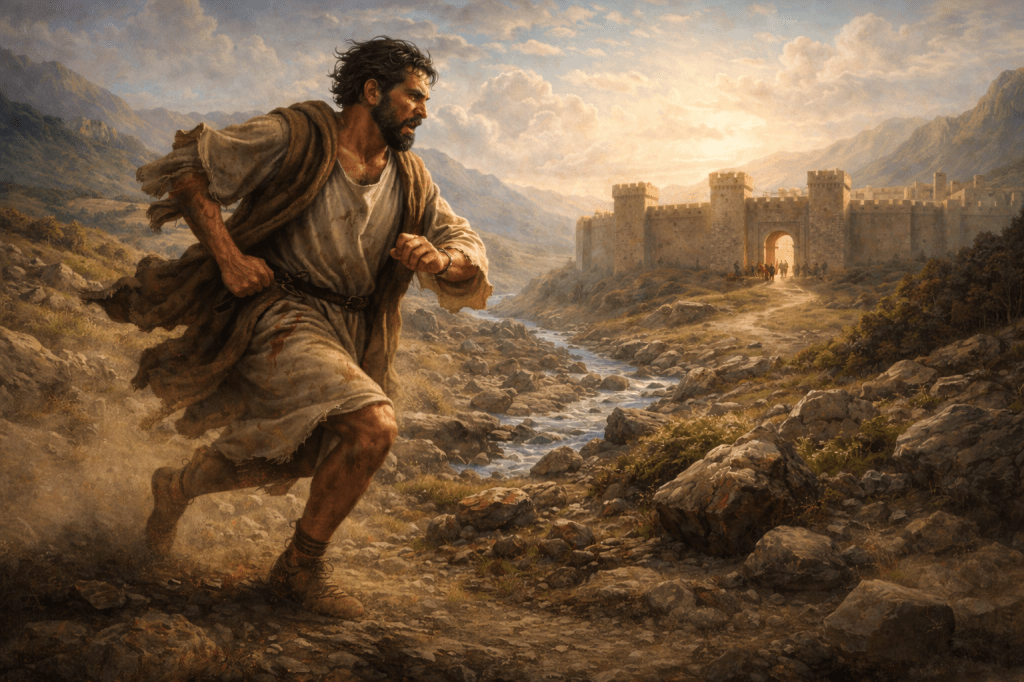
    “Now the LORD said to Abram, ‘Go forth from your country, and from your relatives and from your father’s house, to the land which I will show you.’”

    God’s call to Abram begins with a command and a promise—but not a map.
    “Go,” God says. Leave what is familiar. Step away from what is secure. I will show you where later.

    That is unsettling. Abram is asked to move away from family, homeland, and inheritance without knowing the destination. Yet Scripture presents his response without drama or delay: “So Abram went.” Faith, at its core, is not having all the details—it is trusting the One who gives the direction.

    Abram had already experienced a partial journey. His family had left Ur but settled in Haran—a comfortable, established place. Haran was progress, but not obedience. It wasn’t until God spoke again that Abram stepped fully into his calling.

    Genesis 12 reminds us that faith often requires movement before clarity. God rarely reveals the entire path at once. Instead, He asks for a willing heart—one ready to consent and then act. Obedience begins not when we feel ready, but when we trust God enough to take the next step.

    Swiss physician and author Paul Tournier once observed, “The greatest tragedy in life is that most people spend their entire lives indefinitely preparing to live.” Abram did not wait until every uncertainty was resolved. He obeyed while questions remained. And it was in motion—not hesitation—that God’s promise began to unfold.

    • Reflection: What does it look like for you to walk faithfully with God in the midst of a culture that often pulls you in a different direction?

    EVENING— The Oak of Moreh

    • Focal Passage: Genesis 12:6

    🌳“Abram passed through the land as far as the site of Shechem, to the oak of Moreh.”

    God’s promise to Abram is generous—but it is not self-focused. Abram would indeed be blessed, but not so he could settle into comfort. God’s intention was larger: “So you shall be a blessing.” Blessing was never meant to stop with Abram; it was meant to flow through him.

    As Abram traveled through the land, Scripture notes that he stopped at the oak of Moreh.🌳 It was likely a large, enduring tree—already standing long before Abram arrived. In the ancient world, such trees were landmarks, places of meeting, and often centers of local worship. There, beneath its branches, God appeared to Abram and promised, “To your descendants I will give this land.”

    Abram did not own the land. He had no title, no boundaries, no security. Yet under that oak, he built an altar and worshiped. Before he ever possessed the promise, he honored the Promiser. Abram learned that being a blessing does not require arrival—only faithfulness.

    A life that blesses others is often rooted in unseen faith. Like the oak itself, it grows quietly over time, offering shade and strength long before anyone notices. Abram’s obedience at the oak of Moreh set the pattern for a life lived not for accumulation, but for impact.

    God’s promise to Abram reached far beyond that moment. Through his obedience would come a family, a nation, and ultimately a Savior through whom all the families of the earth would be blessed. Abram likely could not see that far—but he didn’t need to. He simply needed to trust God where he stood.

    • Reflection:  Where has God placed you right now, and how might He be calling you to live as a blessing there—even before you see the full outcome?
    • Closing Prayer:  Father, thank You for the blessings You have entrusted to me. Teach me to hold them with open hands and to live faithfully where You have planted me. May my life, like a sturdy tree, bring shade and blessing to others for Your glory. Amen.
    • Read Genesis 8; 9:8-17

    MORNING— The Olive Leaf

    • Focal Passage: Genesis 8:11

    🌿“The dove came to him toward evening, and behold, in her beak was a freshly picked olive leaf. So Noah knew that the water was abated from the earth”

    For days, Noah could see nothing but water. The ark drifted without landmarks, direction, or timetable. Then one evening, the dove returned—not with answers, but with an olive leaf. It was a small sign, but it was enough. Dry land was forming. Life was returning. God was at work beyond what Noah could see.

    The olive branch did not mean the journey was over. The waters were still receding. The ark door was still closed. But hope had been placed into Noah’s hands. God often does that—offering reassurance before resolution, signs before outcomes, encouragement before clarity.

    Sometimes we want God to open the door immediately. Instead, He sends us an olive branch—a quiet reminder that He has not forgotten, that change is underway, that waiting has not been wasted. Hope is not always loud. Often it arrives gently, carried back by faith.

    If Noah had ignored the olive leaf, he would have missed what God was doing. But he noticed. And noticing strengthened his patience.

    • Reflection: What “olive branch” might God be placing in your life right now—small signs of hope that invite you to trust Him while you continue to wait?

    EVENING— The Promise in the Sky

    Focal Passage: Genesis 9:15

    “And I will remember My covenant, which is between Me and you and every living creature of all flesh; and never again shall the water become a flood to destroy all flesh.”

    When Noah finally stepped onto dry ground, his first response was worship. Before building a home or planning a future, he built an altar. Gratitude overflowed before answers were complete. And God responded—not with demands, but with a promise.

    In Genesis 9, God makes a covenant with Noah and all creation. Never again would the earth be destroyed by flood. The sign of that promise was a rainbow—a bow set in the clouds. In ancient terms, a bow was a weapon. God was, in effect, hanging up His bow, declaring mercy.

    The rainbow still speaks today. It reminds us that judgment is restrained, grace is offered, and repentance is still possible.

    Also, the seasons (8:22):  4 times a year in much of the world, God changes the canvases.  Snow on Lake Eerie in January, Rain and Mud in Lucas, Ohio (my hometown) during March, the longer days of summer at the beach or wherever you vacation in June, and the deciduous trees shedding their leaves in September. 

    These things remind us of the faithfulness of God.  The world keeps turning. God continues to bless. The seasons too are a sign from God He will be faithful to the covenant He made with Noah. 

    God’s faithfulness does not mean life will be easy. It means He will never abandon His promises. Even when circumstances are confusing, even when outcomes are delayed, God remains Semper Fidelis—Always Faithful.

    • Reflection: What promise of God do you need to trust again tonight, even if the fulfillment has not yet come?
    • Closing Prayer: Faithful God, thank You for remembering Your people and keeping Your promises. Help me trust You in seasons of waiting and recognize Your mercy in every sign of hope You place before me. Tonight, I rest in the assurance that You are always faithful. Amen.

    • Read Genesis 6

    MORNING— Finding Favor

    • Focal Passage: Genesis 6:8

    “But Noah found favor in the eyes of the Lord.”

    Genesis 6 opens with a sobering description of the human heart—violence filling the earth, corruption spreading unchecked, and thoughts bent continually toward evil. In the middle of that darkness, one quiet sentence stands out like a shaft of light: “But Noah found favor in the eyes of the LORD.”

    Noah was not perfect, but he was faithful. While the world around him drifted further from God, Noah chose to walk with Him. Favor did not mean Noah was spared from difficulty. It meant he was known by God, seen by God, and guided by God in a generation that had forgotten Him.

    This verse reminds us that faithfulness often looks ordinary before it looks heroic. Long before Noah built an ark, he lived a life oriented toward God. In a culture bent on compromise, Noah’s quiet obedience set him apart.

    God still sees those who walk with Him—especially when that walk feels lonely.

    • Reflection:  What does it look like for you to walk faithfully with God in the midst of a culture that often pulls you in a different direction?

    EVENING— What is Gopher Wood?

    • Focal Passage: Genesis 6:13-14, 18

    🌳Make for yourself an ark of gopher wood; you shall make the ark with rooms, and shall cover it inside and out with pitch.”

    One of the most intriguing details in Noah’s story is also one of the least explained. God tells Noah to build the ark from gopher wood—a word that appears nowhere else in Scripture. We don’t know exactly what kind of tree it was. Scholars have suggested cedar, cypress, or juniper, but the Bible never says. And perhaps that is the point.

    God did not ask Noah to understand the wood. He asked him to obey.

    Noah did not design the ark. He did not choose the materials. He simply followed the instructions God gave. The ark was not a human survival strategy; it was a divinely designed refuge. Whatever gopher wood was, it had to endure judgment—months of immersion, violent waters, crushing pressure. The ark was not built to be admired, but to hold fast.

    Genesis also emphasizes that the ark was covered inside and out with pitch. The Hebrew word used here is closely related to the word for atonement—a covering. The waters of judgment fell, but they could not penetrate what God had sealed. Salvation did not come by avoiding judgment, but by being protected through it.

    The pattern is unmistakable. Just as the ark was God’s chosen means of rescue, so Christ is God’s appointed Savior. The power was never in the wood itself—but in the God who provided the way.

    God left gopher wood unidentified so we would not miss the greater truth:
    We are saved not by understanding everything, but by trusting what God has provided.

    • Reflection: Where is God calling you to trust His provision, even when you don’t fully understand His design?
    • Closing Prayer: Father, help me obey You even when answers are incomplete. Teach me to trust Your wisdom more than my understanding. Thank You for providing a refuge through judgment and salvation through Christ. Tonight, I rest in what You have already prepared. Amen.

    • Read Genesis 4

    MORNING— Bringing Out Our Best

    • Focal Passage: Genesis 4:3–4

    “So it came about in the course of time that Cain brought an offering to the LORD of the fruit of the ground. Abel, on his part also brought of the firstlings of his flock and of their fat portions. And the LORD had regard for Abel and for his offering.”

    Cain and Abel both brought offerings to God, but Scripture carefully notes a difference. Cain brought an offering. Abel brought the firstlings and the best portions. The issue was not the kind of gift but the priority of the heart. Abel honored God with what mattered most. Cain offered something—but not his best.

    Most of us understand this instinctively. If you’re invited to a wedding, you don’t bring whatever happens to be lying around the house. You choose carefully. You give intentionally. What you bring reflects how you value the relationship.

    Now Scripture never suggests that farming was inferior to shepherding. What mattered was devotion. Abel approached God with reverence and trust. Cain approached God on his own terms. And when his offering was not received, resentment took root.

    Genesis 4 quietly asks whether we approach God with the same intentionality. Worship that costs nothing often means little. God is not impressed by appearance, but He is honored by devotion. Abel’s offering revealed trust and gratitude. Cain’s revealed reluctance.

    This story asks us a quiet but searching question: When I come before God, am I offering Him my best—or what’s left over? God does not demand perfection, but He does desire priority. What we give first reveals what we value most.

    • Reflection:  When it comes to your time, attention, and worship, are you offering God your best—or simply what fits comfortably into your schedule?

    EVENING— Sin at the Door

    • Focal Passage: Genesis 4:6–7

    “If you do not do well, sin is crouching at the door; and its desire is for you, but you must master it.”

    Before Cain ever lifted his hand against his brother, God intervened. Sin, the Lord warned, was crouching at the door—like a predator waiting patiently for the right moment. Cain was not yet guilty of murder, but he was already standing at a dangerous threshold. Anger had taken root. Resentment was settling in. And God, in mercy, spoke before the damage was done.

    Counselor and author Ed Welch observes, “Anger is often the result of unmet desires that have been allowed to grow unchecked.” Cain wanted affirmation. He wanted recognition. When those desires were frustrated, anger began to simmer.

    Similarly, Paul Tripp writes, “People don’t usually explode in anger without first rehearsing it in their hearts.” Cain didn’t act impulsively. He replayed the offense. He nurtured the grievance. And over time, what was internal became destructive.

    We know this pattern well. A comment we can’t let go. A comparison we keep revisiting. A disappointment we never bring into the light. Sin rarely kicks the door down. It waits for us to leave it cracked open.

    God’s warning to Cain still carries hope: “You must master it.” Cain was not powerless. He could choose obedience. He could respond rightly. The tragedy was not the presence of temptation, but the refusal to heed God’s counsel.

    Tonight, Genesis invites us to pause and pay attention—before anger speaks louder than wisdom.

    • Reflection: What desire, disappointment, or unresolved emotion might be quietly rehearsing itself in your heart, and how can you bring it honestly before God tonight?
    • Closing Prayer: Father, thank You for warning me before damage is done. Help me recognize what is stirring in my heart and respond with humility and obedience. Give me the wisdom to confront sin early and the strength to choose what is right. Guard my heart as I rest tonight. Amen.

  • Read Genesis 3

    MORNING— The Tree That LOOKED Alive

    • Focal Passage:  Genesis 3:1-7

    🌳“When the woman saw that the tree was good for food, and that it was a delight to the eyes, and that the tree was desirable to make one wise, she took from its fruit and ate; and she gave also to her husband with her, and he ate.”

    In 2012, after Hurricane Sandy swept across the East Coast, teams from the U.S. Forest Service surveyed forests along the Atlantic shoreline. What they found was unsettling. Hundreds of trees—red maples and Atlantic white cedars—were still standing tall. Their trunks were firm. Their branches full. Their bark looked healthy.

    But every one of them was dead.

    Saltwater from the storm surge had seeped deep into the soil. The trees absorbed it slowly. Salt doesn’t kill a tree immediately. From the outside, everything can look fine. But inside—at the root level—the tree loses its ability to take in life. Within weeks, entire “ghost forests” stretched across parts of New Jersey and New York. The researchers called them zombie trees—standing, but lifeless.

    When you read Genesis 3, think of those trees.

    Eve didn’t reach for the fruit because it looked dangerous. Scripture says it looked good. Nourishing. Desirable. Harmless. Just like those “zombie” trees appeared strong long after their roots were poisoned. The serpent’s question—“Did God really say?”—slipped in quietly, like salt into the soil.

    Adam and Eve were still standing. Still walking. Still talking.
    But something inside them had begun to wither.

    Genesis 3 reminds us that not everything that looks alive is healthy—and not everything God warns us against looks harmful at first. Some things destroy slowly, from the roots up.

    Yet the story doesn’t end in a ghost forest. The God who walked into the garden still walks toward us. And through Christ, He restores what sin has drained and brings life back to dead roots.

    Reflection:  Where do you see the effects of the Fall most clearly—in the world around you or in your own heart—and how does God’s promise of redemption speak hope into that brokenness today?

    EVENING— Loss of Life

    • Focal Passage:  Genesis 3:22-24

    🌳 “So He drove the man out; and at the east of the garden of Eden He stationed the cherubim and the flaming sword which turned every direction to guard the way to the tree of life.”

    After sin entered the world, God did something both sobering and merciful. He closed the way back to the tree of life. Cherubim were stationed at the entrance to Eden, and a flaming sword guarded the path. Humanity was no longer free to return and eat from the tree that gives life.

    This was not cruelty. It was protection. To eat from the tree of life in a fallen state would have meant living forever in brokenness, corruption, and separation from God. Eden was lost, but God refused to let death have the final word. The guarded gate was not the end of hope; it was the beginning of redemption.

    In the morning we saw how sin poisons quietly, like saltwater seeping into the roots of a tree that still looks alive. By evening, the damage is fully revealed. Adam and Eve are alive, but no longer whole. Still breathing, but cut off from the source of life. What looked harmless has now brought separation.

    Yet even here, grace is present. God does not abandon His creation. He clothes Adam and Eve. He promises a coming Deliverer. And He begins the long work of restoration that will one day reopen the way to life. Scripture later tells us that access to the tree of life is restored through Christ, who bore judgment so that life could be given again.

    The guarded tree reminds us that life cannot be taken on our terms. Life must be received on God’s terms. And tonight, we are reminded that every boundary God sets is ultimately meant to protect life, not withhold it.

    • Reflection:  Where have you mistaken God’s boundaries for restriction, rather than recognizing them as protection meant to preserve life?
    • Closing PrayerFather, help me trust Your heart even when I don’t fully understand Your ways. Thank You for protecting me from what would harm me and for working redemption where I see loss. Teach me to rest in Your mercy and to hope in the life You promise through Christ. Amen.

  • Read Genesis 2:1-25

    MORNING— Two Trees Before Us

    • Focal Passage:  Genesis 2:15-17

    “The Lord planted a garden toward the east, in Eden; and there He placed the man whom He had formed.  Out of the ground the Lord God caused to grow every tree that is pleasing to the sight and good for food; the tree of life also in the midst of the garden, and the tree of the knowledge of good and evil. The LORD God commanded the man, saying… ‘from the tree of the knowledge of good and evil you shall not eat.’ ”

    🌳 At the heart of Eden stood two distinct trees: the tree of life, representing God’s gift of ongoing life in His presence, and the tree of the knowledge of good and evil, representing the choice to define life apart from Him. Adam and Eve were not commanded to reach for the tree of life— but they were commanded to trust God by obeying His word about the other tree.

    Before the fall, choosing God meant choosing life.
    After the fall, the way to the tree of life was closed.
    But the pattern remains: each day we still face the choice between trusting God’s wisdom or leaning on our own.

    While we cannot return to Eden, Scripture later tells us that Christ Himself opens the way back to life (Revelation 2:7). Until that day, the “tree” we choose is not a literal one—it is the posture of our heart. Obedience is still the pathway to life. Independence from God is still the path to loss.

    Genesis 2 invites us to examine not which tree we reach for, but whose voice we trust.

    Reflection: In what area of your life today do you sense the tension between trusting God’s guidance and relying on your own understanding? Read Proverbs 3:5

    EVENING— Leaving and Cleaving

    • Focal Passage:  Genesis 2:18-25

    “For this reason a man shall leave his father and his mother, and be joined to his wife; and they shall become one flesh.”

    Genesis 2 gives us God’s original blueprint for marriage—a pattern Jesus Himself quotes in Matthew 19. A healthy marriage, Scripture says, involves both leaving and cleaving. Leaving means shifting primary loyalty from parents to spouse, creating a new family unit with new priorities. As author Mike Mason puts it, next to the love of God, a marriage becomes the most important earthly relationship—one that must come before careers, friendships, even ministry.

    Then comes cleaving. The Hebrew word dabāq paints a picture of two lives bonded together like glue—two becoming “one flesh.” C. S. Lewis compared it to a violin and a bow: separate pieces, yet one instrument when joined. This unity is expressed physically in sexual intimacy, but it reaches far deeper. True oneness includes emotional presence, mutual sacrifice, and a shared life of grace.

    A counselor once told the story of a husband crushed by pressure at work and disappointment at home. When he walked through the door discouraged and depleted, his wife quietly came beside him—her presence, her touch, her gentle questions giving him room to breathe again. “I didn’t feel alone anymore,” he said. That’s oneness. That’s cleaving.

    Marriage isn’t easy. But God’s design still holds. Leave what pulls you apart. Cleave to what draws you together. It is the road back to unity and health.

    • Reflection: What is one practical way you can “cleave” to your spouse this week—offering presence, encouragement, or intentional grace?
    • Closing PrayerFather, thank You for the gift of marriage and the pattern You established from the beginning. Strengthen every union, heal what is strained, and help us love with patience, humility, and devotion. Teach us to leave what distracts and cleave to what unites. Amen.
    • Read Genesis 1:1-25

    MORNING— A Tree Planted

    • Focal Passage:  Genesis 1:12

    “The earth brought forth vegetation, plants yielding seed after their kind, and trees bearing fruit with seed in them, after their kind; and God saw that it was good. ”

    🌳 Before God ever created people, He filled the earth with trees that could bear fruit—and seed. On day three, the Lord planted provision not only for the first humans but for every generation that would follow. Trees were designed to nourish, to shade, to sustain, and to multiply. Their fruit feeds the present; their seed ensures the future.

    Genesis reminds us that God always prepares what we need before we need it. Long before we take our first steps into a new season, God has already planted the provision that will carry us through it.

    Reflection:  How often do you stop and thank God for today’s blessings, remembering that He planted and nurtured them long before you were aware of His provision?

    Evening— Seeing People Through Fresh Lenses

    • Focal Passage:  Genesis 1:26–27

    “Let Us make man in Our image, according to Our likeness…
    So God created man in His own image… male and female He created them.”

    Someone has said that we all view the world through our own handcrafted lenses.  Try as we might, we can’t seem to view others outside our own biases.  Genesis 1 invites us to put on a new set of lenses. Every person you meet today—every one of them—bears the image of God. That truth alone changes the way we encounter our world.

    C. S. Lewis captured this beautifully:

    “There are no ordinary people. You have never talked to a mere mortal…
    Next to the Blessed Sacrament itself, your neighbor is the holiest object presented to your senses.”

    The most “ordinary” person in your path today carries eternal weight:  Your spouse.  Your kids.  Your coworkers.
    The barista.  The cashier.
    The person who frustrates you.  The person who blesses you.                             

    Each is an eternal being.  All are image bearers of God. This truth alone should reshape the way we view others—and ourselves.

    Dr. Robert Pyne tells a powerful story about his son, Steve:

    “Steve had open-heart surgery at eight months old. Some people wouldn’t have allowed that surgery—because Steve has Down Syndrome.  It’s tempting to defend his life by listing everything he can do. But the real reason his life was worth saving is this: he has inherent dignity as a human being made in the image of God.  The same is true for people who will never read, never speak, or never smile. Their worth does not come from what they can do, but from whose image they bear.”

    Today, try putting on creation lenses, shaped by the truth that every person carries God’s imprint. 

    Our vision will certainly improve.

    • Reflection: Who is one person in your life you tend to overlook, avoid, or take for granted—and how might seeing them as an image bearer change the way you interact with them today?
    • Closing PrayerFather, open my eyes today.  Help me see every person I meet—family, friends, strangers, even difficult people—as someone created in Your image and deeply loved by You.  Let me treat others with dignity, kindness, and grace.  Amen.
  • Introduction

    The story of Scripture begins and ends with a tree.

    In Genesis, a tree stands at the center of God’s garden—a reminder of His generosity, His presence, and the life He intended for His people. In Revelation, this tree reappears—its leaves bringing healing, its fruit offered freely, its roots drawing from the river of life. And in the middle of history, between Eden and New Creation, there stands a third tree: the cross of Christ.

    These three trees—the Tree of Life, the Tree of Calvary, and the Tree of Life restored—mark the great movements of God’s redeeming work.
    They tell us where we came from, what went wrong, and how God is making all things new.

    This devotional is a journey through that story.

    Beginning January 1st and over the next 365 days, we will walk from creation to new creation, from ruin to redemption, from brokenness to restoration. You will read passages that reveal God’s character, His promises, His warnings, His mercy, and His relentless pursuit of His people. You will walk with Abraham beneath the stars, listen to Moses beside the burning bush, stand with Joshua at the Jordan, kneel with David in confession, and wait with the prophets for the coming King.

    We will follow Jesus from His cradle to His cross to His empty tomb.
    We will watch the early church take root and flourish.
    And we will finish where Scripture finishes—beneath the branches of the Tree of Life, where God’s people will dwell with Him forever.

    Along the way, we will encounter many trees: the tamarisk Abraham planted, the oaks of righteousness promised in Isaiah, the parable of the fig tree, and the mustard seed that grows into sheltering branches. These are not incidental details. The Bible uses trees to remind us who we are, who God is, and what kind of story He is writing.

    Trees are rooted. Trees grow slowly. Trees endure storms. Trees provide shade, fruit, beauty, and restoration.
    Trees remind us that His work in us—and through us—happens season by season, not all at once.

    This devotional is not meant to be rushed. It is meant to be received.

    Each day includes a Scripture reading and a reflection designed to help you slow down, breathe deeply, and see both God and people more clearly. Some entries will challenge you; others will comfort you. Some will confront your assumptions; others will lift your eyes. All of them will point you back to the God who planted the first garden and is preparing the last one.

    Whether you are beginning your spiritual journey or continuing it, whether this is your first time reading the Bible or your fortieth, my prayer is that this year will give you fresh eyes—new lenses—for seeing God, seeing His world, and seeing the people He loves.

    So, take a deep breath. Open your Bible. Step beneath the branches.
    You are about to walk the most beautiful path ever written—from Tree to Tree. 

    C. S. Lewis in his masterpiece, The Lion, the Witch and the Wardrobe has Lucy Pevensie step into an ordinary wardrobe—fur coats brushing against her arms—suddenly feel the coats thin out, and her feet crunch in snow.  She realizes she is no longer in a room but in a forest. What seemed familiar opens into something vast, living, and unexpected.

    May these pages lead you closer to the One who planted a forest of truth for all of us to explore.
    May you, as Psalm 1 says, become a tree planted by streams of water—rooted, flourishing, and alive in Him. 

    Let the journey begin.