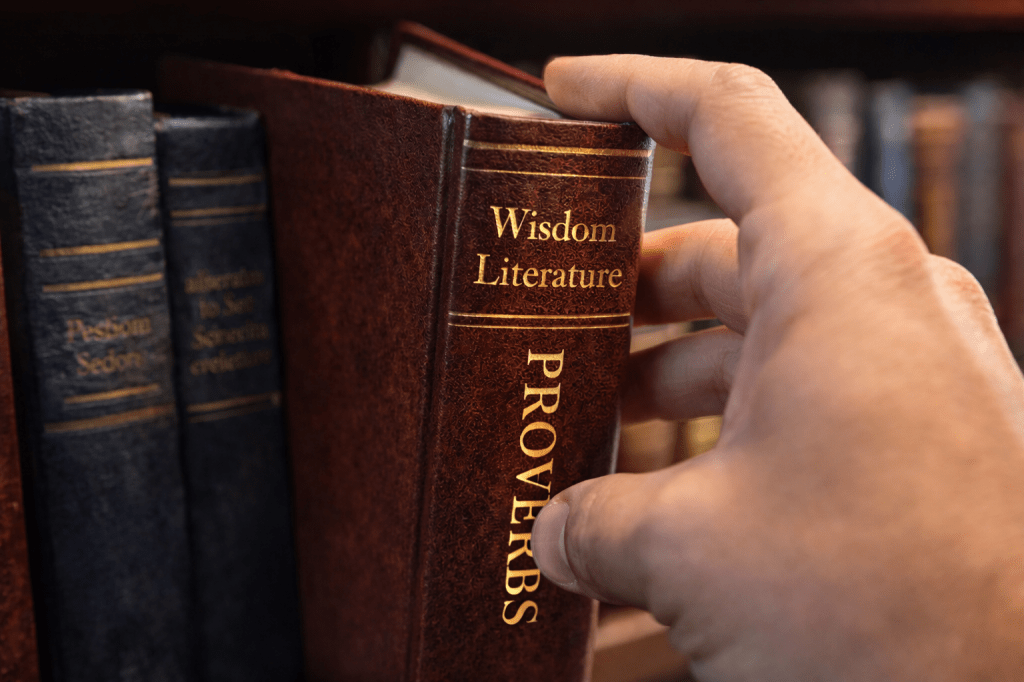
• Read Proverbs 27, 30

    MORNING— Iron Sharpens Iron

    • Focal Passage: Proverbs 27:7

    “Iron sharpens iron, so one man sharpens another.”

    Some lessons you can only learn in the presence of another person.

    Proverbs 27 doesn’t romanticize friendship. It tells the truth: real friends bring friction. Not the kind that burns you down, but the kind that hones you—like two blades making each other useful again. That’s why Solomon pairs “Iron sharpens iron” with this bracing line:

    “Better is open rebuke than love that is concealed. Faithful are the wounds of a friend…” (Proverbs 27:5–6)

    Most of us don’t mind encouragement. We love encouragement. The hard part is letting someone who loves us tell us what we’re missing—where we’re drifting, where we’re rationalizing, where our tone has sharpened but our heart has dulled. A faithful friend doesn’t just say, “You’re fine.” A faithful friend says, “You’re better than this—and I’m with you while you grow.”

    And if you’re thinking, “I don’t even know how to find that kind of friendship,” Learn from the words of Harville Hendrix who said: “there aren’t ‘friends’ out there—there are strangers, and if you want a friend, you have to make one.” That’s painfully practical. Friendship is built on intention—time, shared life, honest counsel, and forgiveness in both directions.

    Proverbs even gives us a tiny picture of steady, ordinary faithfulness:
    “He who tends the fig tree 🌳 will eat its fruit…” (Proverbs 27:18)
    Friendship is like that fig tree 🌳. You don’t get sweetness without cultivation. A text. An invitation. A follow-up. A willingness to sit and listen. A habit of showing up.

    So here’s a gentle check-in: are you treating friendship like a lottery ticket—hoping it just happens—or like a fig tree 🌳 —something you tend with patience?

    • Reflection:  Who is one “stranger” God may be inviting you to turn into a friend this month—and what is one simple next step (coffee, a walk, an invitation, a phone call) you can take?

    EVENING— A Call to Wonder

    • Focal Passage: Proverbs 30:4

    “Who has established all the ends of the earth? What is His name or His son’s name? Surely you know!”

    Agur’s wisdom doesn’t come through sounding impressive. It comes through sounding honest.

    He looks at the world and admits his limits:
    “Surely I am more stupid than any man… Neither have I learned wisdom…” (Proverbs 30:2–3)
    That’s not self-hatred. It’s humility. And humility has a strange power—it puts you in a posture where wonder can reach you again.

    Agur watches the world move—an eagle cutting the sky, a serpent slipping over rock, a ship crossing the sea—and he says, “There’s more here than I can fully explain.” (Proverbs 30:18–19) Then he studies the smallest creatures—ants preparing, shephanim hiding in the rocks, locusts moving in ranks—and he learns that God loves to tutor us through creation. (Proverbs 30:24–28)

    And right in the middle of all that wonder, he asks a question that hangs in the air:
    “What is His name… or His son’s name?” (Proverbs 30:4)

    Centuries later, we can answer what Agur could only reach for. The God who “established all the ends of the earth” has made Himself known—and He has a Son. John says the Son was there at the beginning, and through Him all things came into being (John 1:1–3). Paul says creation holds together in Him (Colossians 1:16–17). The world isn’t only beautiful—it’s pointing. Wonder is meant to lead somewhere: to worship, to trust, to Jesus.

    And here’s where Proverbs 27 and 30 meet without forcing it: we are better together not only because friends sharpen us, but because we were made for communion—with God and with one another. Isolation shrinks our world to the size of our own thoughts. Wonder re-opens it. Friendship helps keep it open.

    So tonight, receive this as permission: step outside if you can. Look up. Breathe. Let the vastness of God quiet the noise of self. And then bring your small life—your real needs, your anxious corners—back under His care.

    • Reflection:  What has been stealing your wonder lately—and what is one small practice (a walk, a screen-free moment, a psalm, a prayer) that could return you to awe in God?
    • Closing Prayer:  Father, thank You for not leaving us alone—You place us in families, churches, friendships, and community for our good. Give us courage to pursue wise companionship, humility to receive honest counsel, and love to offer it with gentleness. And as we end this day, lift our eyes again: You established the ends of the earth, and You have made Yourself known through Your Son. Restore our wonder.  Amen.

  • Hi everyone! Earlier this year I put out a book on Jeremiah titled “Are You There God, It’s Me, Jeremiah.” It was well received. But upon reading my copy I found too many errors so I knew I had to release a new edition.

    For those that have already purchased the first one, this isn’t a plea for you to buy another. If you are happy, I’m happy.

    I did put in a few incentives if you decide to purchase the new edition. I numbered the chapters (something Janine insisted I do), put in a table of contents, added a brand new chapter titled: “Should I Stay or Should I Go” and put in a Study Guide for Small Groups at the end, featuring question for group discussion.

    Thanks for all the support! And for those who read my tree to tree devotional from around the country and around the world whom I haven’t even met, check out this book. I’ve very excited about it.

    Blessings!

    PW (Pastor Wayne)

    • Read Proverbs 18

    MORNING— How Foolishness is Established

    • Focal Passage: Proverbs 18:3

    “He who gives an answer before he hears, it is folly and shame to him.”

    Proverbs 18 introduces us again to a familiar character — the fool. Not the unintelligent person. Not someone lacking IQ. But someone lacking wisdom.

    When I was a young believer, I used to read Proverbs and think, Well, I’m not a fool. I know the Lord. But over time I’ve realized the better question isn’t whether I’ve ever acted foolishly. The better question is: what kind of fool am I drifting toward when I stop listening?

    Proverbs reveals progression. Foolishness hardens over time if it goes unchecked.

    1. The Naïve Fool — He Doesn’t Know Any Better

    Proverbs 18:13 describes the person who answers before hearing. The one who forms conclusions without investigation. The one who reacts before understanding.

    Proverbs 18:17 adds,
    “The first to plead his case seems right, until another comes and examines him.”

    The naïve fool is easily persuaded. Not malicious — just undiscerning.

    Think of the Frosties NFT scandal just a few years ago. An NFT is essentially a digital certificate tied to an image — not a tangible asset, not ownership of a company, just a line of code recorded on a blockchain. Buyers were promised future perks, games, and community rewards. Thousands rushed in. It sounded promising. It felt exciting. Influencers amplified it across social media, creating urgency — get in now or miss out. Within days, the creators disappeared with over a million dollars. The naïve believed the hype without testing it.

    Proverbs 1:4 tells us wisdom exists “to give prudence to the naïve.”
    The simple need discernment. Slow down. Ask questions. Seek counsel. Don’t mistake volume for truth.


    2. The Repetitive Fool — Knows Better but Doesn’t Change

    Proverbs 26:11 says,
    “Like a dog that returns to its vomit is a fool who repeats his folly.”

    This person has already learned the lesson — at least intellectually. They’ve seen the damage. They’ve felt the consequences. And yet they return.

    Proverbs 22:3 warns,
    “The prudent sees the evil and hides himself, but the naïve go on, and are punished for it.”

    The repetitive fool sees the warning sign — and keeps driving.

    The athlete who hides symptoms and worsens injury.
    The patient who ignores medical advice after a health scare.
    The driver arrested multiple times who still chooses to drink and drive.

    This form of foolishness is not ignorance — it is resistance to change.

    What does this fool need? Accountability. Someone who loves them enough to ask hard questions. And a heart willing to receive those questions without bristling.

    • Reflection:  Am I quick to react without listening? Am I repeating something I already know is destructive?

    EVENING— Foolishness that Leads to Destruction

    • Focal Passage: Proverbs 18:10

    “The name of the Lord is a strong tower; The righteous runs into it and is safe.”

    Foolishness deepens if it is not corrected. The latter stages are more serious.

    3. The Stubborn Fool — Knows Better and Still Won’t Accept Instruction

    Proverbs 12:15 says,
    “The way of a fool is right in his own eyes, but a wise man listens to advice.”

    This fool justifies instead of repents. When confronted, he doubles down.

    Lance Armstrong offers a sobering illustration. For years, there were mounting warnings from teammates, journalists, and anti-doping authorities that his cycling success was chemically enhanced. Evidence accumulated. Investigations intensified. Rather than reflect, he attacked critics, sued journalists, and intimidated whistleblowers. His denials were forceful and unwavering.

    In 2012, the U.S. Anti-Doping Agency released overwhelming documentation of systematic doping. Armstrong was stripped of seven Tour de France titles and banned for life. Sponsors withdrew. His reputation collapsed. In 2013, he admitted the truth in a televised interview — years after repeated opportunities to come clean. By then, the legacy damage was permanent.

    The stubborn fool isn’t confused. He is proud.

    The cure? Humility — before destruction comes.


    4. The Scoffing Fool — Knows Better but Mocks Truth

    Proverbs 13:1:
    “A scoffer does not listen to rebuke.”

    Scoffing goes beyond ignoring wisdom. It ridicules it. It rallies others against it. Even when consequences come, Proverbs 19:3 says such a heart may “rage against the Lord.”

    At this stage, foolishness has become identity. Pride is defended as virtue. Correction is viewed as attack.

    What is needed here is repentance — a softening that only God can produce.


    5. The Godless Fool — Openly Rejects God

    Psalm 14:1 declares,
    “The fool says in his heart, ‘There is no God.’”

    This is the final progression. Not merely careless. Not merely proud. But rejecting God outright.

    And yet — Proverbs 18:10 stands in the middle of the chapter like an invitation:

    “The name of the Lord is a strong tower; The righteous runs into it and is safe.”

    Notice the verb. Runs.

    Damon West once stood before a Dallas jury in 2009 and was sentenced to 65 years in prison for burglary after meth addiction destroyed his promising life. A former Division I quarterback, he had spiraled into crime to feed his habit. In prison, an older inmate told him, “Go cry in the shower. Get it out.”

    Under that running water, West says he began talking to God for the first time in years. Not excuses. Not defiance. Just repentance. And instead of condemnation, he sensed mercy.

    In that moment, he ran — spiritually — into the strong tower.

    Over time his life began to change. He embraced accountability. He sought transformation. Paroled years later, he now speaks about redemption and responsibility.

    The strong tower is not for the perfect. It is for the repentant.

    • Reflection:  What kind of fool have I been lately — naïve, repetitive, stubborn, scoffing? And have I run to the strong tower, or am I still trying to fix it myself?
    • Closing Prayer:  Lord, show me where foolishness has crept into my life. Give me the humility to listen, the courage to change, and the wisdom to run quickly to You. Be my strong tower tonight. Amen.
    • Read Proverbs 12

    MORNING— Established in Christ

    • Focal Passage: Proverbs 12:3

    “A man will not be established by wickedness, but the root of the righteous will not be moved.”

    Adoniram Judson arrived in Burma in 1813 with a burning call from God and almost nothing else. No converts. No encouragement. No visible fruit. For six years he preached and translated Scripture without seeing a single person turn to Christ. He buried children in foreign soil. He buried two wives. He spent seventeen months in prison, chained and starving. There were seasons when he came close to losing his sanity.

    And yet he did not leave.

    Why? Because he was rooted.

    By the time of his death, there were over one hundred churches and thousands of believers. Today, millions trace their spiritual lineage to that one steady life. Judson’s circumstances bent him low—but they did not uproot him.

    Proverbs 12:3 gives us language for that kind of endurance:
    “The root of the righteous will not be moved.”

    Notice what the verse does not promise. It does not say the righteous will not be shaken. Storms come to everyone. Leaves fall. Branches creak. But if the root is deep and alive, the tree remains standing.

    In Proverbs, the righteous (צַדִּיק – tsaddiq) are those aligned with God’s ways. For us, that alignment begins even deeper than behavior. Christ fulfilled the Law we could not. His righteousness is credited to us. We are declared righteous by faith before we ever live righteously in practice.

    Jesus calls Himself “the Root” (Revelation 22:16). To be rooted in righteousness is to be rooted in Him.

    From that secure place, fruit begins to grow.

    Proverbs 12 shows us what that fruit looks like in ordinary life:

    • Just thinking — “The thoughts of the righteous are just” (v.5). A righteous person does not simply react; he considers what is fair, true, and helpful.
    • Kind regard — “A righteous man has regard for the life of his animal” (v.10). If someone treats the least with care, it reveals the shape of the heart.
    • Steady speech — “He who speaks truth tells what is right” (v.17). Integrity becomes instinct.
    • Guiding presence — “The righteous is a guide to his neighbor” (v.26). Stability in one life becomes direction for another.

    None of that fruit appears overnight. But when the root is Christ, growth is not a question of if—only when.

    You may not be called to Burma. But you are called to be steadfast—at home, at work, in disappointment, in uncertainty. The question is not whether storms will come. They will. The question is whether your life is anchored in something that cannot be moved.

    • Reflection:  Where are you tempted to measure stability by circumstances instead of by your root in Christ?

    EVENING— The House of the RIghteous

    • Focal Passage: Proverbs 12:7

    “The wicked are overthrown and are no more, but the house of the righteous will stand.”

    Proverbs ends this chapter by widening the lens. Roots lead to houses. Private righteousness shapes public legacy.

    “The house of the righteous will stand.”

    That word house can mean family, lineage, influence—everything that extends beyond you. Wickedness may look strong for a season, but it has no staying power. It collapses under its own weight. Righteousness, though sometimes slow and unnoticed, builds something that endures.

    Gary Thomas once described a funeral where grief turned into applause. A faithful man—husband, father, servant of Christ—had died unexpectedly. As the casket moved down the aisle, the congregation stood and began clapping. Not because death is light. But because a life had been well lived. His passing felt like victory, not defeat.

    That kind of legacy is not crafted in a final week. It is formed across decades—through thousands of small decisions to think justly, act kindly, speak truthfully, and guide others wisely.

    Patrick Cooney tells of wearing two wedding rings—his own and his father’s. After his father’s death, his mother handed him that ring. He wears it not as jewelry, but as a reminder: to be the husband and father his dad modeled. That is what a “house that stands” looks like. Influence that outlives the one who first built it.

    Proverbs 12:12 adds:
    “…the root of the righteous yields fruit.”

    Fruit feeds others. It strengthens others. It seeds the next generation.

    You cannot control how people will summarize your life. But you can control what you cultivate. Every honest word. Every act of mercy. Every decision to remain faithful when it would be easier to drift—these are beams in a house that will stand.

    And the stability of that house does not rest on your perfection. It rests on your Root.

    If Christ is your righteousness, then your growth—however slow—rests on solid ground.

    • Reflection:  If your life were summarized by one consistent fruit, what would you want it to be?
    • Closing Prayer:  Lord Jesus, You are my righteousness and my Root. Establish my life in You so that what grows from me is steady and true. Form in me thoughts that are just, words that are faithful, and a legacy that stands for Your glory. Amen.
    • Read Proverbs 10:10-21, 15:1-4

    MORNING— Shell Collecting on the Shoreline

    • Focal Passage: Proverbs 10:11-12

    “The mouth of the righteous is a fountain of life, but the mouth of the wicked conceals violence.
    Hatred stirs up strife, but love covers all transgressions.”

    Proverbs 10 feels different from the earlier chapters.

    In Proverbs 1–9, we hear extended appeals — a father instructing his son, Wisdom crying aloud in the streets. But when we reach chapter 10, the tone changes. The tide rolls out, and the shoreline is suddenly covered with shells — compact sayings, bright truths, sharp warnings, each one able to stand alone.

    You don’t read this section like a narrative.
    You read it like shell collecting.

    You slow down. You look carefully. Some shells you admire and leave behind. Others you pick up because they fit your hand — because they fit your life. And in chapter 10:10–21, one cluster keeps surfacing: mouth, lips, words, tongue.

    Solomon presses into us this wisdom: our words matter.

    Jesus said it with sobering clarity:

    Matthew 12:36 (NASB 1995)

    “But I tell you that every careless word that people speak, they shall give an accounting for it in the day of judgment.”

    Every careless word.

    That isn’t meant to drive us into panic. It calls us into awareness. Because Proverbs makes clear that words do not drift in from the outside. They rise from within.

    “The mouth of the righteous is a fountain of life.”

    A fountain does not manufacture water. It releases what is already there. Words reveal the source.

    If bitterness flows out, the issue is not merely speech — it is the spring.

    That’s why my wife Janine’s story matters so much. She grew up in an abusive home. Turmoil was normal. Fear was familiar. As a child in Catholic school, one day a nun pulled her aside. The sister had begun to suspect something was wrong. She looked at Janine and said:

    “You have a choice. You don’t have to grow up to be like the environment you’ve grown up in.”

    That was it. Truth spoken at the right moment. Words that told her the pattern did not have to continue. They were a fountain of life.

    Solomon also warns of the opposite current:

    “Hatred stirs up strife, but love covers all transgressions.”

    Hatred agitates. It pokes at wounds. It keeps conflict simmering. Love chooses not to inflame every offense. It refuses to weaponize every irritation.

    And Solomon adds a caution many of us need daily:

    “When there are many words, transgression is unavoidable,
    But he who restrains his lips is wise.” (10:19)

    Sometimes wisdom sounds like fewer syllables.

    And sometimes it sounds like one life-giving sentence that changes someone forever.

    • Reflection:  What is flowing most freely from your mouth right now — agitation or life?

    EVENING— A Soothing Tongue is a Tree of Life🌳

    • Focal Passage: Proverbs 15:1, 4

    “A gentle answer turns away wrath, but a harsh word stirs up anger.”                                           “A soothing tongue is a tree of life, but perversion in it crushes the spirit.

    As the shoreline continues into Proverbs 15, common shells continue to pile up.

    Still regarding the tongue.
    Still about the weight of words.

    But now Solomon gives us one of the most beautiful phrases in the book:

    “A soothing tongue is a tree of life🌳.”

    That image reaches all the way back to Eden. A tree of life🌳 means nourishment, shade, steadiness, renewal.  A soothing tongue is not weak speech. It is disciplined speech. It is strength governed by love.

    “A gentle answer turns away wrath.”

    Notice what Solomon does not say.

    He does not say the smartest answer turns away wrath.
    He does not say the sharpest comeback turns away wrath.
    He does not say the most forceful rebuttal wins the day.

    A gentle answer.

    We all know how quickly harsh words can escalate a moment. One sharp phrase multiplies tension. One sarcastic remark deepens the wound. Words can crush a spirit.

    But a soothing tongue? That becomes shade for someone overheated by conflict. It becomes fruit for someone starving for encouragement. It becomes stability in a shaky moment.

    Proverbs 10:21 reminded us that “the lips of the righteous feed many.” Words nourish. They sustain. They strengthen.

    They become a tree of life. 🌳

    Tomorrow, walk into your conversations with this prayer: Lord, make my words shade for someone.

    • Reflection: Who in your life most needs a gentle answer from you? What would a tree-of-life response sound like?
    • Closing Prayer:  Father, set a guard over our mouths and a watch over our lips. Forgive the words that have stirred anger or wounded hearts. Cleanse the source within us so that what flows out brings life. Make our speech gentle, steady, and healing. Let our tongues become trees of life in a world quick to crush.
      Through Jesus, the living Word,
      Amen.
      🌳
    • Read Proverbs 3

    MORNING— Unwavering Trust

    • Focal Passage: Proverbs 3:5-6

    “Trust in the LORD with all your heart and do not lean on your own understanding. In all your ways acknowledge Him, and He will make your paths straight.”

    There is something unsettling about walking in the dark.

    Even in your own house. You think you know the layout. You’ve walked the hallway a thousand times. But remove the light and suddenly every step is cautious. Your hands reach out. Your pace slows. Familiar ground feels uncertain.

    That is what life feels like at times.

    You thought you understood the landscape. You assumed you knew the next turn. And then the lights dim — a diagnosis, a betrayal, a closed door, an unexpected change.

    Proverbs 3 does not begin by promising more light. It begins by calling for trust.

    “Trust in the LORD with all your heart…”

    The Hebrew word batach carries the idea of placing your full weight upon something. It is the opposite of bracing yourself. It is releasing the need to prop yourself up.

    We are far more accustomed to bracing.

    We brace for bad news.
    We brace in relationships.
    We brace emotionally so we will not be disappointed again.

    But Scripture calls us to place the full weight of our inner life — our intellect, will, fears, and plans — upon the Lord.

    And then it adds, “Do not lean on your own understanding.”

    Often we consult God, but reserve final judgment. We pray, but we still calculate outcomes. We nod toward heaven, but we trust our instincts more. Our understanding is limited by what we can see in front of us. God’s understanding stretches beyond bends in the road we have not yet reached.

    “In all your ways acknowledge Him.”

    The word translated acknowledge means to know — deeply, relationally. It is not a polite mention of God before meals. It is the steady awareness that He is present in every decision, every conversation, every frustration, every celebration.

    The way you handle success.
    The way you handle disappointment.
    The way you speak when irritated.
    The way you spend, save, rest, and respond.

    All your ways.

    When trust moves from theory into practice, something remarkable happens: “He will make your paths straight.”

    Straight does not mean painless. It does not mean obstacle-free. It means aligned. It means directed. It means you are no longer zigzagging between self-reliance and surrender. There are fewer unnecessary detours. Less storm-chasing. Less debris to clean up later.

    You walk with steadiness because you are no longer walking alone.

    • Reflection:  Where are you still bracing for impact instead of resting your full weight on God?

    EVENING— Discipline that Leads to Life🌳

    • Focal Passage: Proverbs 3:11-12, 18

    “My son, do not reject the discipline of the LORD or loathe His reproof, for whom the LORD loves He reproves, even as a father corrects the son in whom he delights… She is a tree of life🌳 to those who take hold of her, and happy are all who hold her fast.”

    Trust becomes most difficult when obedience becomes costly. Sometimes the crookedness in our path is not caused by the world around us but by the Lord correcting us within it.

    “My son, do not reject the discipline of the LORD.”

    Discipline is rarely welcomed. It stings pride. It exposes blind spots. It forces us to admit we were leaning more on ourselves than we realized. Yet Scripture insists that correction is not rejection. It is affection.

    “For whom the LORD loves He reproves.”

    If God were indifferent, He would allow you to drift without interruption. If He did not claim you, He would not redirect you. Hebrews 12 tells us that discipline is painful for a moment, but afterward it yields “the peaceful fruit of righteousness.”

    Proverbs 3:13 says, “How blessed is the man who finds wisdom.” And (v. 18) “She is a tree of life to those who take hold of her.”

    The tree of life🌳 shows up again—something planted in Genesis and which will be restored in Revelation.  Humanity once reached for autonomy in a garden. We leaned on our own understanding and grasped at knowledge apart from trust.

    Wisdom invites us back.

    To take hold of wisdom is to take hold of life as it was meant to be lived — rooted in dependence, sustained by trust, corrected by love. Ultimately, this path is made straight because Christ walked a crooked one. The cross looked like the ultimate detour. It was suffering, shame, injustice. And yet it was the straightest path to redemption the world has ever known.

    Through Him, our wandering hearts are brought back. Through Him, discipline becomes restoration. Through Him, the tree of life blooms again. 🌳

    • Reflection: Is there any correction in your life right now that you are resisting? What if it is evidence of God’s delight in you?
    • Closing Prayer:  Father, teach us to stop bracing and start trusting. Forgive us for leaning on ourselves when You have invited us to rest in You. When Your correction comes, help us receive it as love. Through Christ, straighten our wandering paths and root us deeply in the life that only You can give.
      Amen.
      🌳

    • Read Proverbs 1

    MORNING— Where Wisdom Begins

    • Focal Passage: Proverbs 1:7

    “The fear of the Lord is the beginning of knowledge; Fools despise wisdom and instruction.”

    Do you want a good life? Not just survival. Not just getting by. But a life marked by strength, stability, and satisfaction?

    Proverbs opens with that promise. Solomon, son of David, king of Israel, lays out his purpose plainly:

    “To know wisdom and instruction,
    To discern the sayings of understanding,
    To receive instruction in wise behavior,
    Righteousness, justice and equity.”
    (vv. 2–3)

    The book of Proverbs is instruction in how to live well. Ancient “adulting,” if you will. The book of Proverbs is the most practical book in the Bible. It does not merely ask why we suffer (Job), why we worship (Psalms), or why we exist (Ecclesiastes). Proverbs answers how.

    How do we live for the best overall results?
    How do we make decisions that hold up over time?

    Tragedies sometimes come without warning. Earthquakes. Fires. Floods. We pray. We help. We guard our words. We act with compassion.

    But not every collapse is sudden.

    In 2007, during rush hour in Minneapolis, the I-35W bridge fell into the Mississippi River, killing 13 and injuring over 100. It felt sudden. But it was not unannounced. Engineers had warned for years. Reports labeled it “structurally deficient.” Repairs were planned—but never prioritized.

    A life without wisdom can look stable. But if cracks are ignored long enough, collapse is only a matter of time.

    Solomon says wisdom is the filter that keeps the engine running clean. Change the oil but ignore the filter, and eventually the sludge wins. Likewise, ignore wisdom long enough and clarity erodes, direction fades, and strength weakens.

    So where does wisdom begin?

    “The fear of the Lord is the beginning of knowledge.”

    Cultural consensus does not produce wisdom. Reverent awe does. The fear of the Lord is standing before God with deep awareness of who He is. It is the settled conviction: God is wiser than I am. I will follow Him.

    The opposite posture?

    “Fools despise wisdom and instruction.”

    Not unintelligent—unteachable! Stubborn. Resistant. “No one tells me what to do.”

    Wisdom begins with surrender that maybe we don’t know it all.

    • Reflection:  Where might there be small cracks forming in your life—areas where you are hearing warning signs but postponing change?

    EVENING— Wisdom Shouts in the Streets

    • Focal Passage: Proverbs 1:22-23

    “How long, O naïve ones, will you love simplicity? And scoffers delight themselves in scoffing, and fools hate knowledge?  Turn to my reproof, behold, I will pour my spirit in you; I will make my words known to you.”

    A few years ago, when NFL player Damar Hamlin collapsed on the field in cardiac arrest, millions watched in silence. Teammates knelt. Broadcasters prayed. The entire culture paused.

    When Hamlin awoke, one of his first questions was written on a board: “Did we win?”

    The doctors answered, “Yes—you won the game of life.”

    He later spoke openly about his faith, saying God used him as a vessel. A sudden brush with mortality made him count his days differently.

    Moses prayed in Psalm 90:

    “Teach us to number our days, that we may present to You a heart of wisdom.”

    To number our days is to value them. To use them. To build on rock before the storm hits.

    As the day closes, Proverbs 1 widens the lens. Wisdom is not whispering in a corner.

    “Wisdom shouts in the street, she lifts her voice in the square.” (v. 20)

    Wisdom is public. Visible. Accessible. She calls out to the naive, the young, the experienced:

    “Turn to my reproof; Behold, I will pour out my spirit on you.” (v. 23)

    There is invitation. But there is also warning.

    “Because I called and you refused… then they will call on me, but I will not answer.” (vv. 24, 28)

    Ignore wisdom long enough and eventually you cannot hear her clearly. Solomon describes storms—calamity like a whirlwind (v. 27). That language echoes forward to Jesus’ words in Matthew 7:

    “Everyone who hears these words of Mine and acts on them… will be like a wise man who built his house on the rock.”

    Storms come to both houses. The difference is not the weather. It is the foundation.

    Proverbs ends the chapter with promise:

    “But whoever listens to me will dwell secure and will be at ease, without dread of disaster.” (v. 33)

    Wisdom is shouting.
    The question is not whether she speaks.
    The question is whether we are listening.

    • Reflection: Who are you listening to most right now—God’s voice, godly counsel, or the noise of the crowd?
    • Closing Prayer:  Father, teach me to fear You rightly. Guard me from stubbornness and pride. Help me to listen before the storm comes, and to build my life on Your Word. Give me a heart of wisdom that honors You with the days You have given. In Jesus’ name, Amen.
    • Read Psalm 139

    MORNING— Known All the Way Through

    • Focal Passage: Psalm 139:1-2

    “O LORD, You have searched me and known me. You know when I sit down and when I rise up;
    You understand my thought from afar.”

    Psalm 139 confronts us with the kind of truth that steadies our day before it even begins: you are not a mystery to God. Not your schedule. Not your moods. Not the half-formed thoughts you wouldn’t even begin to try to explain.

    David cries: “You have searched me and known me.”

    That word searched means God has already done the heart-work we usually avoid. He knows what’s really driving us—fear, pride, fatigue, envy, longing, faith, love—often all tangled together. And He doesn’t learn it the way people do (piecemeal, over time, and often inaccurately). He knows us completely.

    David keeps pressing it: God knows the ordinary rhythms—sitting down, rising up. God knows the internal world—thoughts “from afar.” And before a sentence ever clears one’s teeth, God already knows it (v. 4). That does two things at once:

    • It humbles us. We can’t manage appearances with God.
    • It comforts us. We don’t have to perform to be understood.

    Your life was not an accident: God formed you (vv. 13–14). Indeed He was acquainted with you while you were still an “unformed substance” (v. 16). Your days are not random dots—He knows the whole page. That doesn’t make the hard parts easy. It does mean the hard parts are not being overlooked.

    When David reflects on God’s knowledge, presence, and creative power, he responds with awe:

    “How precious also are Your thoughts to me, O God!”

    And then — surprisingly — allegiance.

    “O that You would slay the wicked, O God.”

    These verses make modern readers uncomfortable. But David is not doing the equivent of venting on social media. He is bringing his anger to God.

    In light of God’s working in his life, David draws a line: He will stand on the Lord’s side.

    • Reflection:  What part of you have you been trying to manage in God’s presence—when He’s inviting you to be fully known instead?

    EVENING— A Bold Prayer

    • Focal Passage: Psalm 139:23-24

    “Search me, O God, and know my heart; Try me and know my anxious thoughts; And see if there be any hurtful way in me, and lead me in the everlasting way.”

    There is nothing wrong with “safe prayers.”  God delights in hearing us pray. But safe prayers are just that:  safe.  Here is an oldie but a goodie:  “Lord, lead, guide and direct me.”  One of the problems with this prayer is that it has become so rote that we don’t even realize we are asking God to do the same thing 3 times… but only in that exact order.  This prayer addresses God as “our holy assistant.”

    If you come to me as a pastor… and ask for my guidance, I will help steer you in the right direction.  But you would never come to me and say: “Whatever you tell me to do, I will do.  Wherever you tell me to go… my bags are packed.”

    Yet… that is precisely what David’s prayer closing Psalm 139 says. It is far from a safe request from a cosmic concierge.

    David had already confessed: God, You know me. Now he turns that into a request: Show me more. So show me what You see. That’s courageous. Because self-examination is never neutral. If God puts His finger on something, life has to change.

    Notice the shape of the prayer:

    • Search me — expose what’s real, not what’s polished.
    • Try me — refine what’s divided and anxious.
    • See if there’s a hurtful way — not only what harms me, but what I’m doing that harms others.
    • Lead me — don’t just diagnose me; direct me.

    This is bold because it assumes change.

    Most prayers ask God to change circumstances.

    This prayer asks God to change the one praying.

    Years ago, a young minister sought counseling because his marriage was collapsing and his preaching had grown harsh and judgmental. At first, he blamed everyone else. Slowly, painfully, the truth surfaced. Years earlier, during military service overseas, he had fallen into sin and never forgiven himself. He had confessed it to God long ago — but he buried it from every human eye and refused to receive grace. The unresolved guilt hardened him. It leaked into his marriage. It shaped his tone. It poisoned his joy.

    What changed him was not a new strategy. It was confession. He allowed God to search what he had avoided. And when he brought the hidden thing into the light, forgiveness began to heal what silence had damaged.

    Psalm 139 invites that kind of honesty.

    • Reflection: Before you sleep, can you pray Psalm 139:23–24 slowly—meaning each line—and let God lead you toward one concrete next step?
    • Closing Prayer:  Father, You know me completely, and You do not turn away. Search me and show me what is true, not to crush me but to free me. Forgive what is sinful, heal what is wounded, and lead me in the everlasting way through Jesus. Amen
    • Read Psalm 133-134

    MORNING— Blessed Unity

    • Focal Passage: Psalm 133:1

    “Behold, how good and how pleasant it is for brothers to dwell together in unity!”

    A story is told of a tiny pygmy warrior standing proudly over a dead rhinoceros. Someone asked, “Did you kill that?”
    “Yeah,” he said, “I killed it.”
    “How?”
    “With my club.”
    “How big is your club?”
    “About a hundred of us.”

    There are things you simply cannot do alone.

    The final stretch of the Psalms of Ascent assumes that. These were pilgrim songs—sung by families and caravans as they went up to Jerusalem for the great feasts. They were meant to be heard in many voices, walking the same road.

    Psalm 133 begins with a word that asks us to stop and stare: “Behold…” Look at this. Pay attention. “How good and how pleasant it is for brothers to dwell together in unity.”

    Good: it is right, fitting, aligned with God’s will.
    Pleasant: it is genuinely enjoyable.

    We rarely find those two together. Some things are good but not pleasant (medicine). Others are pleasant but not good (double-fudge cake as a food group). True unity in God’s family is both.

    That’s why it’s so striking when it’s missing.

    Philip Yancey tells of speaking at a pastors’ conference in Myanmar. Nearly all the leaders there had spent time in prison for their faith. When he offered to speak on suffering, the organizer said, “No, they expect that. They’re used to it. We’d like you to speak on grace. The various groups of Christians here can’t get along with each other.” Shared persecution had not guaranteed shared love.

    Jesus prayed otherwise in John 17—that His followers would be one, “so that the world may believe” the Father sent Him. Our unity is not a side theme; it is part of our witness.

    David reaches for rich images to describe it:

    “It is like the precious oil upon the head,
    Coming down upon the beard, even Aaron’s beard,
    Coming down upon the edge of his robes.”

    Oil on Aaron was not a polite dab. It ran down over beard and garments. The high priest carried the names of the tribes on his vest. Unity, like that oil, starts at the head but flows over the whole people. It is messy, costly, all-encompassing.

    Then:

    “It is like the dew of Hermon
    Coming down upon the mountains of Zion;
    For there the LORD commanded the blessing—life forever.”

    Mount Hermon in the far north is high and cool, covered with snow in winter and heavy dew in summer. Zion, by contrast, is smaller and often dry. David imagines Hermon’s refreshing dew falling on Zion—a picture of life where you would least expect it.

    That is what God-given unity feels like: refreshment that could not have been manufactured by personality, strategy, or shared taste. It is grace coming down.

    “No Christian is an only child,” Eugene Peterson wrote. The ascent to Zion ends with a family gathered under one Father, drenched in the same blessing.

    • Reflection:  Where is God inviting you to move from “fellow attender” to “brother/sister of”—to actively seek unity rather than merely wish for it?

    EVENING— Reaching the Summit

    • Focal Passage: Psalm 134:1-2

    “Behold, bless the LORD, all servants of the LORD, who serve by night in the house of the LORD!
    Lift up your hands to the sanctuary and bless the LORD.”

    If Psalm 133 is the family arriving together, Psalm 134 is the moment at the gate.

    The pilgrims have climbed the long road, sung their way through valleys and passes, and now stand within sight of the temple. This short psalm is likely a final exchange between the travelers and the priests.

    First, the call goes to the servants of the LORD—those who “serve by night in the house of the LORD.” They were the ones who stayed when the crowds went home. Lights trimmed. Offerings tended. Songs sustained through the dark hours.

    The pilgrims address them: “Behold, bless the LORD…” In other words, remember what a privilege you’ve been given. Don’t just manage the routine—worship.

    Those who lead God’s people need that reminder. Pastors, elders, worship leaders, teachers, volunteers—anyone who “serves by night”—can grow weary. They can keep the machinery going and lose the music over time. Encouragement from God’s people helps guard their hearts and sharpen their zeal.

    Then comes the gesture:

    “Lift up your hands to the sanctuary
    And bless the LORD.”

    Hands lifted are not performance. They are posture—open, dependent, offering. The Hebrew word for “bless” (barak) carries the sense of kneeling. When we bless the LORD, we bow in worship and speak well of His name.

    The psalm closes with the leaders answering back:

    “May the LORD bless you from Zion,
    He who made heaven and earth.”

    Worship moves both directions. God’s people bless Him; He, in turn, blesses them from Zion—the place of His presence, the meeting point of heaven’s Maker with earth’s pilgrims.

    This is how the Songs of Ascent end:
    not in complaint, but in praise;
    not with scattered voices, but with a people answering each other in blessing.

    The journey continues beyond the psalm, of course. We go back to ordinary days, ordinary work, ordinary conflicts. But the pattern is set: Gather as one family under one Head. Refresh and heal one another on the way. Call your leaders to worship, and let their worship call you higher.

    Come expecting a gift, not only from those who serve, but from the God who made heaven and earth.

    • Reflection:  As you gather for worship, do you come mainly to “get something,” or also to bless—to bless your brothers and sisters, your leaders, and above all the LORD Himself?
    • Closing Prayer:  Lord, thank You for calling us into a family and not a solitary faith. Pour out Your Spirit among us, refreshing weary hearts and strengthening those who serve. Teach us to bless one another and to lift our hands to You with sincerity and joy. May our life together point clearly to You, the Maker of heaven and earth. Amen.
    • Read Psalm 120, 127, 128

    MORNING— A Cry from Rock Bottom

    • Focal Passage: Psalm 120:1-2

    “In my trouble I cried to the LORD, and He answered me. Deliver my soul, O LORD, from lying lips, from a deceitful tongue.”

    Psalm 120 stands at the bottom of a staircase.

    If you glance at the headings in your Bible from Psalm 120 through 134, you’ll see the same phrase repeated: “A Song of Ascents.” These were pilgrim songs—a road–trip playlist for God’s people as they traveled up to Jerusalem for the great feasts: Passover in the spring, Pentecost in early summer, Tabernacles in the fall.

    No matter where you began, going to Jerusalem meant going up. The city sits high in the hills, and the roads rise toward it. As families walked those roads, they sang. These songs reminded them who they were, where they were going, and who walked with them.

    Jesus would have sung these with Mary and Joseph as they went up for Passover (Luke 2:41). Generations earlier, the returning exiles used them as they came back from Babylon—onward and upward toward home.

    Our journey with God has a similar shape. We are not just moving through time; we are moving toward Zion, toward the presence of God. The Psalms of Ascent trace that journey—from far away to home, from distress to worship.

    And it all begins at the bottom.

    “In my trouble I cried to the LORD, and He answered me.”

    The psalmist speaks from a place of pressure. The word for “trouble” carries the sense of being hemmed in, squeezed with no way out. His distress is not vague. It has a voice.

    “Deliver my soul, O LORD, from lying lips,
    From a deceitful tongue.”

    He lives among people whose words wound, whose lies pierce like arrows and burn like hot coals. Reputation is being shredded. Peace is being mocked.

    “Woe is me, for I sojourn in Meshech,
    For I dwell among the tents of Kedar!”

    Meshech and Kedar were distant, hostile places—names that came to represent a world far from the safety of God’s people. In other words: “I am living in a place that doesn’t fit who I am anymore.”

    That is where many journeys with God begin—at the realization that we cannot keep living where we are, spiritually speaking. We are tired of the lies around us and the compromise within us. We are tired of being “for peace” while everything around us leans toward war.

    So what does the psalmist do?
    He does not pretend it is fine. He does not return fire. He cries out.

    Rock bottom becomes the first step of ascent when it drives us to prayer.

    • Reflection:  Where do you feel hemmed in right now—by circumstances, by words, by conflict—and what would it look like to make that place the starting point of a fresh cry to the Lord?

    EVENING— Happy Work, Holy Home 🌳

    • Focal Passage: Psalm 128:3-4

    “Your wife shall be like a fruitful vine within your house, your children like olive plants 🌳 around your table. Behold, for thus shall the man be blessed who fears the LORD.”

    As the pilgrims climbed toward Jerusalem, they didn’t just sing about enemies and distress. They also sang about homes, work, and the kind of happiness that can’t be bought.

    Psalm 127 begins with a hard reset:

    “Unless the LORD builds the house,
    They labor in vain who build it;
    Unless the LORD guards the city,
    The watchman keeps awake in vain.”

    You can pour yourself into projects, careers, security systems, retirement plans—yet if God is left out, the effort collapses under its own weight. “Vain” appears three times in the opening verses. It is the description of a life spent pushing hard on the wrong foundation.

    God is the true builder. God is the real guardian. He even gives rest:

    “For He gives to His beloved even in his sleep.”

    Sleep becomes a quiet confession of trust: “Lord, You are still working when I am not.”

    Psalm 128 then turns the lens toward the home and calls it blessed—not for being perfect, but for being centered in the fear of the Lord.

    “How blessed is everyone who fears the LORD,
    Who walks in His ways.”

    Fear here is reverence—a settled recognition that God is God and we are not, that His ways define what is good. From that posture flows a different kind of happiness: work that has meaning, meals that taste of contentment, relationships that carry grace.

    Our focal verses paint the picture:

    “Your wife shall be like a fruitful vine within your house,
    Your children like olive plants
    🌳 around your table.”

    The vine brings vitality and joy to the home. The olive plants 🌳 grow slowly, taking years to mature, but once established they can bear for generations. This is patient joy. Family as gift, not burden. Children as arrows with purpose. A table ringed with lives that God intends to use.

    The blessing is not a fantasy postcard. It is a promise tied to a posture:

    “Behold, for thus shall the man be blessed
    Who fears the LORD.”

    The Psalms of Ascent remind us that our real destination is the presence of God. Along the way, He cares about how we work, how we rest, and how we love the people sitting around our tables. Homes, like hearts, are meant to be built and guarded by Him.

    • Reflection:  Where do you most need to invite the Lord back into the “building” and “guarding” of your life—your work, your home, or your future plans?
    • Closing Prayer:  Lord, You know the places where I feel stuck at the bottom and the places where I labor as if everything depends on me. Bless the work of my hands as I learn to fear You and walk in Your ways. Shape my home, my relationships, and my future so that they sing of Your faithfulness as I journey onward and upward with You. Amen.