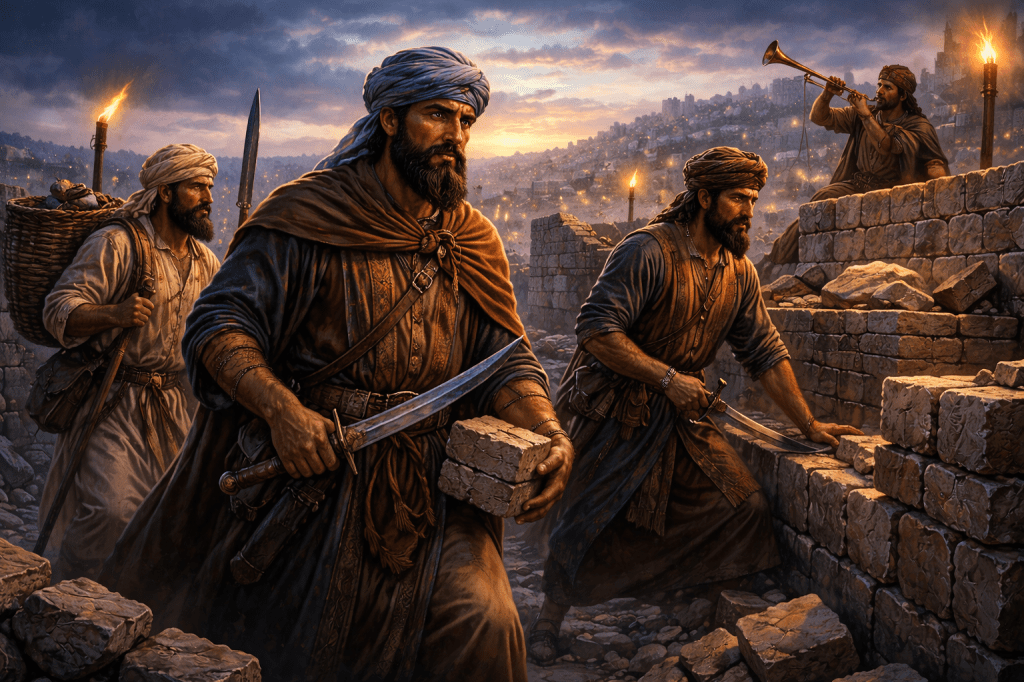
• Read Job 3 & 4

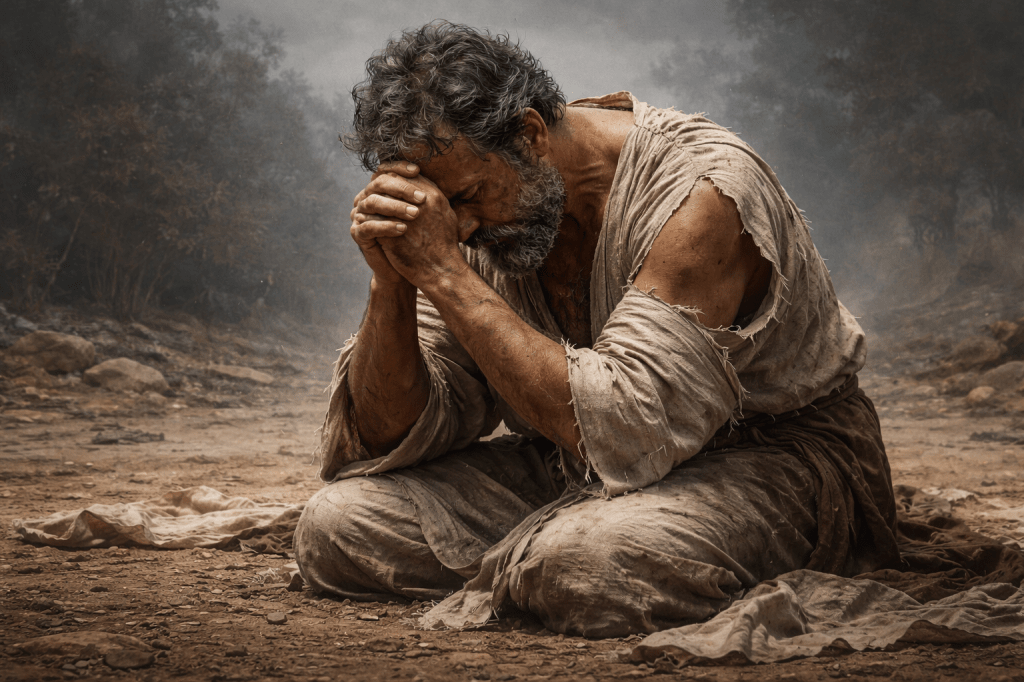
    MORNING— Cursing the Day You Were Born

    • Focal Passage: Job 3:1

    “Afterward Job opened his mouth and cursed the day of his birth.”

    Job does not curse God.
    He curses the day.

    That matters.

    Satan’s objective was never simply to make Job suffer—it was to provoke him into renouncing God. And here, in what may be the darkest chapter of the book, Job does not do it. His words are raw, poetic, and unfiltered, but they are still spoken to God, not against Him.

    Job wishes the calendar itself could be undone. He imagines the lights going out on the day of his conception, the sun swallowed by darkness, dawn never breaking. Hebrew “wish verbs” fill the chapter—may this, let that—revealing not intention but longing. Job is not plotting his death. He is grieving his existence.

    This may well be one of the most depressing chapters in the Bible. It offers no promises. Few sermons are made from it. And yet God did not remove it from Scripture. He preserved it.

    Scott Sauls tells of encountering a suicide note written by a pastor—faithful, gifted, well-known—who described depression like drowning, gasping for one more breath. The note closed with words that still confessed Christ as “Our Only Hope in Life and Death.” That tension—faith still present, hope barely breathable—is closer to Job 3 than we are often able to admit.

    We are often uncomfortable with that tension. We want lament softened, edited, or resolved. We want people to “tone it down.” But Job is allowed to speak. God does not silence him.

    Lament is not unbelief.
    It is faith refusing to pretend.

    • Reflection:  Do you allow yourself—and others—to speak honestly before God, or do you hurry grief toward resolution before it has finished telling the truth?

    EVENING— When Helping Hurts

    • Focal Passage: Job 4:2

    “If one ventures a word with you, will you become impatient?  But who can refrain from speaking?”

    Eliphaz means well.
    That may be the most troubling part.

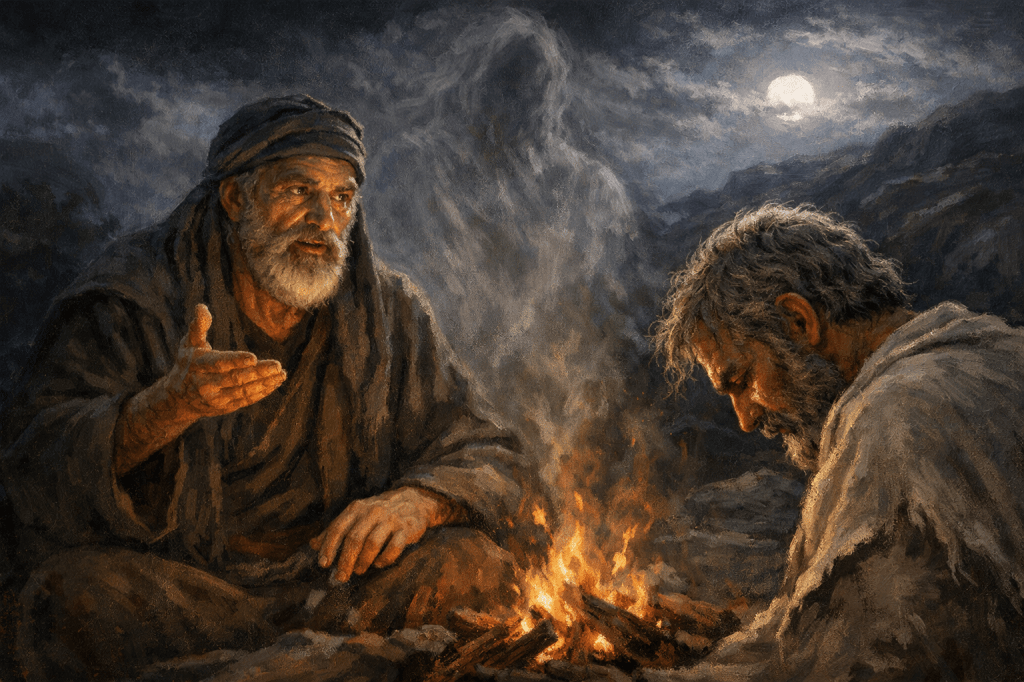
    He listens to Job’s anguish—and then explains it. Innocent people don’t suffer, he says. Trouble has causes. Pain has explanations. If something this devastating happened, something must have gone wrong. What did you do, Job?

    Eliphaz even brings spiritual credentials. A vision. A whisper in the night. A truth that sounds orthodox: No one is righteous before God. The problem is not that Eliphaz believes false things—it’s that he applies true things at the wrong time, to the wrong person, for the wrong reason. Wisdom applied without discernment becomes cruelty. He speaks less to comfort Job than to protect his understanding of how the world should work.

    Know someone who is in a Job-like state right now?  The most important think you can do for them is to let them know they are seen by God.  And that His desire is to comfort them.

    “The LORD is near to the brokenhearted
    And saves those who are crushed in spirit.”

    Psalm 34:18 (NASB 1995)

    It can feel as though God is hidden. Job feels that keenly. But Scripture insists otherwise. Nearness is not always perceptible, but it is promised.

    So, veer from the tired, false theology of Eliphaz. Be there. Encourage. Comfort. Resist the urge to explain what you cannot see. Do not assign motives—to the sufferer or to God. You cannot see behind the curtain of their life, nor behind the curtain of the cosmos.

    • Reflection:  When someone is suffering, do you rush to explain God—or do you slowly encourage them to feel His comfort ?
    • Closing Prayer:  Lord, You are near to the brokenhearted, even when You feel far away. Teach us how to lament honestly without losing faith, and when darkness feels louder than hope, keep us from quitting—keep us close to You.
      Amen.
    • Read Job 2

    MORNING— Will We Accept Good Only?

    • Focal Passage: Job 2:10

    “Shall we indeed accept good from God and not accept adversity?”

    Job’s suffering is not finished. Job 2 opens with a scene that feels painfully familiar. Once again, the sons of God present themselves before the LORD. Once again, Satan appears. Once again, God points to Job.

    Job has already lost his children, his wealth, and his standing. Yet God says something striking:

    “He still holds fast his integrity, although you incited Me against him to ruin him without cause.” (Job 2:3)

    That phrase can stop a reader cold. Didn’t Satan do these things?
    Yes. He did.

    But by granting permission, God takes responsibility for what is allowed. Scripture is not saying God caused evil. It is saying God never surrendered control. This is sovereignty—not the idea that God does everything, but that nothing happens outside His authority.

    Satan argues that Job’s faith has not yet been tested at its core. He believes Job endured loss only because his health remained intact. Touch the body, Satan claims, and devotion will fail.

    Once again, God sets limits. “Behold, he is in your power, only spare his life.” (Job 2:6)

    Even here, suffering is not unrestrained. Satan is powerful, but never autonomous.

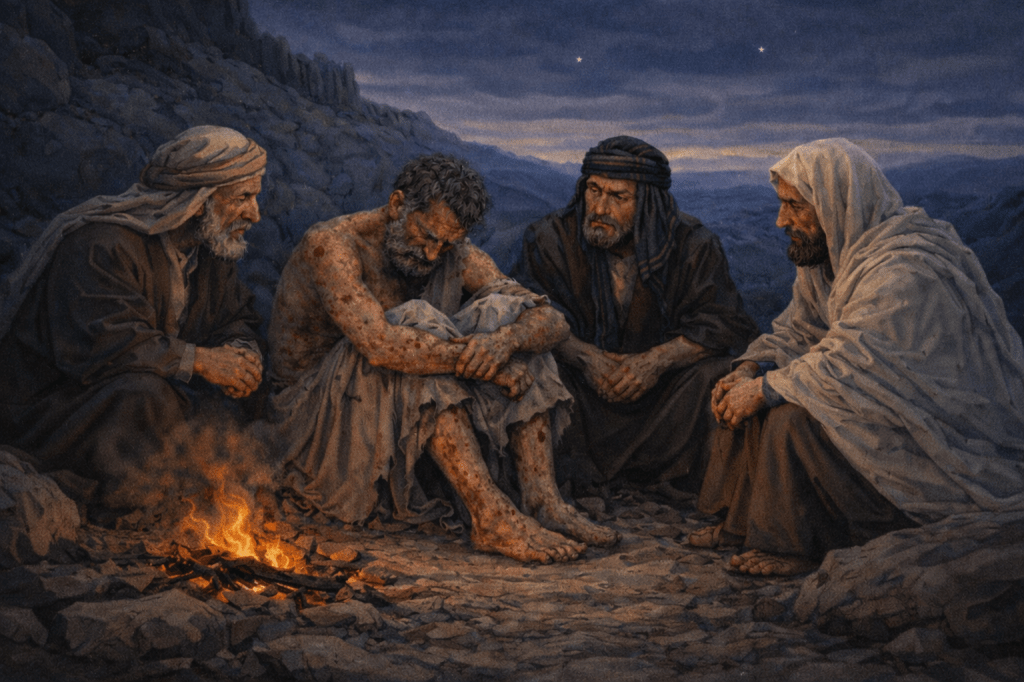
    What follows is a descent into physical agony. Job is struck with painful boils from head to foot. He sits among the ashes, scraping his skin with a broken piece of pottery. There is no relief. No sleep. No escape. If you have ever found yourself in that place—where pain lingers and questions multiply—you understand why Scripture lingers here.

    Job’s wife speaks from her own grief. She has buried ten children. She has lost security, stability, and the companion she once knew. Her words are raw, not calculated: “Do you still hold fast your integrity? Curse God and die!” (Job 2:9)

    Job answers with clarity and restraint: “Shall we indeed accept good from God and not accept adversity?” (Job 2:10a)

    Scripture’s verdict is clear:  “In all this Job did not sin with his lips.” (Job 10b)

    Job does not deny pain. He does not pretend suffering is good. But he refuses to allow hardship to redefine who God is.

    • Reflection:  When suffering deepens rather than resolves, what expectations of God are exposed in your heart?

    EVENING— What Job’s Counselors Did Right

    • Focal Passage: Job 2:13

    “Then they sat down on the ground with him for seven days and seven nights with no one speaking a word to him, for they saw that his pain was very great.”

    Job has reached the lowest point of his suffering. His body is broken. His grief is overwhelming. His wife’s words cut deeply. And into that moment step three friends: Eliphaz, Bildad, and Zophar.

    We remember them for the arguments they will eventually make, but it is easy to forget that in chapter 2 they get several important things right—things that still matter in moments of real grief today.

    1. They came.  “They came each one from his own place…” (v.11)  Many people retreat when suffering appears. These men traveled to be with Job. Presence is a ministry long before words ever become one.

    2. They came with compassion.  “…to sympathize with him and comfort him.” (v.11) Their intent was good. Their hearts were engaged. Their first instinct was not correction—it was solidarity.

    3. They allowed themselves to feel the loss. “They raised their voices and wept…” (v.12)  This is rare. Some try to stay composed around grief, as though strength is shown by emotional distance. Job’s friends let themselves break open with him.

    4. They sat with him. “They sat down on the ground with him…” (v.13)  Not above him. Not apart from him. On the ground, where pain had taken him. Shared posture is shared burden.

    5. They stayed as long as the moment required. “…for seven days and seven nights…” (v.13)  Grief has no stopwatch. They gave Job time before giving Job advice.

    6. They held their tongues. “…no one speaking a word to him…” (v.13)  Before their speeches went wrong, their silence went right. Most of the harm they will later cause comes not from their presence but from their explanations. For this first full week, they speak nothing—and it is the wisest they will ever be.

    7. They saw the depth of his pain. “…for they saw that his pain was very great.” (v.13)  They did not minimize it. They did not dismiss it. They acknowledged its size. Sometimes the most healing words are not explanations but simple honesty: “This is terrible. I see it.”

    Early in his medical career in India, Dr. Paul Brand cared for a baby girl named Anne, the child of missionary parents. Despite devoted care, she did not survive. Brand wept openly with the family, carrying a deep sense of failure as a physician.

    More than thirty years later, Anne’s father, now a pastor in Kentucky, introduced Brand to his congregation simply as “the doctor who cried at our Anne’s funeral.” The family did not remember a surgeon who failed, but a man who stayed and shared their grief.

    Job’s friends will eventually speak poorly, think wrongly, and wound deeply. But here—at the beginning—they model something we often forget: 

    Sometimes the most spiritual act is simply to sit down beside someone whose world has collapsed and stay long enough for them to know they are not alone.

    • Reflection:  When someone around you suffers, do you rush to speak—or do you offer the kind of presence Job received in his first seven days of sorrow?
    • Closing Prayer:  Holy God, teach us to trust You when suffering deepens and to stay with one another when words fail.  Shape us into people whose presence reflects Your compassion, and hold us steady when life places us in the ashes.
      Amen.
    • Read Job 1

    MORNING— A Good Man, A Hard Test

    • Focal Passage: Job 1:1

    “There was a man in the land of Uz whose name was Job; and that man was blameless, upright, fearing God and turning away from evil.”

    Years ago, I was standing in a checkout line at the grocery store. The man in front of me had only two items: a book titled Where Is God When It Hurts? and a six-pack of beer. The contrast caught my attention, so I commented on it.

    He looked back and said, “I figured either one or the other would help.”

    Then adding, almost as an afterthought, “I don’t know why my grandson doesn’t love me anymore.”

    The pain on his face has stayed with me ever since.

    We meet people with questions like that more often than we realize. Sometimes those questions are spoken aloud. Other times they are carried into the night, waking us when sleep should come. When suffering presses in, many turn to whatever might dull the ache. Others—sometimes even those with no faith background—reach for the book of Job.

    Not because it explains everything, but because it takes pain seriously.

    Job’s story opens without a date or a familiar location. Uz is not Israel. Job is not introduced as a covenant figure. That lack of specificity is intentional. Suffering does not belong to one culture, one generation, or one kind of person.

    Job himself is described as blameless. The Hebrew word tam does not mean sinless. It describes a life that is whole and sincere, without hidden compartments. Job feared God. He turned away from evil. His faith shaped how he lived, how he worked, and how he cared for his family.

    For a season, life followed the pattern Proverbs often describes.

    Job had children.
    He possessed great wealth gained honestly.
    He was respected among his peers.
    He prayed consistently for his sons and daughters.

    In a skeptical world, we expect a flaw. Someone so steady must be hiding something. Scripture removes that suspicion quickly.

    God Himself draws attention to Job.

    “Have you considered My servant Job?” (Job 1:8)

    Job is neither warned nor corrected. He is commended. That is what makes what follows so unsettling. Satan challenges the sincerity of Job’s faith, arguing that devotion thrives because protection surrounds it. Remove the hedge, he claims, and faith will collapse.

    The hedge was real.
    And the hedge came down.

    This does not happen because God stops caring. It happens because faith is about to be tested in a way prosperity never could. The opening of Job does not rush us toward answers. It slows us down long enough to ask what suffering reveals about the faith we carry into it.

    • Reflection:  When pain enters your life, where do you instinctively reach for help?  And what questions surface that you may not yet have words for?

    EVENING— Enduring Faith When it Hurts the Most

    • Focal Passage: Job 1:20

    Then Job arose and tore his robe and shaved his head, and he fell to the ground and worshiped.

    The losses come without pause.

    Four messengers arrive in succession. Each report compounds the last. Before grief can settle, it is overtaken by more devastation. By the end of the day, Job has lost his livelihood, his servants, and his children.

    Scripture does not soften the moment.

    Job responds physically and visibly. His robe is torn. His head is shaved. His body reflects what has been taken from him. Then he falls to the ground and worships.

    “Naked I came from my mother’s womb,
    And naked I shall return there.
    The LORD gave and the LORD has taken away.
    Blessed be the name of the LORD.” (Job 1:21)

    Job does not yet know what the reader knows. He is unaware of the heavenly exchange. He does not understand the scope of what has been permitted. Even so, Scripture offers a clear evaluation:

    “Through all this Job did not sin nor did he blame God.” (Job 1:22)

    That assessment matters.

    Diane Komp, a pediatric oncologist, once asked a grieving father during a stalled bone marrow search, “What kind of terms are you and God on these days?”
    He paused before answering, then said, “You really went to the heart of the matter.”

    That question reaches the core of Job. Reading his story is to examine faith under pressure.

    In the aftermath of tragedy people are not chiefly asking for airtight explanations or theological debates. They are asking where they can bring their grief without being corrected, rushed, or told to move on. Job provides that space. He grieves openly. He does not deny pain or minimize loss. At the same time, he, at least in chapter 1, refuses to place God in the dock as the accused.

    Augustine once wrote that the same fire refines gold and consumes straw. The difference lies not in the trial itself, but in what the trial reveals.

    Before the debates with friends begin.
    Before the questions multiply.
    Before God speaks from the whirlwind.

    Job’s faith endures.

    • Reflection:  When suffering removes stability and explanation, where does your faith settle?
    • Closing Prayer:  Faithful God, You are present when life is full and when it is stripped bare. Teach us not to measure Your goodness by our circumstances or Your faithfulness by our comfort.  When grief overwhelms us, draw us toward worship.
      Amen.
    • Read Esther 7; 9-10

    MORNING— Wisdom at the Banquet

    • Focal Passage Esther 7:3-4

    “Then Queen Esther replied, ‘If I have found favor in your sight, O king, and if it please the king, let my life be given me as my petition, and my people as my request; for we have been sold, I and my people, to be destroyed, to be killed and to be annihilated.’”

    Esther does not rush this moment. She reaches it deliberately.

    She has already invited the king and Haman to two banquets. She waits. She watches. She allows tension to build. When she finally speaks, she does so in a setting where the king is receptive and Haman is exposed.

    Her words are carefully chosen. She does not begin by accusing Haman by name. She begins with herself—“let my life be given me…”—and only then widens the scope to include her people. By the time Haman is identified, the king already understands the gravity of what has been done.

    This is tact joined to courage. Esther names the truth at the right moment, in the right place, and in a way that cannot be dismissed.

    When the king leaves the room in anger and returns to find Haman collapsed on Esther’s couch, the matter is settled. Haman’s fate is sealed.

    The device prepared for Mordecai is then revealed. It is not a gallows in the modern sense, but a tall wooden impaling spike, erected outside Haman’s house. The brutality of it matches the brutality of his intent. He is executed on the very instrument he prepared for another.

    The reversal is complete. Pride collapses under its own weight. What was hidden is brought into the open.

    • Reflection:  Where might wisdom call you to speak truth with patience, clarity, and proper timing?

    EVENING— A Festival Born from Survival

    • Focal Passage: Esther 9:22

    “As the days which the Jews rid themselves of their enemies, and the month which was turned for them from sorrow into gladness and from mourning into a holiday…”

    Deliverance does not erase memory. The threat was real. The danger was close. That is why the story ends not with silence, but with celebration.

    Purim is established so the people will remember—not only that they survived, but how the situation was reversed. The lot cast to determine their destruction becomes the marker of their deliverance. What was meant to fix their end instead fixes their calendar of joy.

    Notice how that joy expresses itself. The people feast. They send gifts. They share with those in need. Celebration spills outward into generosity, binding the community together.

    The book then closes by showing what followed the crisis. Mordecai rises to a position second only to the king, and his leadership is remembered not for emergency measures, but for what came after. He is described as one who sought the good of his people and spoke for the welfare of his whole nation (Esth. 10:3).

    The violence of the moment gives way to stability. Power is exercised not merely to survive, but to secure peace. The final picture is not fear-driven reaction, but sustained care for a people who once lived under the threat of annihilation.

    • Reflection:  After seasons of danger or upheaval, how might God be calling you to seek the good and welfare of others with the influence you now have?
    • Closing Prayer:  God of reversal and redemption, we thank You for the ways You bring gladness out of fear and stability out of chaos. Teach us to remember Your deliverance rightly, to celebrate with gratitude, and to use whatever influence we are given for the good and welfare of others. May our joy lead to faithfulness long after the crisis has passed. Amen.
    • Read Esther 4

    MORNING— Knowledge Becomes Responsibility

    • Focal Passage Esther 4:1

    “When Mordecai learned all that had been done, he tore his clothes, put on sackcloth and ashes, and went out into the midst of the city and wailed loudly and bitterly.”

    In 2021, Frances Haugen, a data scientist at Facebook, released internal documents showing the company knew its platform was harming users—especially teenagers—but failed to act. Speaking out would cost her career and reputation. Remaining silent would allow known harm to continue, particularly toward young people whose mental health the company’s own research showed was being affected. She chose disclosure, not because it was safe, but because it was necessary.

    The decree in Esther 4 carries a similar weight. What began as court politics becomes an existential threat. An entire people are marked for destruction, and the date is fixed.

    Mordecai responds in the only way that makes sense to him. He tears his clothes, puts on sackcloth and ashes, and stands in public grief. He refuses to pretend that everything is fine.

    Esther, insulated inside the palace, hears that Mordecai is distressed and sends clothes, hoping to restore normalcy. Mordecai will not accept them. Some moments demand lament rather than management.

    Through a messenger, Mordecai explains what Esther does not yet know—the edict, the money paid, the date set. With that knowledge, Esther’s position changes. She is no longer simply a queen who happens to be Jewish. She is now a Jewish queen facing a moment that requires a response.

    Grief clarifies reality. It strips away distance and forces the question: What will I do now that I know?

    • Reflection:  When troubling truth reaches you, do you try to manage appearances—or face reality honestly before God?

    EVENING— A Life Protected or a Life That is True?

    • Focal Passage: Esther 4:13-14

    “Do not imagine that you in the king’s palace can escape any more than all the Jews… And who knows whether you have not attained royalty for such a time as this?”

    Esther explains the risk. Approaching the king without being summoned could mean death. She has not been called for thirty days. The danger is real, and Mordecai does not minimize it.

    Instead, he reframes the moment.

    He removes the illusion of exemption—position will not shield her.
    He expresses confidence that deliverance will come from somewhere.
    Then he asks the question that turns the story: Who knows whether you have come to royal position for such a time as this?

    Esther responds by calling for fasting—three days, no food, no water. She prepares herself and her people. Then she speaks words shaped by resolve rather than certainty: “If I perish, I perish.”

    Etty Hillesum, a young Jewish woman who kept a diary while living under Nazi occupation and was later killed at Auschwitz, wrote words that echo Esther’s moment with striking clarity:

    “One must be willing to give up a life that is protected, in order to live a life that is true.”

    Esther stands at that exact threshold—choosing courage over safety, resolve over retreat, and faithfulness over self-preservation.

    History often turns on a single decision made by someone who understands the cost and chooses to act anyway.

    • Reflection:  What responsibility may be set before you—not with guarantees, but with purpose?
    • Closing Prayer:  Father, when moments arrive that call for courage rather than comfort, give us clear eyes and steady hearts. Help us recognize the roles You have placed us in and the times You have appointed us for. Teach us to choose what is true, even when it is costly, trusting that You remain at work beyond what we can see. Amen.
    • Read Esther 2-3

    MORNING— Positioned Without Knowing Why

    • Focal Passage Esther 2:17, 21-23

    “The king loved Esther more than all the women… so he set the royal crown on her head…
    Now when Mordecai was sitting at the king’s gate… he learned of a plot… and the king’s life was spared.”

    By this point in the story of Israel, the people are still living in exile. Jerusalem has not yet been rebuilt, and many Jews remain scattered throughout the Persian Empire. The king on the throne is Xerxes (Ahasuerus), ruler of a vast empire stretching from India to Ethiopia. Persia allows its subjects to keep their customs and religion, but they remain a vulnerable minority, dependent on the goodwill of those in power.

    It is into this setting—far from the land, far from the temple—that Esther’s story unfolds.

    Esther enters the story without fanfare—but not by accident.

    Her Hebrew name, Hadassah, is hidden behind a Persian name, Esther. At Mordecai’s urging, she conceals her Jewish identity. She gains favor first with Hegai, then with the king himself. She becomes queen, not through ambition or maneuvering, but through a series of doors opening she never requested.

    At the same time, Mordecai overhears a plot to assassinate the king. He reports it. The threat is neutralized. The moment passes. No reward comes—at least not yet.

    These two scenes sit side by side for a reason. Esther is elevated. Mordecai acts with integrity. Neither knows why it matters.

    Esther is one of only two books in the Bible where God’s name is never mentioned (the other being Song of Solomon), but in Esther, God’s fingerprints are everywhere.

    Not every calling announces itself. Some arrive disguised as ordinary faithfulness—showing up, telling the truth, doing what is right when no one seems to notice. The story reminds us that position often precedes purpose, and significance is sometimes revealed only in retrospect.

    • Reflection:  Where might God have placed you faithfully—without yet explaining why? Are you building character now before your big moment?

    EVENING— A Larger Plot Emerges

    • Focal Passage: Esther 3:5-6

    “When Haman saw that Mordecai did not bow down… Haman was filled with rage… he sought to destroy all the Jews.”

    Chapter 3 changes the tone abruptly.

    A man named Haman is promoted by the king. Power goes to his head. When Mordecai refuses to kneel before him, he escalates from personal slight to genocidal rage. Mordecai’s refusal was not political; it was rooted in conscience. Haman’s response is not rational; it is fueled by pride.

    The die is cast—pur—to determine the day of annihilation. What looks like chance becomes the mechanism of terror. The king hands over his signet ring, and a decree goes out to erase an entire people.

    The contrast is sharp. Mordecai once exposed a murder plot faithfully and without recognition. Now a far greater plot unfolds publicly and legally.

    And God appears to be silent. At least, on the surface.

    This is where the book of Esther presses us hardest. There are moments when evil advances efficiently, when the faithful seem powerless, and when God seems absent. But every story we find ourselves in invites trust—not because circumstances look hopeful, but because God’s providence is already in motion.

    The crown, the gate, the overheard conversation, the forgotten act of loyalty—all of it is already in place before the crisis erupts.

    Esther and Mordecai are not offered as flawless models, but as witnesses to this truth: God is at work long before His purposes are visible.

    • Reflection:  When circumstances feel ominous and God feels silent, what helps you trust that He is still at work behind the scenes?
    • Closing Prayer:  Faithful God, when Your hand is unseen and Your voice unheard, teach us to trust Your providence. Help us remain steady in small acts of faithfulness and courageous when larger moments come. Give us hope to believe that You are already at work, even when the story feels unresolved. Amen.
    • Read Nehemiah 9; 12:27-47

    MORNING A Time to Mourn

    • Focal Passage Nehemiah 9:1-3

    “Now on the twenty-fourth day of this month the sons of Israel assembled with fasting, in sackcloth and with dirt upon them… They read from the book of the law of the LORD their God for a fourth of the day; and for another fourth they confessed and worshiped the LORD their God”

    Fyodor Dostoyevsky once described the moment his prison chains were struck from his ankles. The fetters clattered to the floor, still warm from his body. He picked them up, hardly believing they had bound him moments before. “Yes, God be with us,” he wrote. “There would be freedom, a new life, resurrection.”

    Israel knows that feeling.

    By Nehemiah 9, the walls are standing, but the people are still sorting through the weight of exile—years of loss, failure, and stubborn rebellion. So they gather, not to celebrate yet, but to remember. They fast. They wear sackcloth. They put dirt on themselves. This is not performative humility. It is honest grief.

    For six hours, they do two things:
    They listen to God’s Word.
    They respond to God in prayer.

    The prayer itself walks carefully through history—creation, covenant, Egypt, wilderness, kings, rebellion, exile. Over and over, the pattern repeats: God is faithful; the people are not. And yet, again and again, God pursues them.

    They confess more than isolated sins. They confess forgetting. They confess stubbornness. They admit that exile did not come from bad luck, but from real disobedience. Still, the dominant note of the prayer is not despair—it is hope.

    “But You are a God of forgiveness, gracious and compassionate, slow to anger and abounding in lovingkindness; and You did not forsake them.”

    Chains fall off when truth is told.
    Freedom begins when memory is honest.

    • Reflection:  What parts of your story need to be remembered truthfully—not to shame you, but to remind you how faithful God has been?

    EVENING A Time to Dance

    • Focal Passage: Nehemiah 12:43

    “And on that day they offered great sacrifices and rejoiced because God had given them great joy… so that the joy of Jerusalem was heard from afar.”

    The dedication of the wall is anything but restrained. Singers are gathered from the surrounding towns. Instruments ring out. Two choirs climb the wall and move in opposite directions—Ezra leading one, Nehemiah the other—until praise circles the city like a living crown.

    This is not private devotion; it is public thanksgiving. The wall that once symbolized fear now carries song. The city that once echoed with taunts now resounds with joy. And the text goes out of its way to tell us that everyone joins in—men and women, adults and children. Joy is shared, not reserved.

    The priests purify the people, the gates, and even the stones. Not because joy is fragile, but because it is holy. What God restores is not treated casually. Celebration itself becomes an act of reverence.

    The joy is so full that it travels beyond Jerusalem. It spills over into generosity, into provision for worship, into daily rhythms of praise. This is not a momentary high; it is a city learning how to live again.

    There are seasons when prayer sounds like weeping. And there are seasons when prayer sounds like singing. Nehemiah 12 reminds us that both belong. God not only hears cries for mercy—He delights in songs of gratitude.

    Walls were rebuilt. Chains were gone. And joy—real, audible joy—rose where ruin once stood.

    • Reflection:  Where has God brought restoration that deserves not just gratitude, but joyful celebration?
    • Closing Prayer:  Lord God, You are the giver of great joy. What You restore, You fill with song; what You rebuild, You crown with praise. Teach us to celebrate Your faithfulness with glad hearts and generous lives, and to let our joy rise not only in private gratitude but in public witness. May the joy You give be heard far beyond us, for Your glory. Amen.
    • Read Nehemiah 8

    MORNING— A Hungry People Gather

    • Focal Passage Nehemiah 8:1-3

    “And all the people gathered as one man at the square which was in front of the Water Gate… Then Ezra the priest brought the law before the assembly… and he read from it… from early morning until midday… and all the people were attentive to the book of the law.”

    The gathering at the Water Gate feels almost spontaneous. Whether Nehemiah formally called it or not, the text emphasizes something more important: they gathered as one man. Unity did not have to be manufactured. It was already there.

    This scene echoes Ezra 3, where the people also gathered “as one man.” The parallels are striking. In Ezra, the focus was the temple. Here, the focus is the Torah, mentioned nine times in the chapter. The walls are nearly finished; now God rebuilds the people.

    Revival breaks out—not because they are in a special place, but because they are before a living Word.

    Ezra reads for hours—five of them—and the people stay attentive. There are no shortcuts here. Scripture is not summarized, skimmed, or outsourced. It is read, honored, and explained. Ezra stands on a simple wooden platform, the forerunner of every pulpit since the Reformation, reminding us that God feeds His people through His Word.

    The people stand. They speak. They lift their hands. They bow with faces to the ground. Worship engages the whole person—mind, body, and heart.

    And the Word is made clear. Verse 8 tells us it was read with understanding—translated, explained, and broken into manageable portions. Mature spirituality begins with a healthy diet of Scripture, not occasional tastes.

    • Reflection:  How hungry are you for God’s Word—and how intentional are you about taking it in with understanding?

    EVENING— The Serious Business of Joy

    • Focal Passage: Nehemiah 8:9-10

    “For all the people were weeping when they heard the words of the law… Then he said to them… ‘Do not be grieved, for the joy of the LORD is your strength.’”

    When the Word sinks in, sorrow follows. The people weep because obedience exposes distance. God’s standards reveal how far they have drifted. But Nehemiah and Ezra do not let sorrow become the destination.

    They redirect the people to joy.

    True revival does not end in tears; it moves through them. Sorrow is necessary—but it is a tunnel, not a home. The leaders call the people to celebrate, to share food, to care for those without provisions. Repentance turns outward in generosity.

    Then comes obedience. On the second day, leaders search the Scriptures and discover a long-neglected command: the Feast of Booths 🌿. They act immediately. Branches are gathered. Booths are built. Families camp on rooftops and courtyards. Scripture is read daily.

    By the time we reach Nehemiah 8, the Feast of Booths has only shown up in a handful of big moments—Solomon’s temple dedication (7th month), the early return under Zerubbabel (Ezra 3:4), and now here. Passover is told far more often in the story; Booths is rarely highlighted. That rarity is part of why Nehemiah 8 stands out.

    And the text records something astonishing: this feast had not been celebrated with such fullness since the days of Joshua. Joy marks every step—joy in Scripture, joy in repentance, joy in obedience. The people do not merely feel bad about sin; they change.

    C. S. Lewis once wrote, “Joy is the serious business of Heaven.” That is exactly what Nehemiah is teaching here. Joy is not a denial of sin or suffering; it is the strength God gives once repentance has done its work. Spiritual maturity is not measured by how deeply we feel, but by how faithfully we live—and by the joy that follows. As Nehemiah says, “The joy of the LORD is your strength.”

    Buildings and programs may not impress a watching world. But a people shaped by Scripture and marked by joy just might.

    • Reflection:  Does your walk with God produce a joy sturdy enough to carry obedience—and visible enough for others to notice?
    • Closing Prayer:  Lord God, feed us with Your Word and shape us by it. Lead us through honest repentance into willing obedience, and anchor our lives in the joy You provide. May our worship be deep, our obedience real, and our joy strong. Amen.
    • Read Nehemiah 4 & 5

    MORNING— Opposition from the Outside

    • Focal Passage Nehemiah 4:14-15

    “Do not be afraid of them; remember the Lord who is great and awesome, and fight for your brothers, your sons, your daughters, your wives and your houses… Then all of us returned to the wall, each one to his work.’”

    Advancement rarely goes unnoticed—and it is rarely welcomed by everyone. Opposition comes from the outside first. Mockery. Threats. Intimidation. Sanballat and Tobiah apply pressure both verbally and militarily, hoping fear will do what force cannot.

    Nehemiah responds with clarity and courage. He reminds the people who they are fighting for and who is fighting for them. The result is remarkable: “Then they all returned to the wall.” The wall was not yet thick, but their resolve was.

    Precautions followed. Builders worked with a trowel in one hand and a sword in the other. Guards stood watch. Trumpets were ready. Caution became part of daily life—not paranoia, but wisdom. As the Jewish historian Josephus later observed, Nehemiah himself never tired—working by day, watching by night, eating and sleeping only as necessary. (Anyone who has ever lived on caffeine and good intentions for a stretch knows that kind of exhaustion.)

    From the first rallying cry—“Come, let us rebuild”—to this declaration—“Our God will fight for us”—Nehemiah had become the visible embodiment of the work. The enemy outside had failed.

    But that is not the end of the story.

    • Reflection:  When resistance comes, do you return to the work with faith—or retreat into fear?

    EVENING— Implosion from the Center

    • Focal Passage: Nehemiah 5:6-7a

    “Then I was very angry when I had heard their outcry and these words. I consulted with myself and contended with the nobles and the rulers…”

    Just when momentum is building, Nehemiah does something shocking.

    He stops the work.

    Chapter 5 opens with a “great outcry”—not from enemies, but from their own people. Economic pressure has turned brother against brother. Homes are mortgaged. Children are sold into slavery. Legal rights are being used without moral restraint.

    The enemy is no longer outside the wall.
    The enemy is within.

    Gordon MacDonald writes, “Most spiritual breakdowns are not explosions from the outside but implosions from within.” Nehemiah recognizes the danger immediately. He listens carefully. He allows the injustice to affect him—Scripture says he “sizzled inside.” Then he pauses. He thinks. And he acts.

    He confronts the leaders directly. He appeals not to legality, but to brotherhood. Not to efficiency, but to the fear of God. He invites them to join the solution—and then demands restitution.

    Most leaders fear stopping the work. What if momentum is lost? What if donors get upset? What if progress stalls?

    Great leaders know character is as important as accomplishment.  Nehemiah could have thought: “Let’s just get this thing up and then we can deal with this issue.”  That would have created a functional wall but kept a dysfunctional people.

    So, the work halts until repentance takes root.

    Amazingly, the people respond. Property is restored. Promises are sworn. Worship erupts. Justice is reestablished. Only then does the rebuilding resume.

    Later, Nehemiah himself models the lesson. Though entitled to privileges as governor, he refuses them. He sacrifices what is lawful for the sake of what is right. His motivation is simple and stated plainly: “Because of the fear of God.”

    God allowed famine and pressure because He knew something vital—a wall can be rebuilt faster than a people can be healed.

    • Reflection:  Is there any area where progress is being protected at the expense of character—or where God may be calling you to stop and address what is happening within?
    • Closing Prayer:  God of justice and mercy, guard us from fighting only the enemies we can see. Search our hearts, correct our motives, and give us the courage to pause when repentance is needed. Shape us into people whose character can support the work You entrust to us. For Your glory and the good of others. Amen.
    • Read Nehemiah 1 & 2

    MORNING— Prayer: the Foundation of Calling

    • Focal Passage Nehemiah 1:4-5

    “When I heard these words, I sat down and wept and mourned for days; and I was fasting and praying before the God of heaven. I said, ‘I beseech You, O LORD God of heaven, the great and awesome God, who preserves the covenant and lovingkindness for those who love Him and keep His commandments…’”

    In the English countryside near Leicester there is an old church with a remarkable inscription on the wall. It remembers Sir Robert Shirley, who built that church during Cromwell’s turbulent years. The words read:

    “In the year 1653, when all things sacred were throughout ye nation either demolished or profaned, Sir Robert Shirley, Baronet, did found this church: whose singular praise it is to have done the best of things in the worst of times, and hoped them in the most calamitous.”

    Nehemiah would have understood that line.

    He is living far from Jerusalem, in Susa, the luxurious winter capital of Persia. He holds a position of deep trust as cupbearer to King Artaxerxes—part bodyguard, part chief of security. You do not get that job by being sloppy or distracted. Nehemiah is competent, trusted, and busy.

    Then news arrives.

    A brother from Judah reports that the remnant in Jerusalem is in “great distress and reproach.” The walls are down. The gates are burned. The people are harassed and humiliated. Nehemiah could have offered the safe, polite response—“That’s too bad; I’ll be praying for you”—and gone back to work.

    Instead, he lets the report break his heart.

    “When I heard these words, I sat down and wept and mourned for days; and I was fasting and praying…”

    Before Nehemiah ever lifts a stone, he falls to his knees. Before he becomes a builder, he becomes an intercessor. His prayer is soaked with Scripture—confession of sin, remembrance of God’s promises to Moses, appeal to God’s covenant love. He includes himself in the problem: “I and my father’s house have sinned.” The ruins of Jerusalem are not “their issue” out there; they are “our issue” before God.

    Calling for Nehemiah began when God let him truly see the ruins—and then let that sight drive him to prayer.

    In a world where “all things sacred” often feel demolished, mocked, or shoved to the margins, the question still stands: Who will do the best of things in the worst of times? According to Nehemiah, the answer begins with those who weep, fast, and pray before the God of heaven.

    And yes, that may mean our first “project meeting” is just us, a Bible, and a box of tissues.

    • Reflection:  Have you allowed God to show you any “ruins” that move you to honest confession and persistent prayer, rather than quick fixes or safe distance?

    EVENING— From Knees to Action🌳

    • Focal Passage: Nehemiah 2: 2, 4

    “So the king said to me, ‘Why is your face sad though you are not sick? This is nothing but sadness of heart.’ Then I was very much afraid… Then the king said to me, ‘What would you request?’ So I prayed to the God of heaven.”

    Four months pass between Nehemiah’s first broken-hearted prayer (in the month Chislev) and this moment (in Nisan). Four months of day-and-night praying, planning, and waiting. Nehemiah has not forgotten the ruins, but he has not rushed things either.

    Then, one ordinary day, the king notices.

    Nehemiah’s sadness shows on his face—dangerous in a court where the king’s presence was supposed to guarantee constant cheer. The text is wonderfully honest: “Then I was very much afraid.” Calling does not cancel fear; it simply refuses to obey it.

    The king asks what is wrong. Nehemiah answers carefully, speaking of “the place of my fathers’ tombs” rather than using the explosive name “Jerusalem.” Then comes the question every praying servant eventually faces:

    “What would you request?”

    In that split-second, Nehemiah does what he has been doing for four months: “So I prayed to the God of heaven. I said to the king…” A breath-prayer goes up; a bold request comes out. Prayer is no longer only foundation—it is also fuel.

    Nehemiah asks to be sent. He has a clear goal, a time frame, and even a supply list ready (letters for safe passage, timber from the king’s forest🌳). Prayer hasn’t replaced planning; it has shaped it. As someone once put it, Nehemiah does not live by “Ready, aim, aim, aim…” forever. There comes a moment to fire.

    God answers through the very king who had earlier halted the rebuilding (cf. Ezra 4). The man who once blocked the wall now funds it. Nehemiah sums it up simply: “The king granted them to me because the good hand of my God was on me.”

    Prayer, then action.
    Ruins, then rebuilding.
    Fear, then courage.

    Nehemiah’s story reminds us that God often answers our prayers by sending us into the very ruins we’ve been praying about.

    • Reflection:  Is there a specific step of obedience—small or large—that your prayers have been pointing toward, but you have not yet taken?
    • Closing Prayer:  God of heaven, great and awesome, You see the ruins in our world and in our hearts. Teach us to bring them honestly to You, and then give us courage to act when the time comes. Help us trust that Your good hand is upon us as we obey. Amen.