
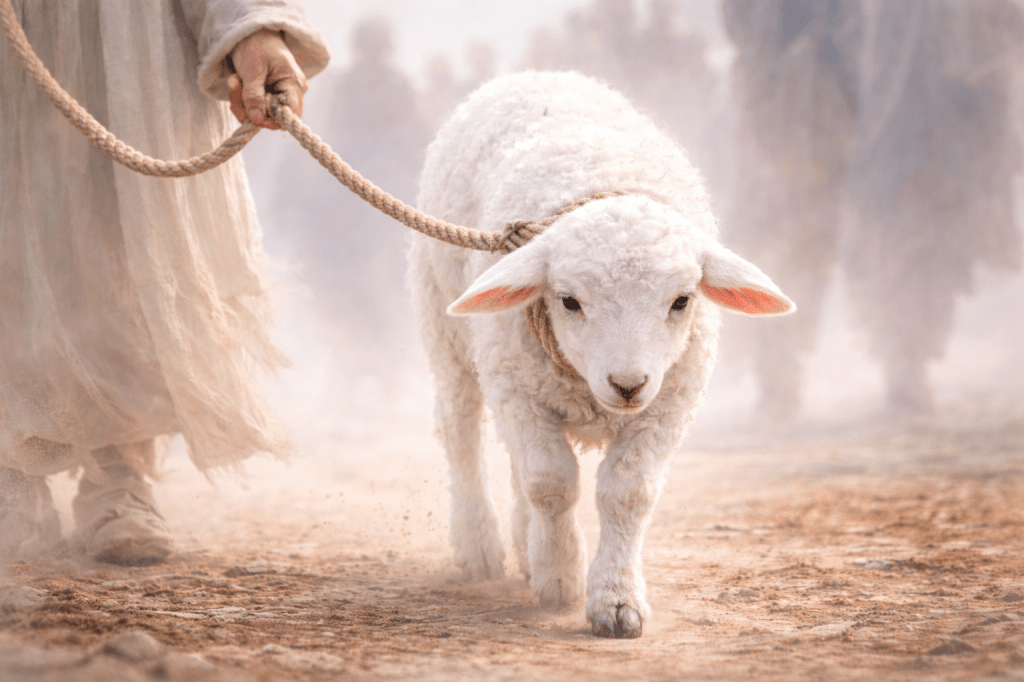
- Read Isaiah 53:4-12
🌅MORNING— The Lamb in Our Place
- Focal Passage: Isaiah 53:4-5
“Surely our griefs He Himself bore, and our sorrows He carried; Yet we ourselves esteemed Him stricken, smitten of God, and afflicted. But He was pierced through for our transgressions,
He was crushed for our iniquities; The chastening for our well-being fell upon Him, and by His scourging we are healed.”
It was February 3, 1959 — “the day the music died.”
Buddy Holly, Richie Valens, and J. P. “The Big Bopper” Richardson were killed when a small, chartered plane went down in an Iowa cornfield. The tour had been punishing — long drives through subzero weather, failing heaters, sickness spreading through the band. After a show in Clear Lake, Holly rented a plane to avoid another freezing bus ride.
Waylon Jennings had originally been scheduled for one of the seats. Richardson, sick with the flu and exhausted, asked Waylon if he could take his place.
Waylon agreed.
Before takeoff, Holly teased him, “Well, I hope your ol’ bus freezes up.”
Waylon replied lightly, “Well, I hope your ol’ plane crashes.”
Five minutes later, it did.
Jennings carried that exchange for the rest of his life. A seat surrendered. A life lost in another’s place. A substitute who paid a price.
Isaiah 53 speaks of a substitution deeper than that.
“Surely our griefs He Himself bore…
The Hebrew word for “bore” is the same word used for the scapegoat in Leviticus 16. On the Day of Atonement, the priest laid his hands on the goat and confessed over it the sins of the people. The animal carried their iniquity away into the wilderness.
Here the Servant carries ours.
He was pierced for our rebellion. Crushed for our iniquity.
The chastening that secured our peace fell upon Him.
By His scourging we are healed.
This substitution of the Servant for our sin, once properly understood, changes everything.
Rose Price survived the concentration camp Treblinka in the second World War. Her mother and much of her family were murdered. Guards beat prisoners while sneering, “Jesus told us to hit you. Jesus hates you.”
For years, she believed that lie.
Then one day she picked up her daughter’s Bible.
“I started reading it, and I noticed that he was the Lamb… “And he didn’t kill me, he didn’t put me in a camp, he didn’t kill my family. He died for me? He died for me! He loved me this much. That he gave himself for me.”
The story of Jesus’ death is still saving lives.
More so than the promise of Heaven or the threat of Hell.
If hearing about His sacrifice doesn’t reach you—little else will.
“All of us like sheep have gone astray.”
We wandered. Each of us turned to his own way. Sin is not merely weakness; it is revolt. It bends what is straight. It twists what is good. It fractures what was whole.
In Christ, the wayward sheep can come home.
“The LORD has caused the iniquity of us all to fall on Him.”
- Reflection: Have you allowed this to become personal? Not humanity in general — but you?
🌆EVENING— The Satisfied Servant and the Open Invitation
- Focal Passage: Isaiah 53:10-11a
“But the LORD was pleased to crush Him, putting Him to grief; If He would render Himself as a guilt offering, He will see His offspring, He will prolong His days, and the good pleasure of the LORD will prosper in His hand. As a result of the anguish of His soul, He will see it and be satisfied…”
The Servant did not resist.
He did not defend Himself.
He did not call down angels.
He was led like a lamb to slaughter.
Isaiah says something staggering in verse 10:
“The LORD was pleased to crush Him.”
Not pleased in cruelty. Pleased in purpose. The cross was not an accident of history. It was the outworking of a plan conceived before the foundation of the world.
“If He would render Himself as a guilt offering…”
That phrase reaches back into Leviticus. The guilt offering was brought when a wrong had been committed and restitution was required. Something had to bear the cost. Blood was shed because sin is not theoretical; it damages, it defiles, it incurs debt.
“As a result of the anguish of His soul, He will see it and be satisfied.”
Satisfied.
The Father’s justice answered.
The sinner’s debt paid.
A people redeemed.
Children adopted.
The lost brought home.
Revelation 22:17 says:
“And the Spirit and the bride say, ‘Come.’ And let the one who hears say, ‘Come.’ And let the one who is thirsty come; let the one who wishes take the water of life without cost.”
Without cost? Really? Well, without cost to us. And Jesus, who paid the cost, was satisfied in His work.
Brennan Manning once told of visiting Yolanda, a 37-year-old woman dying of leprosy in Louisiana. Her body had been ravaged. Her husband had left. Her children did not visit. She was dying alone.
Yolanda could not read. She had never read a Bible. To Manning’s knowledge, no one had ever read the Song of Solomon to her.
But as he prayed over her, the room seemed filled with light, and her face shone, and she said: “I am so happy.”
“Why?” he asked her.
“The Abba of Jesus told me He would take me home today.”
She described hearing: “Come now, my love… let me see your face… for your voice is sweet and your face is beautiful.”
Six hours later, she was gone.
Why was the Father pleased to crush His Servant?
Why was the Servant satisfied in His anguish?
Because through this sacrifice salvation could be offered “without cost” to anyone who would come. After witnessing His sacrifice we are to see the Lamb’s invitation.
“Come.”
Will we do so?
- Reflection: Have you come to Him — not merely admired Him, not merely studied Him — but come?
- Closing Prayer: Lamb of God, You bore what was ours. You satisfied justice. You opened the way home. Give us eyes to see Your sacrifice, hearts to trust Your finished work, and courage to come as You call. Amen.

Leave a comment