
- Read Daniel 7:9–14; 8:15-18
🌅MORNING– The Son of Man Arrives
- Focal Passage: Daniel 7:13-14a
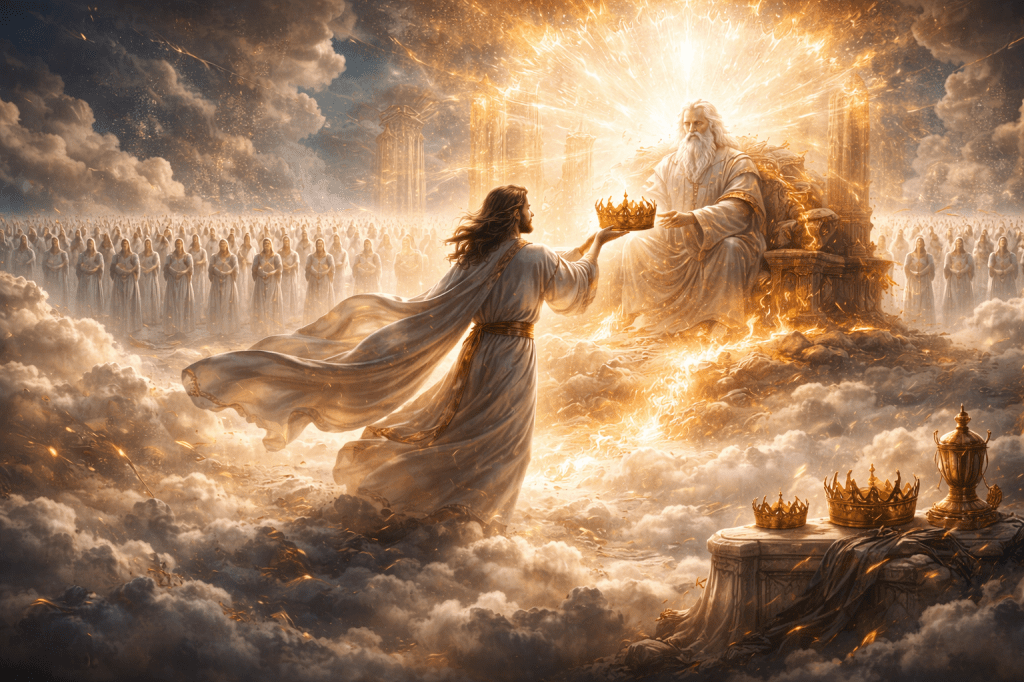
“I kept looking in the night visions, and behold, with the clouds of heaven one like a Son of Man was coming, and He came up to the Ancient of Days and was presented before Him. And to Him was given dominion, glory and a kingdom”
Daniel’s earlier visions dealt with beasts—kingdoms rising from the sea of human ambition. The imagery was fitting. These empires behaved like beasts. They devoured, trampled, and boasted. They expanded through force, maintained control through fear, and measured success by the extent of their power. Babylon, Medo-Persia, Greece, and Rome would each leave their mark on history, but they all shared the same fatal flaw: they were ultimately human kingdoms magnified to monstrous proportions.
Then Daniel’s gaze is lifted from the chaos of earth to the throne room of heaven.
The turmoil of the nations gives way to perfect order. Thrones are set in place. The Ancient of Days takes His seat. His clothing is white as snow, His hair like pure wool. Fire blazes from His throne, and a river of fire flows from before Him. Thousands upon thousands stand in attendance. Myriads upon myriads stand before Him. The court sits, and the books are opened.
What looked permanent on earth suddenly appears temporary in heaven.
The boastful horn that dominated Daniel’s attention is still speaking, but now it is speaking under judgment. The beasts that seemed so powerful are revealed to be accountable. History is not moving randomly. It is moving toward a divine verdict.
Then Daniel sees the figure who stands at the center of God’s plan for the world.
“And behold, with the clouds of heaven One like a Son of Man was coming.”
After chapter after chapter of beasts, Daniel sees a man.
The contrast is striking. The kingdoms of earth have become beastlike in their exercise of power, but the ruler who approaches God’s throne possesses true humanity as God intended it. Yet He is clearly more than a mere man. He comes with the clouds of heaven, imagery associated throughout the Old Testament with the presence and majesty of God Himself (Psalm 104:3; Isaiah 19:1). He approaches the Ancient of Days and is welcomed into His presence.
What follows is the great transfer of authority toward which history has been moving.
“And to Him was given dominion, glory and a kingdom, that all the peoples, nations and men of every language might serve Him.”
Earthly rulers seize power. This kingdom is given.
Earthly kingdoms rise and fall. This kingdom endures.
Earthly rulers gather followers from a region or a generation. This King receives the allegiance of all peoples, all nations, and all languages.
Daniel watches as everlasting dominion is entrusted to the Son of Man. His kingdom will not pass away. His rule will not be overthrown. No successor will replace Him. No rival will conquer Him. No rebellion will unseat Him.
This vision becomes one of the most important messianic passages in the entire Old Testament. More than any other title, Jesus identified Himself as the Son of Man. He used the designation repeatedly throughout His ministry, drawing directly from Daniel’s vision.
The significance becomes unmistakable during His trial before the Sanhedrin. When the high priest demanded to know whether He was the Christ, Jesus answered:
“You will see the Son of Man sitting at the right hand of Power, and coming with the clouds of heaven.” (Mark 14:62)
The room exploded in outrage. The high priest tore his robes because he understood exactly what Jesus was claiming. Jesus was identifying Himself as the Son of Man of Daniel 7—the One who would receive everlasting dominion from the Ancient of Days.
Daniel saw what emperors never could.
The beasts rule for a season.
The Son of Man rules forever.
- Reflection: When you think about the future, what dominates your imagination—the beasts of the moment, or the throne that outlasts them?
🌆EVENING– Lifted to Stand
Focal Passage: Daniel 8:17-18
“So he came near to where I was standing, and when he came I was frightened and fell on my face… But he touched me and made me stand upright.”
Daniel has spent chapter 8 watching a ram and a goat collide in a vision that Gabriel later identifies as future kingdoms. What appeared at first to be strange imagery carried sobering implications. Nations would rise. Nations would fall. Violence would sweep across the ancient world. Even God’s people would endure seasons of suffering.
By the time Gabriel approaches him, Daniel is exhausted by what he has seen.
When Gabriel approaches to explain what he has seen, Daniel does what many people in Scripture do when confronted by heavenly glory. He falls on his face. The response is instinctive. Divine revelation has a way of exposing how small we are and how little we truly control.
Yet the remarkable moment in the passage is not Daniel’s fall.
It is God’s response.
“He touched me and made me stand upright.”
That touch is filled with grace.
Daniel is not rebuked for being overwhelmed. He is not scolded for his weakness. Neither is he left lying in the dust. The messenger raises him to his feet because God intends His servant to continue serving.
Throughout Scripture, God often lifts those who fall before Him. Ezekiel collapsed before the glory of the Lord until the Spirit set him on his feet (Ezekiel 2:1-2). John fell as though dead before the risen Christ on Patmos until Jesus laid His hand upon him and said, “Do not be afraid” (Revelation 1:17). Again and again, God’s presence humbles His servants, but His grace restores them.
There is dignity in being raised by God.
Daniel is not merely given information about the future. He is strengthened to live faithfully in the present. The vision has not changed the political landscape. Persia will still rise. Greece will still come. Conflict will still unfold. Daniel will not control any of it.
What has changed is Daniel’s perspective.
He now knows that history is not drifting aimlessly. The God who revealed these events remains sovereign over them all.
Chuck Swindoll wisely observes:
“Prophecy was never intended to satisfy curiosity about the future; it was given to stabilize the believer in the present.”
That is exactly what happens here.
God does not reveal the future so His people can spend their lives speculating. He reveals enough of the future to anchor their faith in the middle of uncertainty. Daniel leaves this encounter with no ability to alter empires, yet he gains something far more valuable: confidence that God reigns above them.
The same truth steadies believers today. Daniel reminds us that God has never asked His people to carry the weight of governing history. He asks us to trust Him while living faithfully within it. When fear threatens to drive His children into despair, He still does what He did for Daniel.
He reaches down and steadies them.
We were never meant to spend our lives face-down before tomorrow’s uncertainties. Humility belongs in the Christian life, but so does confidence. We stand because God has lifted us. We serve because God has strengthened us. We move forward because the future ultimately belongs to Him.
Daniel rose from the ground and continued serving in the courts of kings because he had already seen the greater King.
And so can we.
- Reflection: When the weight of the future presses in, do you remain collapsed beneath it — or do you allow God to lift you back to your feet and send you forward?
- Closing Prayer: Ancient of Days, You reign above every rising and falling kingdom. Fix our eyes on the Son of Man who has received the everlasting dominion. When visions of this world’s turmoil unsettle us, lift us to our feet. Anchor us in Your unshakable throne and make us steady people in unsteady times. Amen.

Leave a comment