
- Read Hosea 1-3
🌅MORNING– Names for Judgment
- Focal Passage: Hosea 1:2
“When the LORD first spoke through Hosea, the LORD said to Hosea, ‘Go, take to yourself a wife of harlotry… for the land commits flagrant harlotry, forsaking the LORD.’”
The book opens with a reminder:
“The word of the LORD which came to Hosea…” (1:1)
God’s Word is timeless. He spoke then. He still speaks now. Even through this, the first of 12 “so called” minor prophets.
Hosea’s name, more properly Hoshea, comes from the Hebrew verb “to save.” It shares roots with Joshua. With Jesus. That is not accidental. The prophet’s life will become a living sermon about salvation.
But the sermon begins in shock.
Hosea is commanded to marry a woman who will be unfaithful.
From Abraham offering Isaac to the rich young ruler walking away sorrowful, obedience in Scripture is often costly. Hosea’s calling is not merely to preach against Israel’s unfaithfulness — he must feel it.
The names of the children his wife Gomer bears will preach before Hosea ever does.
Jezreel — a name tied to bloodshed and judgment (2 Kings 10).
Lo-Ruhamah — “Not Pitied.”
Lo-Ammi — “Not My People.”
Imagine naming your child “Alamo” or “September 11th.” People would ask, “Why would you do that?” But these names are not cruelty. They are warning. God is stepping in to avenge bloodshed. He is announcing that covenant violation has consequences.
And yet — even in chapter one — hope appears:
“Yet the number of the sons of Israel will be like the sand of the sea…” (1:10)
The Abrahamic promise is not erased. Alienation will not have the last word. Division will not be final. Hosea’s broken marriage mirrors God’s broken covenant relationship. His heartache becomes a window into divine grief.
Prophets were boat-rockers. Hosea challenges the nation not with dramatic displays of power, but through the painful story of his broken marriage.
Before we rush to judgment on Israel, we should remember that the central issue in Hosea is not information but relationship. Israel knew God’s commands. They had heard God’s prophets. What they lost was their love for the One who had redeemed them. The warning is as relevant now as it was then. It is possible to remain around the things of God while drifting from the heart of God.
- Reflection: When obedience costs comfort, do you shrink back — or do you trust that God’s commands reveal His heart, even when they wound?
🌆EVENING– Love That Allures and Redeems
Focal Passage: Hosea 2:14
“Therefore, behold, I will allure her, bring her into the wilderness and speak kindly to her.”
Hosea 2 is not an easy chapter to read.
The language is painful. God exposes Israel’s unfaithfulness in unmistakable terms. The nation has pursued other gods, trusted other lovers, and credited idols for blessings that came from the Lord alone. The chapter contains rebuke, discipline, and the consequences of covenant betrayal.
Yet buried in the middle of these warnings is one of the most surprising turns in all of Scripture. The verse begins with a word that seems almost out of place: “Therefore…”
We expect judgment. We expect rejection. We expect God to wash His hands of a people who have repeatedly broken their promises. Instead, He says: “Therefore, behold, I will allure her.”
The logic of grace is different from the logic of man. Because she has wandered, God pursues. Because she has forgotten Him, God draws near. Because she has run from His love, God determines to remind her of it.
The word translated allure carries the idea of wooing or persuading the affections. This is not the language of a king crushing a rebellion. It is the language of a husband seeking the heart of his bride. God is not merely interested in correcting behavior. He desires restored relationship.
Even the wilderness takes on new meaning.
Throughout Israel’s history, the wilderness was often associated with testing and discipline. Yet it was also the place where God met His people, provided for them, and taught them to depend upon Him. What appears at first to be a place of deprivation becomes a place of rediscovery.
There, God says, He will speak tenderly to her.
The Hebrew expression literally speaks of speaking “to the heart.” God intends to reach beyond external obedience and restore affection. He will give vineyards once again. The Valley of Achor—the valley of trouble made famous by Achan’s sin in Joshua 7—will become a door of hope.
Only God can transform a place remembered for failure into a place marked by grace.
Then Hosea 3 shows us how costly that restoration will be.
The Lord tells Hosea to love Gomer again.
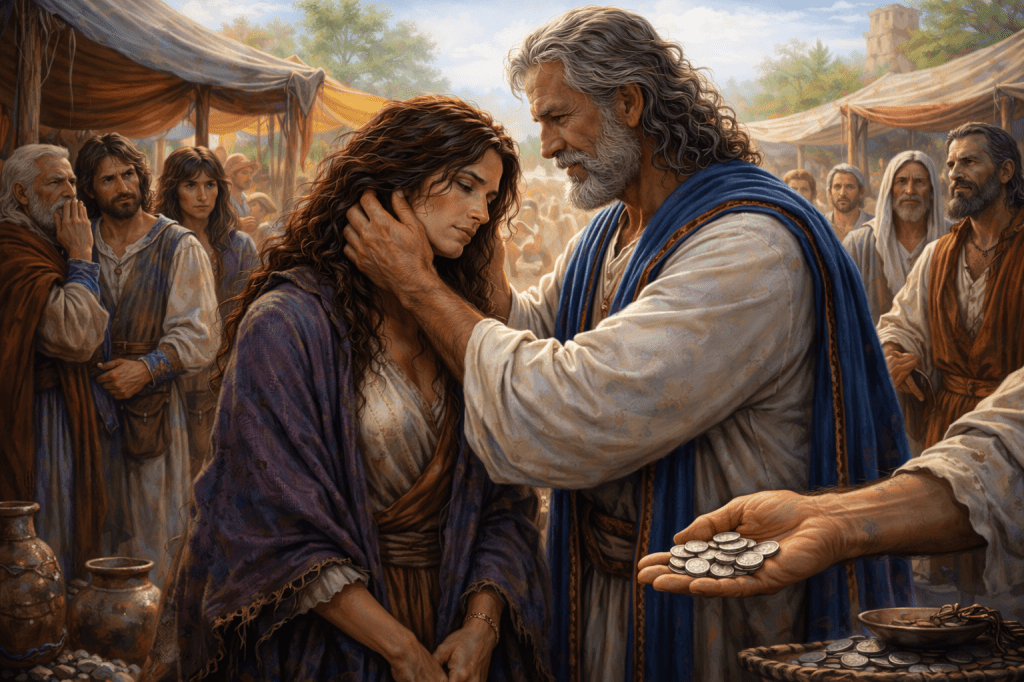
By this point she appears to have fallen into some form of bondage. Whether slavery, debt, or another desperate circumstance, she is no longer free. Hosea finds the woman who broke his heart and purchases her freedom.
The price is carefully recorded: “Fifteen shekels of silver and a homer and a half of barley.”
The amount appears to equal the value of a slave. Hosea is her lawful husband, yet he must pay to reclaim her. Imagine the scene.
The prophet stands before those who now hold power over the woman who betrayed him. He reaches into his purse and counts out the silver. He adds the barley to complete the price. The woman who had abandoned him now watches as the man she wounded purchases her freedom. The transaction is deeply personal. Hosea does not merely forgive from a distance. He pays.
The Gospel echoes throughout the scene.
Paul writes: “You have been bought with a price.” (1 Corinthians 6:20) And Peter: “you were not redeemed with perishable things… but with precious blood, as of a lamb unblemished and spotless, the blood of Christ.” (1 Peter 1:18-19) Bought and redeemed.
Like Gomer, we wandered. Like Gomer, we found ourselves enslaved by powers we could not overcome.
And like Gomer, we were redeemed at a price.
- Reflection: When you remember your First Love — the joy of early devotion — has it cooled into routine? What would it mean to let God allure your heart again?
- Closing Prayer: Saving God, You pursue when we wander. You speak tenderly when we expect judgment. Thank You for a love that pays the price to redeem. Draw us back when we drift. Restore our song. Teach us to walk in Your ways with wisdom and discernment. Amen.

Leave a comment