
- Read Amos 7
🌅MORNING– The Lord Changed His Mind?
- Focal Passage: Amos 7:2-3, 8
“O Lord God, please pardon! How can Jacob stand, for he is small?” The Lord changed His mind about this. “It shall not be,” said the Lord. (7:2–3)
Amos 7 opens with visions.
First: locusts devouring the late crop—the harvest that came after the king’s portion had already been taken. This would leave the people with nothing.
Second: a consuming fire drying up the great deep and the farmland.
After each vision, Amos prays:
“O Lord God, please pardon! How can Jacob stand, for he is small?”
He does not defend Israel’s innocence. He appeals to their weakness. Jacob is small. Fragile. Vulnerable. If this judgment falls in full, they will not survive.
And twice we read:
“The Lord changed His mind about this.”
That phrase troubles some readers. Does God change? Is He unstable? Does He revise His plans?
Yet the Hebrew verb nacham can mean “to relent,” “to be moved with compassion,” or “to withhold announced judgment.” It does not suggest that God gained new information. It reveals that God responds within relationship.
Throughout Scripture, God announces judgment conditionally—even when the condition is unstated. Jeremiah 18 makes this explicit: if a nation turns, He relents; if it hardens, He proceeds.
What we are seeing in Amos 7 is not divine inconsistency. We are seeing divine mercy in response to intercession. God ordains not only the ends, but the means. Amos’s prayer is part of the story God is telling. The Lord allows His servant to stand in the gap.
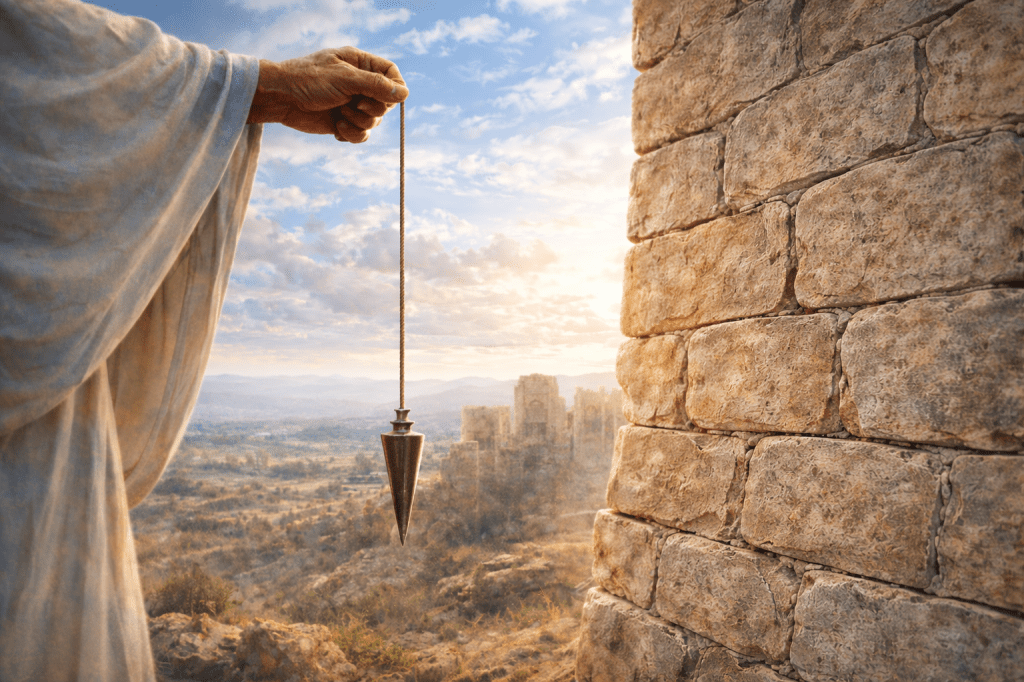
But then comes the third vision: the plumb line. A wall built. A measuring line held against it. Here God says:
“I will spare them no longer.”
The first two visions could be delayed. The third reveals structural reality. Israel is not slightly misaligned. The nation is fundamentally crooked. The plumb line will not bend to match the wall.
Intercession had delayed judgment. Persistent rebellion would now bring judgment to completion. The prosperous days of Jeroboam II would not last forever. Though Israel appeared strong, Amos saw what others could not. Within a few decades the Northern Kingdom would fall to Assyria, its people carried from the land into exile. The kingdom that felt secure was already being measured by God’s standard.
Amos shows us something vital: prayer matters. God listens when His people cry out. Yet His patience is never permission. Mercy delays judgment, but it does not erase the need for repentance. The time to respond to God’s warnings is while they are still being given.
Reflection: Where do you need to stand in the gap and pray—and where might God already be holding a plumb line to your own life?
🌆EVENING– Go Home, Shepherd Boy! 🌳
Focal Passage: Amos 7:12-15
“Then Amaziah said to Amos, “Go, you seer, flee away to the land of Judah… but no longer prophesy at Bethel…” But Amos replied, “I am not a prophet, nor am I the son of a prophet; for I am a herdsman and a grower of sycamore figs. But the Lord took me from following the flock and the Lord said to me, ‘Go prophesy to My people Israel.’”
Mark Herringshaw was twelve years old when he was visiting his uncle’s home in Ohio. During the night he awoke with the strong sense that God was speaking to him. The message came as a question rather than a command: Would he spend his life communicating the Gospel? Mark immediately understood what that meant. God was calling him to preach.
The problem was that he did not want to.
As a teenager, he watched the struggles of pastoral ministry up close. He saw criticism directed at his father. He witnessed church conflict. One evening after a particularly difficult church meeting, he looked at his father and declared, “I’ll never do what you’re doing.”
For the next ten years, he ran from the calling he knew God had placed on his life. He worked different jobs and searched for direction, yet nothing seemed to fit. Finally, frustrated and confused, he prayed, “God, what’s wrong with me? Why can’t I find my place? What do You want me to do?”
A Bible sat nearby. He opened it and his eyes landed on Colossians 4:17:
“Be sure to carry out the ministry the Lord gave you.”
In that moment, he remembered the night in Ohio. He remembered God’s call. He remembered his own resistance. The issue was not uncertainty. The issue was obedience. Within two months, he accepted a pastorate.
Amos would have understood that struggle.
The plumb line vision is followed by a confrontation. Amaziah, the priest of Bethel, reports Amos to King Jeroboam II. Bethel was not merely a place of worship. It was the center of the Northern Kingdom’s religious establishment, closely connected to the throne itself. Religion and politics had become deeply intertwined.
Amaziah’s response to Amos is revealing.
He does not refute the message. He does not challenge the truthfulness of the prophecy. Instead, he tells Amos to leave. Go back to Judah. Earn your living there. Take your preaching somewhere else. In essence, Amaziah is saying, “You don’t belong here.”
Amos’ answer is one of the most memorable statements in the book: “I am not a prophet, nor am I the son of a prophet.”
He is not denying that he is speaking for God. He is explaining that he did not arrive through the usual channels. He was not part of a prophetic guild. He had not been trained in elite circles. He held no official religious office.
Instead, he says: “I am a herdsman and a grower of sycamore figs.”
This was ordinary work. Humble work. The kind of labor that leaves calluses on your hands and dust on your sandals. Sycamore figs were not luxury fruit. They were common food for common people. Amos spent his days tending flocks and caring for trees🌳 in the small Judean town of Tekoa.
Yet everything changed with four simple words: “But the Lord took me.”
Amos did not volunteer for this assignment. He did not campaign for it. He did not seek a platform or build a following. The Lord took him. The Lord called him. The Lord sent him.
That is why he could not simply go home when Amaziah demanded it. Amaziah had position, influence, and institutional authority. Amos had something else. He had a calling from God.
Throughout Scripture, God often chooses unlikely messengers. Moses was tending sheep when God called him. Gideon was hiding in a winepress. David was watching his father’s flock. The disciples were fishermen. Their authority did not come from impressive résumés. It came from the One who sent them.
There are moments when obedience requires us to remain where we would rather leave. There are times when faithfulness means speaking truth that others would prefer not to hear. The issue is not whether the assignment is comfortable. The issue is whether it came from God.
Amos could not return to Tekoa simply because the priest of Bethel was uncomfortable. The Lion had spoken. The Shepherd had called. And the shepherd boy had to obey.
The same Lord still calls people today. Not everyone is called to preach, but every believer is called to follow wherever Christ leads. The question is not whether we feel qualified. The question is whether we are willing.
- Reflection: Is there an area of obedience that you have been resisting because it feels uncomfortable, inconvenient, or beyond your abilities? What might change if you focused less on your credentials and more on God’s calling?
- Closing Prayer: Lord, teach us to pray boldly and obey faithfully. Keep us humble in our calling and steady under opposition. May we stand where You place us, And speak what You command. Amen.

Leave a comment