
- Read Zechariah 4
🌅 MORNING – Our Source of Power🌳
- Focal Passage: Zechariah 4:6
“Not by might nor by power, but by My Spirit,” says the Lord of hosts.”
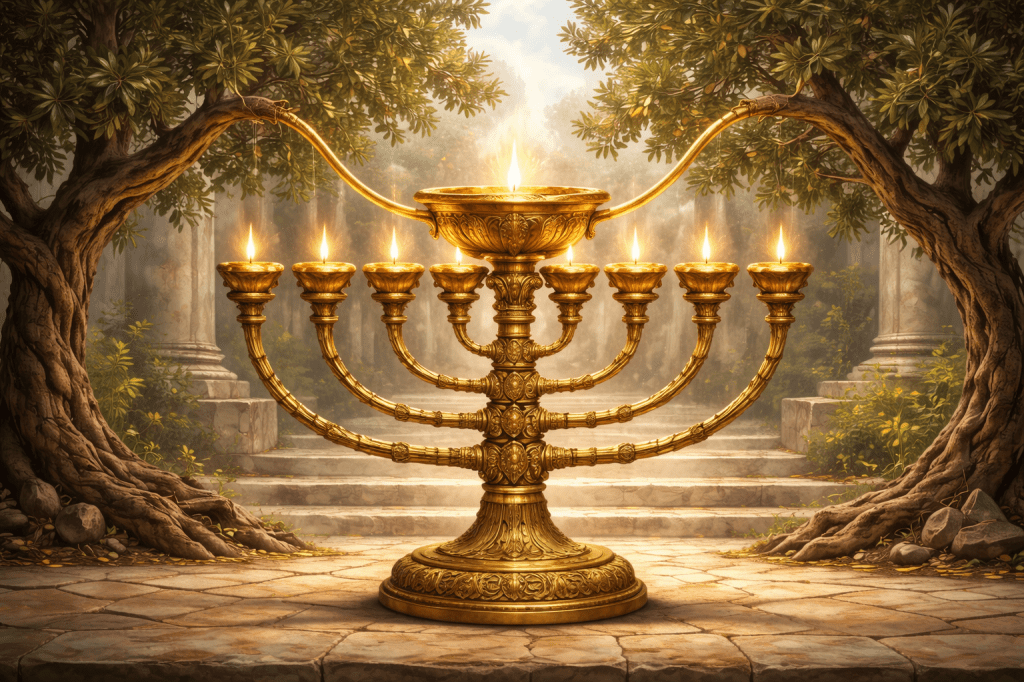
Zechariah’s visions continue through the night. In this one he sees a lampstand—a menorah, the familiar seven-branched lampstand used in the tabernacle and later in Solomon’s temple.
The menorah was made of pure gold, and each stem held bowls shaped like almond blossoms. The priests were responsible for filling the lamps with oil so that the light would continually burn in the sanctuary. But the lampstand Zechariah sees is different.
Above it sits a large reservoir or bowl, something not part of the original temple design. From this bowl oil flows continuously through pipes into the seven lamps. The lamps do not rely on priests to refill them. They have a perpetual source of oil.
Beside the lampstand stand two olive trees 🌳—one on the right and one on the left. From each tree🌳 a branch feeds golden oil through pipes into the bowl, which then distributes oil to the lamps. The picture is one of constant supply.
The message becomes clear when God speaks to Zerubbabel, the governor charged with rebuilding the temple.
“Not by might nor by power, but by My Spirit.”
“Might” refers broadly to human resources—wealth, influence, military strength, human ability.
“Power” points more directly to manpower or physical force. In other words: not by brains or by brawn. The rebuilding of the temple would not ultimately depend on human strength. It would succeed because the Spirit of God would sustain the work.
Zerubbabel faced a mountain of obstacles—discouragement, opposition, limited resources, and a half-finished temple that had sat idle for years.
Yet the Lord declared: “What are you, O great mountain? Before Zerubbabel you will become a plain.” (Zechariah 4:7)
God levels mountains. But He often does so over time. Zerubbabel would still work for about four more years before the temple was completed. The walls of Jerusalem would not be finished until the days of Nehemiah nearly a century later. The work moved forward because God’s Spirit was behind it.
This is important for every believer. If it is all up to you to save your neighbor, you will become discouraged. If it is all up to you to set your church on fire, you will burn out. We have responsibility. But we do not work alone.
When the temple was finished, the people would shout: “Grace, grace to it!”
The headstone—the finishing stone placed at the top of the structure—would mark the completion of the building. The word for grace here is chên, meaning favor, beauty, acceptance. The work would be completed because of God’s favor.
God had placed His reputation behind the promise.
And the same God who sustained that temple-building project still sustains His work today.
- Reflection: What area of life or ministry are you tempted to rely on human strength instead of depending on the Spirit of God?
🌆 EVENING – Small Things🌳
Focal Passage: Zechariah 4:10
“For who has despised the day of small things?”
Ministry often looks unimpressive at the beginning. When the foundation of the second temple was laid, many people were disappointed. Compared to Solomon’s temple, the new building seemed small and insignificant. God knew the temptation His people faced: to measure His work by size instead of faithfulness.
So He asks a searching question: “Who has despised the day of small things?”
The temple project may have looked small, but heaven was paying attention.
Zechariah says the seven eyes of the Lord roam throughout the earth, watching as Zerubbabel holds the plumb line in his hand. God rejoices not merely when the project is completed—but while the work is happening.
We are often enamored with size in ministry. Bigger crowds, larger buildings, greater influence. But God’s kingdom frequently begins in small ways.
It is easy to think:
“What difference does it make if I teach Sunday school?”
“What difference does it make if I bring a meal to someone in need?”
“What difference does it make if I share Christ with one neighbor?”
But God sees the plumb line in the builder’s hand.
Dr. James Boice observed: “As I counsel with people in our day, many of them young people, I am convinced that one of their biggest problems is that they expect shortcuts.”
He goes on to say that people often want a simple principle that unlocks the entire Bible without careful study. They want an experience that instantly lifts them to a higher level of spirituality without daily discipline. They want a nearly perfect church without the difficulty of working through problems.
But that is not how God normally works.
He builds slowly and steadily.
He levels mountains over time.
He strengthens faith through perseverance.
He accomplishes great things through ordinary obedience.
The two olive trees🌳 in Zechariah’s vision help explain the point. They represent two anointed leaders standing before the Lord of the whole earth: Zerubbabel the governor from the royal line of David, and Joshua the high priest.
One led the rebuilding of the temple.
The other oversaw the sacrificial system.
Together they bore witness to God’s work in Israel.
Two is a small number. Yet throughout Scripture God frequently calls two witnesses. The synergy is powerful. When two stand together in faithfulness, their testimony carries strength and credibility.
Jesus sent His disciples out two by two. Revelation describes two witnesses who stand before the Lord of the earth (Revelation 11:3–4).
We were never meant to serve alone. And we were never meant to measure God’s work by size. What seems small to us may be part of something far greater than we can see.
- Reflection: In what ways might you be tempted to overlook small acts of obedience because they appear insignificant?
- Closing Prayer: Lord, remind us that Your work advances not by human strength but by Your Spirit. Help us remain faithful even when the work seems small. Strengthen our hearts to trust Your promises and rejoice in every step of obedience. Amen.

Leave a comment