
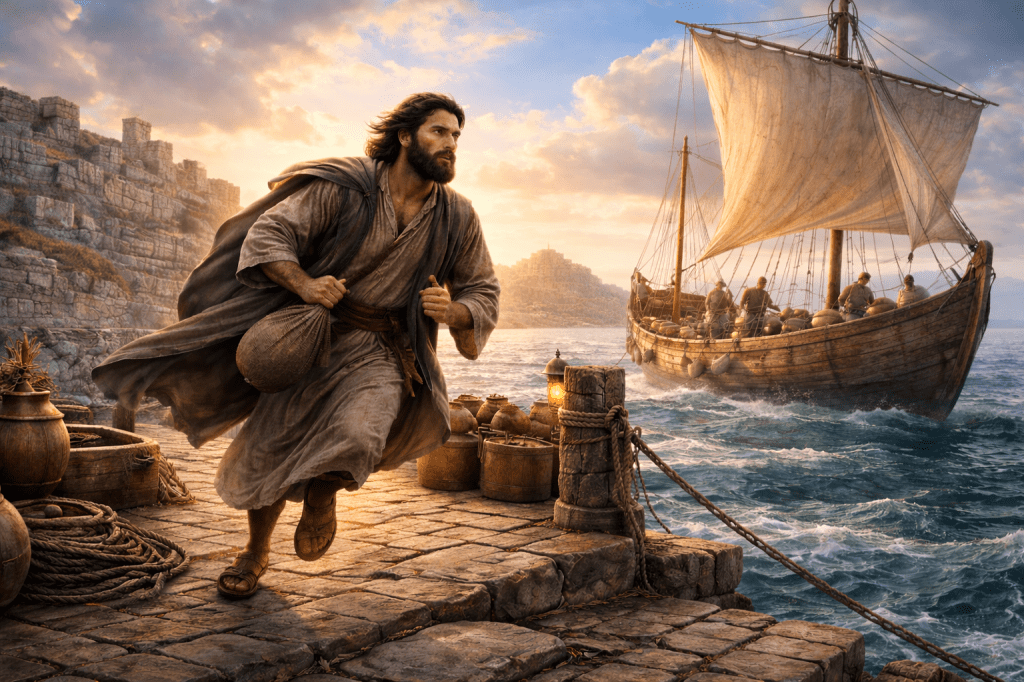
- Read Jonah 1
🌅MORNING– When the Call Comes – And We Run
- Focal Passage: Jonah 1:1-3
“The word of the Lord came to Jonah the son of Amittai saying, ‘Arise, go to Nineveh the great city and cry against it…’ but Jonah rose up to flee to Tarshish from the presence of the Lord.”
Francis Ridley Havergal was brilliantly gifted—a scholar of Hebrew and Greek, an accomplished musician, and a woman with every opportunity for recognition. Yet she viewed her abilities as gifts entrusted to her by God rather than possessions to be used for herself. In February of 1874, after becoming deeply aware of her need for complete surrender to Christ, she spent a sleepless night writing what would become one of the church’s most beloved hymns:
Take my life, and let it be
Consecrated, Lord, to Thee…
The hymn continues with a series of offerings—hands, feet, voice, silver, gold, intellect, and will—until it reaches its climax:
Take myself, and I will be
Ever, only, all for Thee.
Those words were more than poetry to Havergal. They became a pattern for her life. She renewed that consecration often and sought to live it sincerely. When she died in 1879 at only forty-three years of age, she requested that her tombstone bear a single verse: “The blood of Jesus Christ His Son cleanseth us from all sin.” (1 John 1:7)
She meant the prayer she had written.
Jonah, however, might have sung a very different hymn:
Take my life… but let me be.
We move from yesterday’s passage and the prophet Amos, who embraced his difficult calling, to a prophet who literally ran from one.
The book of Jonah begins with a call that could hardly be clearer. Jonah was not a fictional character or a symbolic figure. Second Kings 14:25 places him firmly within Israel’s history during the reign of Jeroboam II. He came from Gath-hepher in Galilee and served as a prophet to the Northern Kingdom. The story that follows is not legend, folklore, or parable. It is the account of a real man wrestling with a real command from God.
The Lord’s instruction was straightforward: “Arise, go to Nineveh.”
Nineveh was the capital city of Assyria, a nation known for its cruelty and violence. Assyria was not merely another foreign country. It was a looming threat and a hated enemy. Jonah understood exactly what God was asking him to do, and that clarity was the problem. Who wants an enemy to repent when one can merely watch God pay them in full for their cruelty?
Yet God tells Jonah to “rise and go to Nineveh.”
And Jonah rises and moves in the opposite direction.
As the narrative unfolds, Jonah’s movement is consistently downward. He goes down to Joppa. He goes down into the ship. He goes down below deck. The geography mirrors the spiritual reality. Running from God is always a descent. It may feel like freedom at first, but it gradually carries us lower than we intended to go.
Three times in these opening verses we are told that Jonah was fleeing “from the presence of the Lord.” The repetition is intentional. It forces us to ask an obvious question: How does someone flee from the God who made the sea and the dry land?
The answer, of course, is that he cannot.
In 2003, a man named David Horton attended a Cincinnati Reds game while wanted for a parole violation. During the game he kissed his girlfriend, and the stadium’s “Kiss Cam” projected the moment onto the giant video screen. Unfortunately for Horton, his parole officer happened to be in the crowd that day. Out of more than twenty thousand people in attendance, he was recognized, located, and arrested in his seat.
It is a humorous story, but it illustrates a serious truth. We are often far less hidden than we imagine.
Jonah could purchase a ticket. He could board a ship. He could put miles between himself and the place God had called him to go. But he could not outrun the God who had called him.
Neither can we.
Sometimes our flight is not as dramatic as Jonah’s. We do not board ships bound for distant ports. Instead, we postpone obedience. We ignore convictions. We tell ourselves that we will deal with a matter later. Yet every delay is a small step away from the place where God desires us to be.
The good news is that God’s pursuit is stronger than our resistance. The story of Jonah is not ultimately about a prophet running from God. It is about a God who refuses to abandon His prophet.
- Reflection: Which direction are your feet headed right now — toward obedience, or toward Tarshish?
🌆EVENING– The Storm, the Silence, and the Sovereignty of God
Focal Passage: Jonah 1:4, 9, 17
“The Lord hurled a great wind on the sea…” “I am a Hebrew, and I fear the Lord God of heaven who made the sea and the dry land.” “And the Lord appointed a great fish…”
When Jonah ran, the Lord responded.
The storm that erupted on the Mediterranean was not an accident of nature. Jonah is careful to tell us that the Lord hurled the wind upon the sea. The language is vivid, almost forceful. God throws the storm into Jonah’s path. Yet this is not the action of a God who has abandoned His servant. It is the action of a God who refuses to let His servant abandon Him.
What follows is one of the great ironies of Scripture.
The sailors are terrified. They cry out to their gods. They scramble across the deck, throwing valuable cargo overboard in a desperate attempt to save the ship. Everyone is awake. Everyone is alarmed. Everyone understands that something is terribly wrong.
Everyone except Jonah.
The prophet is asleep below deck.
There is a kind of spiritual numbness that can settle over a heart when it persistently resists God. Jonah is not at peace. He is exhausted from running. The pagan sailors are praying while the prophet sleeps. The men who know nothing of Israel’s God are desperately seeking help while the man who knows the Lord remains silent.
Years ago, photojournalist Kevin Carter won the Pulitzer Prize for a haunting photograph taken during a famine in Sudan. The image showed a starving child collapsed on the ground while a vulture waited nearby. The photograph shocked the world. Many who saw it asked the same question: What happened to the child? What did the photographer do?
The image forced people to wrestle with the difference between seeing suffering and responding to it.
Jonah had done something similar. God had called him toward a city filled with people headed toward destruction, and instead of responding, he walked away. Now he lies asleep while others struggle for their lives.
The captain finally shakes him awake and asks a question that echoes beyond the deck of that ship:
“How can you sleep?”
Soon the truth begins to emerge. Jonah tells the sailors who he is and whom he serves.
“I am a Hebrew, and I fear the Lord God of heaven who made the sea and the dry land.”
The statement is true, but it is also deeply ironic. Jonah claims to fear the God who created the sea while attempting to flee across the very sea God made. His theology is sound. His obedience is not.
The sailors immediately recognize the seriousness of the situation. If Jonah’s God is the Creator of sea and land, then running from Him is impossible. They ask the obvious question:
“What should we do to you that the sea may become calm for us?”
For the first time in the chapter, Jonah stops running from responsibility. He no longer hides behind silence or distance. He acknowledges his role in the crisis and tells them:
“Pick me up and throw me into the sea.”
The moment is significant. Jonah is still far from where God wants him to be, but he has begun to move toward surrender. He is no longer pretending that his choices affect only himself. He is willing to bear the consequences of his rebellion.
When the sailors finally do as Jonah requests, the sea becomes calm.
What happens next is remarkable. The sailors, who began the voyage worshiping other gods, end it fearing the Lord. They offer sacrifices and make vows. God uses a storm, a reluctant prophet, and a desperate voyage to draw pagan sailors toward Himself.
Even in Jonah’s disobedience, God is still accomplishing His purposes.
Then comes the verse that many readers remember best:
“The Lord appointed a great fish.”
The fish is often viewed as the miracle of the story, but the greater miracle may be God’s persistence. Notice the repeated pattern throughout the chapter. God appoints the wind. God appoints the circumstances. God appoints the fish. At every turn, the Lord remains actively involved.
The fish is not merely an instrument of judgment. It is also an instrument of preservation.
Had God wanted to destroy Jonah, He could have left him in the sea. Instead, He prepares a means of rescue. The place that appears to be Jonah’s grave becomes the place where God continues His work in his life.
That is often the way divine mercy operates. Sometimes God’s mercy comes as relief. Sometimes it comes as interruption. Sometimes it arrives disguised as a storm that prevents us from continuing down a destructive path.
The story reminds us that we may run from God’s will, but we cannot run beyond His reach. His sovereignty extends into storms, ships, seas, and even the belly of a great fish. Wherever His children go, His pursuing grace is already there.
- Reflection: Looking back, can you identify a storm, interruption, or unwanted detour that God used to redirect your life? How might His mercy have been present even when the circumstances felt difficult?
- Prayer: Father, thank You for loving me enough to pursue me when I wander. Help me recognize Your hand not only in moments of blessing but also in moments of correction. When You interrupt my plans, give me the wisdom to see Your mercy at work. Thank You that Your grace reaches deeper than my failures and follows me farther than I could ever run. In Jesus’ name, amen.

Leave a comment