
- Read Jonah 3 & 4
🌅MORNING– The Message That Turns a City
- Focal Passage: Jonah 3:1-2
“Now the word of the Lord came to Jonah the second time, saying, ‘Arise, go to Nineveh the great city, and proclaim to it the proclamation which I am going to tell you.’”
What makes a great revival?
Many people imagine revival in terms of crowded meetings, powerful music, famous preachers, or extraordinary experiences. Yet Jonah 3 presents one of the greatest revivals in Scripture, and it unfolds with surprising simplicity.
What makes the story remarkable is that before God works in Nineveh, He works in Jonah.
The city’s revival begins with the restoration of the prophet who was supposed to preach there.
After Jonah’s rebellion, the storm, the plunge into the sea, and three days in the belly of the great fish, the chapter opens with a remarkable statement:
“The word of the Lord came to Jonah the second time.”
Those words are filled with grace.
God does not look for another prophet. He does not discard Jonah and move on to someone more dependable. Instead, He restores the man who failed and recommissions the servant who ran.
When God sends Jonah back to Nineveh, He does not arm him with an elaborate strategy. There is no campaign, no marketing plan, and no attempt to make the message more appealing.
There is simply a word from the Lord.
Jonah’s sermon is startlingly brief:
“Yet forty days and Nineveh will be overthrown.”
The Hebrew word translated overthrown is hapak, a word with an interesting range of meaning. It can describe destruction, as when Sodom and Gomorrah were overthrown. Yet it can also describe a dramatic turning or reversal. In a sense, Jonah’s message contains both possibilities. Nineveh will be overturned one way or another. Either the city will be destroyed, or its people will be transformed.
The outcome depends upon how they respond to God.
What happens next is astonishing.
The message spreads throughout the city, and we read:
“Then the people of Nineveh believed in God.”
There is no record of argument. No prolonged debate. No demand for additional signs. The people hear God’s warning and respond with humility.
Repentance spreads from the streets to the palace. Common citizens put on sackcloth. The king himself rises from his throne, removes his royal robes, and sits in ashes. The most powerful man in the city abandons every symbol of status and authority because he recognizes a greater authority has spoken.
His proclamation captures the spirit of the moment:
“Who knows, God may turn and relent and withdraw His burning anger so that we will not perish.”
There is no presumption in those words. The king does not demand mercy. He simply throws himself and his people upon the possibility of God’s compassion.
That is often where revival begins—not with confidence in ourselves, but with desperation before God. Peter Jenkins discovered something similar during his famous walk across America. Having set out on a journey of more than 4,500 miles, he was searching for meaning and authenticity. Along the way he attended a revival meeting in Alabama. Though he had grown up around church, he had never truly embraced the gospel.
That evening, the preacher remarked that joining a church no more makes a person a Christian than joining a Lions Club makes someone a lion.
The statement struck Jenkins with unusual force. He later described feeling as though truth was cutting through layers of confusion and self-deception. For the first time, he understood that religion was not the same thing as salvation. That night he repented and entrusted himself to Christ.
His life changed direction because he encountered the truth of God’s Word.
Hearts are transformed when God’s Word is proclaimed faithfully and received humbly. Real revival begins when people stop defending themselves, stop making excuses, and begin listening to what God is saying.
- Reflection: When you open God’s Word, do you approach it merely for information, or with a willingness to be changed by it? Is there an area where God has been speaking, but you have resisted responding?
🌆EVENING– When the Heart Lags Behind
Focal Passage: Jonah 4:2
“I knew that You are a gracious and compassionate God, slow to anger and abundant in lovingkindness…”
William Carey became convinced that Christ’s command to make disciples of all nations still applied to the church. When he urged fellow ministers to take the gospel to the unreached, one older pastor reportedly rebuked him:
“Young man, sit down. When God pleases to convert the heathen, He will do it without your aid or mine.”
But Carey could not escape the conviction that God’s heart was larger than their vision.
Eventually he left England for India, where he spent decades preaching Christ, translating Scripture, and helping launch the modern missionary movement. Carey understood something that Jonah struggled to accept:
God’s mercy reaches farther than we often want it to.
By the time we reach Jonah 4, Nineveh has repented. The people have believed God’s warning. From the king to the common citizen, they have humbled themselves before the Lord. And God responds exactly as He often responds to genuine repentance:
“When God saw their deeds, that they turned from their wicked way, then God relented concerning the calamity which He had declared He would bring upon them.” (Jonah 3:10)
This should be the happiest moment in the book. Instead, Jonah is furious. The opening verse of chapter 4 is startling: “But it greatly displeased Jonah, and he became angry.”
The Hebrew expression is unusually strong. To Jonah, God’s mercy seemed not merely disappointing but wrong. The revival that brought joy to heaven brought frustration to the prophet. At last Jonah reveals the real reason he fled toward Tarshish: “I knew that You are a gracious and compassionate God, slow to anger and abundant in lovingkindness.”
Notice what Jonah is saying. He did not run because he doubted God. He ran because he knew God too well. He knew God’s character. He knew God’s compassion. He suspected that if Nineveh repented, God might forgive them. And that possibility was unbearable to him.
To be fair, Jonah’s feelings did not arise in a vacuum. Assyria was infamous for cruelty and violence. Their armies terrorized nations. Their reputation was well deserved. Jonah had every human reason to despise them and every patriotic reason to want judgment to fall. Yet God looked at Nineveh and saw something Jonah could not see. He saw people who needed mercy.
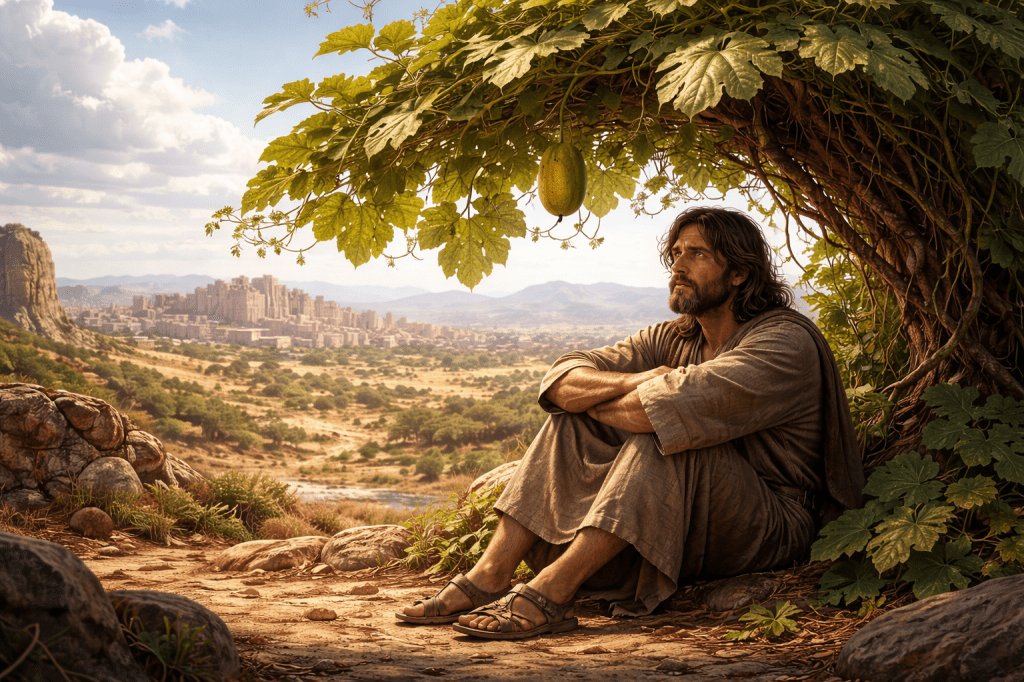
The remainder of the chapter unfolds like a living parable. Jonah leaves the city and settles east of Nineveh to see what will happen. God appoints a plant to grow and provide shade. Jonah is delighted. Then God appoints a worm to attack the plant. The shade disappears, the sun beats down, and Jonah becomes angry enough to die.
The contrast is intentional.
Jonah grieves the loss of a plant that benefited him personally, yet he resents God’s compassion toward an entire city filled with people made in His image. The Lord gently exposes the inconsistency: “Do you have good reason to be angry?”
It is a question that reaches beyond Jonah and into our own hearts. The city had experienced revival, Jonah needed another one.
Outwardly, he had obeyed. He preached the message God gave him. Inwardly, however, his heart had not fully aligned with God’s heart. He wanted justice for Nineveh, but not mercy.
The challenge of Jonah 4 is not merely whether we believe in God’s mercy. It is whether we rejoice when that mercy is extended to people we would rather see judged.
- Reflection: Is there a person, group, or situation where you find it difficult to celebrate God’s grace? What would it look like for your heart to align more closely with His compassion?
- Closing Prayer: Lord, revive us with Your Word and reshape us with Your mercy. Deliver us from small hearts and narrow compassion. Give us courage to proclaim truth and grace to love beyond our comfort. You are gracious and compassionate. Make us so as well. Amen.

Leave a comment